Fox Pop

“I’m practically sold already!”

Supervision by Charles M. Jones. A Merrie Melody released on September 5, 1942.

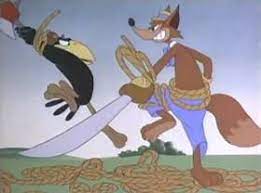
A man sits alone in his cabin. Vulnerable and alone. And some sort of wild animal is heading in his direction. A wolf? Nope, too small for a wolf. It’s a fox! And that thing could cause rabies or chicken famines! But the man is lucky this time, for the fox just takes his radio back to the forest and proceeds to hack it to bits. Two crows are stumped to this very un-foxlike behavior. He tells them his tale.

You see, whilst he was scrounging through the trash cans for food, he overheard the radio saying that foxes are what is “in” at the moment. They’re going to be everywhere and every lady will want one around their neck. This pleases the fox very much, as he imagines what a wonderful world it would be if there were foxes walking freely amongst the humans. (I want to live in such a world.) The radio doesn’t go into details about how these foxes will be in such locations, but it probably expected only humans to be listening, and they’d know.

The fox heads to location the radio said the foxes were coming from: Sterling Silver Fox Fur Farm. He gets himself trapped fairly quickly, but the owner turns him away. It’s fairly racist, but they’re only accepting silver foxes like their name says. Red ones are o-w-t, out. The fox that we will call ‘Fawkes’ is thrown into the garbage. (Which ironically, is where the racist man also belongs.)  Amongst the scrap metal, he finds just the answer to his problem. Not a gun, but silver paint. He gives his coat a good coat and badda-bing, badda-boom, Fawkes is welcomed into the farm.

He’s brought to his “room.” (It is darkly hilarious to see Mr. Sterling escorting him by the paw, rather than just carrying him by the scruff. These foxes lives in luxury for their remainder of life.) Just as he gets settled, the next door fox informs him of the jailbreak that is planned for tonight. And Fawkes is either participating with them, or dying early. His choice. He plays along, but being smaller than the others works to his favor, as he is able to lose himself in the rush and backtrack to the “comfort” of his “suite”. Look, he’s even got a tag attached to his “door”. I mean, door.

It’s here that he learns the awful truth: this place wants the skins of foxes! And I do love his childish naivete. “How will they… get it off of me?” The grindstone knows! Fawkes decides that maybe this place isn’t so great after all, and flees. The hounds are sent after him, chasing him through log and pond alike. But what’s this? The miracle of water has reverted his fur back to its original red! He happily shows the dogs that he is not silver and they have no need to chase him. They’re not racist though, they’re speciesist and pound him for daring to be born vulpine.

And that’s Fawkes’s story. Upon hearing all this, the crows join in and help the little guy smash that problem box that started it all. A kind of relationship I’m not used to seeing between these two animals.

“I’ll give you something to crow about!” “Don’t fox with me!”

Favorite Part: The next door cellmate is pretty bass. He makes a key by biting one out of his nail file. In one chomp!

Personal Rating: 3. A hilariously dark premise that thankfully doesn’t end like this:

I never know whether to laugh or grimace.

Little Lion Hunter

“Shh.”

Supervision by Charles Jones; Story by Robert Givens; Animation by Philip Monroe; Musical Direction by Carl W. Stalling. A Merrie Melody released on October 7, 1939.

It’s Inki’s first day on the job, so we can expect a few flubs. Example: despite what the title clearly states, he’s throwing his spear at any and all animals. (Although, in seriousness, if a giraffe chooses to bend down to eat, it’s asking for death.) Being early in his short career, Inki also looks a bit different than we’d later know him. He’s got large lashes, and a shiny black nose. Making it understandable that I used to think he was female, and you thought he was a deer.

The kid finds some tracks that surely lead to some big, dangerous game, so Inki takes cover behind a tree. And the ‘dangerous’ part comes true when we see what comes from the direction of those tracks: the world’s REAL most deadliest game, the Minah Bird. (You can identify him by his flashing wings.) He clearly didn’t make those tracks, he just killed whatever did for intruding on his territory. (If it was lucky, it wasn’t made to suffer. No promises with this bird, though.)

Inki makes another rookie mistake, he decides to tackle this creature. He follows it, waiting for the perfect moment to use his spear. It either never comes, or he squanders it, as the bird hops into a hole. Now, you should never, never, never ever, never, never, ever put your hand into any hole this bird hopes into, if you value said hand and think there will even be a remote chance that you will use it again. Inki is lucky today, just pulling out a sleeping skunk. Perhaps the bird is giving him one break for being so new at this.

Inki decides to hunt tortoises, as there is less danger involved. But after following the reptile into a log, he finds himself back in the company of the destroyer bird. Having not gotten the hint that he should really flee while he still has eight toes, he throws his spear. Bridging a gap that the bird had no problem jumping into, because even gravity knows better than to try and kill him. Hence the bird’s ability to hop vertically up a tree. Inki climbs up after him, and ends up with the bird on his head. Said bird tries to bite his nose off for daring to let his scalp touch the bird’s talons. (Well, would you like to tell me what the bird is doing?)

While trying to squish it or something, Inki only manages to knock himself back to the ground. He’s managed to escape painful death twice now, so he should really leave the mynah bird hunting to the professionals. (Current members in that profession: -1,000,000,000.) But hark, sounds! (In a jungle? No way.) Sounds like some kind of game is coming close. Inki just needs to listen to find out what he’s up against. It’s the very thing the title said he should have been hunting all along: a lion.

The lion is much closer than Inki’s hearing suggests, and the beast has to physically tap the boy to make his presence known. Inki immediately knows he is over his head now, and bolts without even looking at the cat directly. (Good. He’s learning.) He also knows the basic rule of lion survival: hiding in a hollow tree stump works! They are not one to question why a stump has an eye, or what those horrible screechy, scratchy noises are. (I guess there the sounds of Inki trying to creep away?) But he forgot that this trick only works if you stand still. Even lions know that stumps don’t stroll.

With the lion totally aware, Inki has no choice but to accept his fate. But just then, things are made either worse or better by the appearance of who else was in the stump, good old, terrifying old, the Minah bird. The lion isn’t aware that he should flee while the fleeing’s good; animals can’t learn from mistakes that will kill them. It pounces, and a terrific tussle takes place off-screen. When the bird is done proving who the king of the jungle is, the lion is roughed up, tussed up, and ready for slaughter, but the bird feels he has made his point.

Instead, he lets Inki know that he saved the kid from the lion’s digestive system, and kicks him for bothering him in the first place. It’s here where you learn the twist that I just made up: Inki had found a genie, and wished to survive an encounter with this bird, three times. He probably thought that would mean he’d kill it each time, but you know what pricks genies are.

Favorite Part: When Inki is hiding from the lion behind a tree, the lion taps him on the shoulder. Inki figures out who’s poking him by squeezing the lion’s retractable claw out. Nice subtle teaching!

Personal Rating: 3

What’s brewin, Bruin?

“Oh, goody, goody! Uh, a snowman!”

Directed by Charles M. Jones; Story by Tedd Pierce and Michael Maltese; Animation by Phil Monroe, Ken Harris, Lloyd Vaughn, and Ben Washam; Layouts by Robert Gribbroek; Backgrounds by Peter Alvarado; Effects Animation by A. C. Gamer; Musical Direction by Carl W. Stalling. A Looney Tune released on February 28, 1948.

Having been four years since their last cartoon, we’re given a quick reintroduction to Henry, Ma, and Junyer. The parents are playing a game of gin rummy, and according to the score list, Henry has yet to win. But with Ma’s poker face, that’s no surprise. So challenging her in the first place was Henry’s first mistake. His second was to take advice from his son. Thanks to Junyer’s “tips” Henry loses again. He takes it very well for his standards.

Well, fun time must be put on hold as they really need to get to sleep if they’re going to bypass winter. (They never make the mistake of calling it hibernating. Well done, Chuck!) Each says their prayers and gets into their respective bed. (According to Junyer’s chart on the wall, he’s very good at ‘behinding his ears.’) The problems immediately arise. Ma’s a snorer and Junyer’s cradle creaks. It then falls apart and Junyer’s crying adds to the cacophony. Since he’s a half-decent father deep down, and it will shut the kid up, Henry allows the tyke to share his bed.

That was his third mistake, as Junyer’s bulk flattens Henry, but things get more unpleasant because of a leak in the roof. As the son of the household, it’s Junyer’s job to plug it up. The water finds an out through his ears, so that solution won’t work. Henry jams the hole full of long underwear, which holds a little better, but eventually leads to a bigger problem. (Who in this household wears those?)The window is also open, per Ma’s wishes seeing as how she opens it every time Henry closes it. Even bricks can’t keep her away. (Wives always win.)

When the stuffed moose head on the wall falls on Henry, Junyer and Ma take notice of the strange being in their house, and chase it with a gun and a mallet. After Henry gets revealed, Junyer earns another star on his ‘good boy’ chart by bringing the spanking brush to Henry. But no, this final straw demands more than that. Henry is going to get some sleep, and his family is NOT going to interfere with that. This means tying the two to their beds, (Junyer’s now fixed) muzzling their mouths, (Junyer’s muzzle miscolored) plugging that hole correctly, nailing the window shut and even making sure the clock is silenced. This will be a blissful slumber to savor!

And it’s now spring. Plants are sprouting, animals are calling, and ice is melting. It’s all very beautiful, but very loud. And Henry has suffered too much to have to put up with it! He yells for things to be quiet, and the universe finally cuts him some slack. Time rewinds back to winter so the bear can finally get some rest. (Thankfully, the short ends before time repeats the whole picture.)

Favorite Part: It really is great that Henry got to win at last. Yes, he’s an a-hole who deserves just about every misfortune that befalls him, but he just wanted to enjoy winter the way all creatures should: totally unaware. I’m happy for him.

Personal Rating: 3

Little Brother Rat

“I once had an egg.”

Supervision by Charles M. Jones; Story by Rich Hogan; Animation by Bob McKimson; Musical Direction by Charles W. Stalling. A Merrie Melody released on September 2, 1939.

Sniffles creeps up on a sleeping cat and yanks out a whisker. He must have a death wish! No, it’s just part of a scavenger hunt he’s taking part in. Bringing it back puts in the lead, beating out Jimmy and flat out annihilating Squeakie. (Even though the list asks for whiskers plural. Oops.) There’s just one last item on the list, but it’s certainly the most difficult: an owl’s egg.

Sniffles accepts the challenge and heads back out again. The cat has come outside too by this point, and begins to follow the little prick who caused him a moment of discomfort. (And upset his sense of balance, let’s be real.) Sniffles manages to avoid getting caught by entering a barn, but the cat has no problem waiting for his return. There isn’t any other holes down here, so it’s a good bet the mouse will return.

Up in the barn, sleeps Papa Owl. (Asleep at night because he’s hungover. I don’t know.) Sniffles easily gets his paws on the unhatched Junior, and is almost immediately caught leaving. The father convinces him to put his child back passively and aggressively. Sniffles is then thrown out from this high, because he’s just too big for the owl to swallow whole. (Nice camera movement.) He bounces off the still waiting cat and is flung right back up again. So, guess he’s just stuck in such a perilous position for the rest of his life, eh?

As if! Winning this scavenger hunt is everything to him! The prize must be that good. (Or he just refuses to be bested by Jimmy. Friggin’ Jimmy.) He tries again, and father doesn’t catch him this time. Instead, Sniffles trips. That’s the end of this egg. Or not. Seems it was just about to hatch as the owlet is alive and unharmed and a chibi version of his father. Sniffles tries to coax him back inside, because it will prove this really is an owl egg, rather than a robin egg. The young bird gets in, but his feet stick out and he walks back to his nest.

Sniffles gets a hold of him once more. And then just puts him back anyway. (I guess he only has qualms about stealing other’s children after they’re born.) Once back outside, he finds the little owl has followed him. Even worse, the cat takes notice of the two and chases. Sniffles carries the young bird, and this kind gesture is witnessed by Mr. Owl. He swoops down, grabs the cat, and throws it down a chimney. (He’ll be back to eat it later.) Because of his bravery, Sniffles is given the egg he needed. Yeah! Eat it, Jimmy!

Favorite Part: The way the owl’s eyes gleam and dilate when Sniffles is spotted. Telling him in no uncertain way that the jig is up.

Personal Rating: 3 for those who can accept a Merrie Melody without much comedy. If you can’t, it’s a 2.

Porky’s Ant

“What I wouldn’t give to catch one of those old pigmuh-nuhuh-pigmuh-nuhuh-pigmuh- those midget ants.”

Supervision by Charles M. Jones; Story by Rich Hogan; Animation by Rudolph Larriva; Musical Direction by Carl W. Stalling. A Looney Tune released on May 10, 1941.

What is something you’d like to do? Pretend money is no object. Pretend you’re as fit as need be. Pretend you have not fears or worries about failing. What would you do? Me personally, I’d be traveling the world just to see different animals. Porky is in the midst of that, and I’m envious. He’s just waltzing around Africa with a silent guide reading a book about rare insects. (My dream…)

One such insect is known as the Pigmy Ant (Pgymy formicidae). A creature not named for its size, but because it has a habit of dressing like humans. They’re also worth $150,000.00. Sadly, Porky is more interested in the price than the creature. Luckily for him, one of these ants is following him and his guide. (I wish it was Inki. That’d be a fun cameo.) Pigmy ant hierarchies are determined by the size of the bone in their topknots. The bigger the bone, the more likely you are to score mates. As such, the little gal feels the guide’s bone is better because it’s bigger.

Small, though she may be, the guide can feel her tugging on his clothing. When he turns to look. He crashes into Porky, flinging supplies every which way. When Porky sees the ant, he confirms with the book on her species. Yep. She’s the one! She’s fast, too! She bolts for the safety of her hill before Porky can nab her. Time to do a little luring. Good thing Porky brought some chocolates with him. He sets a bonbon behind some flypaper, unaware that the ant could just walk around it. He throws it away, and it lands on his guide’s face.

The ant ducks under some growth and Porky reaches after, unaware of the slumbering lion within. He throws a lasso that the ant sticks around the cat’s paws and pulls it out. (Porky lifts.) He puts it back. Now he knows that ant’s game, but still doesn’t dare get near her when she returns to its protection. She taunts him, but doesn’t realize the lion gets up and leaves until Porky has crawled out of the bush and is nearing.

Back at the guide, he finds another lion. It chases him back to Porky and the two can do nothing more than hide. Good thing the ant doesn’t hate them. She uses the flypaper to trip the lion up, saving the two from his intestinal tract. Porky is grateful and offers her anything she wants that he can give. She gets her bone, and since she’s following them still, I think she’s decided to let Porky adopt her. (…My… dream…)

Favorite Part: The face Porky makes when he first sees the paw he’s reeled in. He was all prepared to be happy, but fate didn’t get her lines right.

Personal Rating: 2

A Hound for Trouble

“What are you anyway, a dog hater?”

Directed by Charles M. Jones; Story by Michael Maltese; Animation by Lloyd Vaughan, Ken Harris, Phil Monroe, Ben Washam, and John Carey; Layouts by Robert Gribbroek; Backgrounds Philip DeGuard; Voice Characterization by Mel Blanc; Musical Direction by Carl W. Stalling. A Merrie Melody released on April 28, 1951.

It’s hard to be Charlie Dog. Everybody but me seems to despise him, and he’s just been thrown off a boat. (Not for the first time if the captain is to be believed.) He finds he’s been dumped off in Italy of all places. Beauty of that being that there is still a good number of people who could be potential masters. After all, Italians are humans and humans love dogs. (If you don’t, you’re doing a bang-up job of trying to keep your cover from being blown.)

Mama Mia! None of-a de locals capishe de English! It’s a good thing that love is a universal language. Still, English praise will be easier to catch. Charlie sets his sights on on restaurant named Pasquale’s Palazzia de Spagetini. I think the lone employee we see working there is Pasquale himself. He doesn’t give any indication that he can speak a lick of English, but Charlie has made his choice. I admire him choosing a bowl to be his own. Now for the test: showing how lovable and cuddly he is.

Test failed. Although Pasquale is fairly kind in telling the dog to leave. Even if he said yes though, it would be best if Charlie wasn’t inside as Pasquale is leaving for a fifteen minute break. (Those are the best when they’re twice as long.) Then again, staying outside won’t give Charlie a great opportunity to show the guy what a great choice it would be to have an animal in the kitchen amongst the food and utensils that will be entering people’s mouths.

Charlie is now in the kitchen. (A young Brad Bird takes notes.) And just now entering is a customer ready for a feast. He orders… oh boy, here we go. He orders: na bella piatta del una cacciatore di tetrazzini cu ragu di marinara di la piazza rigotini mozzarella fina without onions. (Thank you, Wikipedia.) And I’m pretty sure that translates to a grilled cheese sandwich without onions. They don’t have that. The man settles for spaghett. Charlie serves it to him via spool, and makes sure he doesn’t eat an inch more than he’s paying for. Time for a bit of wine to wash it all down. The man leaves with whatever lunch he can keep down after seeing Charlie stomp the grapes.

Pasquale returns and is not pleased to find his customers being scared away. But Charlie has a surefire way to stay: he’s a singer! You will believe he can find a home after hearing his rendition of “Atsa matta for you?” Pasquale certainly seems convinced as he gives in and agrees to adopt the poor baby. Now, isn’t that touching? No wonder this is Charlie’s final appearance; he’s about to achieve his dream come true! But wait! That leaning tower located in Pisa is going to fall over and crush their little home! Charlie proves he’s the smarter of the two and tries to away from danger, but Pasquale makes him hold the tower while he goes for help. (Seeing as he’s bilingual and all.)

We end with Pasquale happy in his kitchen, no intent of ever going back and Charlie desperately calling for anyone to help; his pleas falling on deaf ears as they only speak Italian. That’s just cruel, Pasquale. (Mostro malvagio. Spero che tu marcisca all’inferno, lentamente.)

Favorite Part: Charlie not only can repeat the original order flawlessly, but he sticks his tongue out at all of us who doubted he could do it. How can anyone not love this dog?

Personal Rating: 3. But I give it a four for myself.

Porky’s Prize Pony

“All horses must report to the starting gate in three minutes.”

Supervision by Charles M. Jones; Story by Rich Hogan; Animation by Ken Harris; Musical Direction by Carl W. Stalling. A Looney Tune released on June 21, 1941.

The county fair has a $10,000.00 prize for their steeplechase, and Porky is planning on winning. He’s got his very own prize pony, (looks a little too big to me) but despite the title, he/she isn’t the focus. That honor goes to another horse who isn’t wanted around the stables. He’s clumsy, he looks pretty limp, and not realistic enough to be worth riding. But he sees Porky at it’s love at first sight. He has a good number of signs on hoof to sell himself to others, but Porky has no interest. (What he does have is a disappearing bucket. It’s awesome.)

The horse tries to show how much help he can be by carrying the bucket of water Porky got for his actual steed. The pig is happy to get some free labor out of the friendly equine, but again, clumsy. He trips and Porky gets all wet. Definitely not going to be taking in that horse. But he’s not finished yet! Next, he will show how athletic he is by jumping a hurdle. What he lacks in accuracy, he makes up for with effort, as he flies high over his target and crashes through a house. (Giving him a hat that fills in all the blanks for this guy’s origin story.)

Stallone’s next jump ends with him crashing into Porky and the frustrated pig throws his bucket at the horse. Stallone so desperately tries to be like Pluto the pup interacting with flypaper, as he tries to pry it off his face, and getting it stuck on his hooves. As he hops around, he crashes into the stable that contains Porky’s prize winner. It’s not harmed, but a bottle of horse liniment falls into its water and since the stuff contains 125% alcohol, I’m sure Porky would forgive me for betting on another jockey.

Come race time, his horse is all but dead. You can’t beat a dead horse, much less ride it, so Porky is out, right? Not if Stallone has any say in things. He picks Porky up and races to the track. (Making it just as the race starts. Great timing!) Since his jumping still leaves a lot to be desired, their plan is to cheat and just run through the obstacles. This works in their favor as  they knock a hurdle higher up than usual and trips up most of the competition. Except for… Sniffles? Is that you?

Stallone hides in a pool of water and drags Sniffles (or a look-a-like rat named Snort) into the drink. And that’s it. We don’t see them again because they were drowned. And this makes for an easy win. Porky is happy as can be, but Stallone scowls. His constant charging had him running straight into the awards, and now his hooves are caught in their trophy. Best get freed quick, lest you get put down.

Favorite Part: Porky’s little giggle when he first sees Stallone. It kills me, and the results play out realistically. Give those desperate for attention a drip, and you won’t get rid of them easily. We’re kind of annoying like that.

Ready Woolen and Able

“See you tomorrow, Sam.”

https://www.dailymotion.com/video/x7zfn66

Directed by Chuck Jones; Story by Michael Maltese; Animation by Ken Harris, Richard Thompson, and Ben Washam; Layouts by Maurice Noble; Backgrounds by Philip DeGuard; Film Editor: Treg Brown; Voice Characterization by Mel Blanc; Musical Direction by Milt Franklyn. A Merrie Melody released on July 30, 1960.

Sam Sheepdog drives to work in his humble, rattly car. Ralph Wolf is doing the same, but because he makes more, he has a much faster, spiffier ride. (That still has nuts, bolts and bits of wire streaming out of it.) The two park in their very own parking spaces, (one of the perks of working in their field) and share pleasantries as they clock-in. Ralph, as previously established, is all about speed and runs right to his first sheep of choice. Partaking in humbler, but still successful means, is Sam who drops a rake for Ralph to step on.

You know how to tell if your friend is a true friend? True friends are allowed to try and blow each other up. Ralph is going to try with his own invention: the TNT-totter. With this device, he plans to fling an explosive stick at the dog. But it just rolls towards him when he jumps on his end. Continuing from there, the wolf tries to roll a lit barrel of gunpowder at his best pal. It bounces over the dog, (leaving Ralph with a wonderful “Oh my aching head” expression) and detonates under a boulder that flies back to Ralph.

Okay, so maybe the simpler approach has some merits after all. Ralph attempts to swing via trapeze over to a plump morsel. But wouldn’t you know it, Sam is at the other end. Ralph puts him back where he belongs confused at the switch. But wait! At the apex of the upswing, there is Ralph again! Ralph climbs up the trapeze only to find Sam was the one holding it up, all along! And when he slides back down, Sam is sitting on the other end. Seeing as how he can’t escape that dog, Ralph opts to jump.

Would you believe it? He passes five Sams on the way down! (One of which is riding in the most static hot-air balloon I’ve ever seen.) A sixth is fishing, the seventh is sleeping with the fishes, (literally, thanks.) and an eighth is inside the whale that Ralph swims into. (A freshwater sperm whale with inaccurate dental structure? Now I’m starting to freak out!) And yes, there’s a ninth one that Ralph encounters when he is spouted out. Terrified, the Wolf swims for shore only to find himself on a nude Sam beach of 33! (Always room for one more, though.) I don’t think Ralph can take much more of this…

Theory, correct. At the end of the day, Sam drives home in his crummy looking, but functional car, and Ralph goes home in an ambulance. Complete with strait jacket. And to think it’s only Monday…

Favorite Part: Ralph tying out some bed springs on his feet. They flip him on his face. And really, what else should he have expected to happen?

Personal Rating: 3

Fair and Worm-er

“I’m a beast.”

https://www.dailymotion.com/video/x7xjovo

Directed by Charles M. Jones; Story by Tedd Pierce, Michael Maltese; Animation by Ben Washam, Ken Harris, Basil Davidovich and Lloyd Vaughn; Layouts and Backgrounds by Richard Morley and Peter Brown; Musical Direction by Carl W. Stalling. A Merrie Melody released on September 28, 1946.

You know about chase cartoons, right? It typically has a chaser and a chasee. Two adversaries. It’s a formula that works. Sure, sometimes you can up the number to three, but it tends to stop there. Not here. Here we have Jones’s unit attempting to cement itself as the ultimate chase cartoon. I must admit, I’ve yet to see anything top it in its amount of characters.

Let’s start with what gets everything rolling: an apple. Sweet, crispy, and worth getting out of paradise for. It’s not really a character though, just an object of desire. Desired by a worm, that is. (I’ve just realized that I haven’t seen apple-loving worms in media for decades now. Pesticides have ruined what was once as believed as cheese-loving mice and peanut-loving elephants.)

Worms are chock full of protein, and lack a skeleton that’s either exo or endo. This makes it a great morsel for something that has no teeth: a crow. We could stop there, but the food chain won’t. A cat wants that crow, and a dog wants that cat. This isn’t enough. How about a dogcatcher trying to do what his title promises? But even he’s got a fear: his wife. She claims to be afraid of nothing, but a little mouse calls her bluff. (Don’t worry. Those last two barely function into our story. They’re relegated to literal running gag.)

The crow tries to disguise his fist, (Yup. Crows have those.) as that apple. The worm may be blind (Those aren’t real eyes because I say so.) but he isn’t that stupid, and he mallets the faux fruit. The dog, meanwhile, is chasing the cat up the tree with the aid of some tree climbing spurs. The resourceful cat eats bananas and sends the peels to the dog, to send him to the gleeful catcher at the bottom. This catches the attention of the crow who does some thinking. If cats chase birds, and dogs chase cats, then its his duty as a bird to give the dog a hand. Brilliant deduction! Just snip a little here and…

The dog falls through the net, but the cat won’t let this setback go unchallenged, and throws him back to the catcher. In turn, the crow gets a boot and kicks the catcher in the shins. This makes the bird the new subject of desire for the man, meaning the dog is free to chase once more. I love how the cat flees piece by piece. Even better is the dog’s pupil turning white with rage. (I’m really not sure if that is a coloring error or not.)

When the worm tries creeping up on the unguarded apple, he isn’t aware that the rest of the chain is on his heels. (The dog just appearing out of nowhere instead of from behind the tree like the others. Definitely an error. Also, the distance to the apple has increased dramatically.) They give themselves away by saying “gesundheit” to the sneezing worm. Everybody chases, but runs from the newest entrant in our cartoon: a skunk. Which is never stated to be Pepe, but it does his signature hop complete with musical score. I’m going to say it’s Pepe. (If Chuck wasn’t the director, I might consider otherwise.) Be glad I’m not claiming the human is Snafu. I totally would!

Whilst everyone follows the worm underground to avoid what’s most definitely Pepe, the worm utilizes a pin to get them out. Each fleeing from the skunk. (And taking away the imprint they made as well. That’s courteous.) Leaving with a gas-mask, (Because worms are known for their keen noses.) The little guy finally gets himself the apple that started all this. A narrator who we haven’t heard from since the beginning asks the worm if this sorta thing happens whenever he wants food. The worm reveals that he wasn’t looking for food, he intends to live in the fruit. (With housing prices what they are, I don’t doubt the whole thing was worth it.)

Favorite Part: The worms launches a torpedo at the crow, but misses and it goes toward the cat. The worm is quick to make sure the bird gets the blast. I choose it not because I secretly love cats and have been hiding my true intentions for my whole life because I’m that insecure. I just like how the worm is willing to protect those who can protect him. It’s how friendships are born.

Personal Rating: 3. Not a whole lot of jokes, and I feel the story could have been more creative. Like, having the odds and evens teaming up? Or maybe the apple was that variety that causes discord and we just kept getting bigger and powerful creatures fighting for its possession? (With the victor being Pepe of course.)

Hare-way to the Stars

“At long last, my dream come true!”

Directed by Chuck Jones; Story by Michael Maltese; Animation by Richard Thompson, Ken Harris, and Abe Levitow; Layouts by Maurice Noble; Backgrounds by Philip De Guard; Effects Animation by Harry Love; Film Editor: Treg Brown; Voice Characterization by Mel Blanc; Musical Direction by Milt Franklyn. A Looney Tune released on March 29, 1958.

Aside from “D.D.I.T.241/5C.,” this might be Marvin’s best remembered short. Kinda odd, as I think it might be the weakest one. In terms of comedy, of course.

Bugs has just woken up for the day, and is feeling the effects of a root vegetable hangover. (Radish juice and carrot juice. Never again.) He’s in need of a nice, cool bath and begins the climb out of his hole. Unbeknownst to him, the space race is still relatively new, and one rocket is being launched right over his house. Still groggy, the rabbit doesn’t notice he has climbed aboard, and continues to not notice until he has left the planet.

Getting hit by a passing satellite, Bugs is carried to some sort of place in space. I… really don’t know how else to describe it. It’s red pathways, panes of glass, and not much else. It’s… beautiful. I’m not trying to be funny for once. These really are some great backgrounds, and I’m automatically bumping the short up a grade because of them. Bugs isn’t so taken with his new surroundings, and wonders if the only other sign of life might be able to get him back home.

Said sign, is Marvin of course. And he’s rocking a color slightly different than how most remember him. His helmet and kilt are brown rather than green, and his…skin?…clothes?…the body area is green rather than red. (A color scheme he’d keep for the rest of his golden-age movie career.) Something’s got him in a real good mood, and he takes no notice of Bugs at first. He’s far more interested in what he calls “The Illudium pu thirty-six exlosive space modulator.” (It’s taken 2000 years of work? Either he’s aged great, or it’s been a project spanning generations.)

Bugs finally gets to request a ride back to Earth, but Marvin has a bit of sad news to relay: Earth’s seconds are numbered as he’s just about to blow it up. You see, it really does a number blocking Marvin’s view of Venus, and there’s just no other way around it; the planet has got to go. Bugs isn’t quite done with the place yet, and takes the I.P.36E.S.M. when the martian isn’t looking. Marvin catches on rather quickly, and decides to send out some reserves.

Enter the Instant Martians. (Even if a previous short claims they’re not.) Ten thousand of them, all crammed into one handy little space. Just add some water, and they instantly spring to full size. (A nifty trick that another alien, Jumba Jookiba, would utilize himself one day.)The trio set out to capture Bugs, and one almost immediately catches up to the rabbit via scooter. Bugs plays a game of “do what I’m doing” with the creature, and tricks it into riding off the edge of the red. Since there is definitely gravity in space, the guy (or maybe girl) plummets.

Bugs then runs into the other…three? (Unless one of them is the one he just barely got rid of. It’s a possibility!) They chase Bugs up to some doors, and each party takes turns holding them open for each other. Sadly for them, it was Bugs’s turn to hold open the door that leads into open space, and the definite gravity takes them away. Having witnessed the whole thing, Marvin has no choice but to get some more of the martians. Good thing he has between 9,997-9,996 left. (And if you’re trying to be a smart @$$ and asking “If Marvin is  martian, why doesn’t he look like them?” Remember that iguanas are earthlings just like us, and we don’t look a whole lot alike.)

Bugs finds himself a saucer that he of course knows how to fly, and prepares for his journey home. En route, he smashes into the martian dispenser, taking the glass part with him and leaving behind Marvin’s explosive. And it’s been lit. Marvin is just happy to get his stuff back, and doesn’t take note of that. Seeing as how it was designed to blow up an entire planet, it does a good job destroying Marvin’s digs. (Eugh. I don’t like seeing him without his shoes on. Thank Chuck that never happened again.)

Bugs manages to get back home, but lands in a sewer. And those things are full of water. He flees, as we see the pavement crack, bulging with over 9,000 invasive species. Here’s hoping “War of the World’s” twist holds true!

Favorite Part: How Marvin doesn’t react with glee when he explains what he’s doing. It’s like when you take down a tree that is growing into your foundation, it needs to go, but one can still fell guilty about how many homes you’re destroying. At least he has more empathy than the Vogons ever did.

Personal Rating: 3.