
Bacall to Arms

“Anybody got a light?”
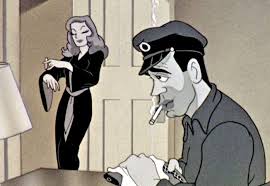
Care to help a fellow American who’s down on her luck?

Directed by Robert Clampett (uncredited); Animation by Manny Gould, Don Williams, Rod Scribner and I. Ellis; Layouts and Backgrounds by Thomas McKimson and Philip DeGuard; Musical Direction by Carl W. Stalling. Released in 1946.

One of Clampett’s last shorts and it feels like his heart wasn’t really in it. Many scenes are reused from “She was an Acrobat’s Daughter,” including the crowd switching seats, the fat hippo, and the young goose annoying his father. A wolf is shown his seat by a female usher. (I swear that’s Porky sitting behind him.) He rushes off to flirt with her but is slapped. A news reel is shown that radar has a new purpose: alerting a family to the mother-in-law coming. The film then starts. A parody of the real picture “To have and have not” called “To have…To have…To have…” (etc.)

It stars parodies of the stars of the actual film, Humphrey Bogart and Lauren Bacall (to arms) played by thier Toontown counterparts: Bogey Gocart and Laurie Bee Cool. The rest of the cast’s names scroll on the screen. They’re not important. The movie itself says they are the “cast off characters.” The wolf (who shall hence forth be known as Winchell) starts to doze off. (After the cartoons, I would too) The Tex Avery hippo is told by Gocart to sit down and stop inconveniencing people as the film is starting.

When Laurie shows up on the screen, Winchell pays attention. She’s so hot, that she leaves little flame trails wherever she walks. As she kisses Gocart, the wolf is in heaven. (The whites of his eyes disappear at one point even.) Winchell continues to go nuts. Kissing the back of the head of the patron in front of him, whistling so hard someone’s wig flies off and jumping out of his clothes. (Apparently the audience left to go smoke at that point as the theater seems deserted.) When Laurie is finished with her cigarette, Winchell dives after it and takes a puff. Not amused, Gocart shoots the wolf and takes it for himself.

It blows up leaving him in blackface. (Yes, this part was cut for television.) He exclaims that he can work for Mr. Benny now. (It’s a little known fact that there were at least 12 Rochesters and that Gocart played the 3rd one)

Personal Rating: 3. There’s just barely enough new here to keep it a little interesting.

Señorella and the Glass Hurache

“Size 4 and 5/8.

All the pretty girls in love with Jose.

Directed by Hawley Pratt; Story by John Dunn; Animation by Gerry Chiniquy, Bob Matz, Virgil Ross, and Lee Halpern; Layouts by Hawley Pratt; Backgrounds by Tom O’Loughlin; Effects Animation by Harry Love; Film Editor: Treg Brown; Voice Characterization by Mel Blanc and Tom Holland; Musical Direction by Milt Franklyn. Released in 1964.

This is the last short that was produced by the old studio before Depatie and Freleng made their own. It features the new opening titles that started with “Now Hear This” and have since become associated with the later shorts.

At Casa de Tacos (IHOT) two guys see an advertisement for this very story. The one on the left has never heard of it, so his compadre fills him in on the sad story. The girl of said story has a pretty crappy life. Not only is she bossed around by her “strap-mother and strap-seesters” but she has to sleep in the fireplace to actually get warm. At least her Disney counterpart got an actual bed!

Her only friends are what the narrator calls bugs, but I don’t because not all insects are bugs. They’re are good “bugs” (Cockroaches who help her with her cleaning. That’s nice of them to go against their nature.) and bad bugs. We’re not told what those are, but they must be parasites as she scratches herself when they are brought up. This could lead them to be fleas (also not bugs) or bedbugs. (Actually bugs!) I’m not too sure which they are though. She doesn’t sleep in a bed, but bedbugs are real bugs and you get a bit of fun wordplay with them. (The bedbugs are badbugs.) Fish aren’t the only animals I know about. But I digress…

A man named Don Miguel (Did Mexico ever have kings at any point? I’ll just say he’s a mayor.) wishes for his son, Jose, to marry. But his son would rather fight bulls all day. So Don flat out states that a fiesta will be held and every eligible senorita will be attending. Well, one won’t be. As all the ladies get prettied up, our titular character looks forward to a night with the cucarachas. But her fairy godmother shows up and turns a cart into a car and the insects into burros. Because she didn’t have anything to turn into fossil fuels, I guess. And not only does she give ‘Ella a smokin’ new outfit, complete with glass huaraches, but plastic surgery too! Why else would her nose change like that? Jose has standards, you know. And she is sent off with the usual midnight curfew.

Jose meanwhile, is not impressed by the army of identical clones and two uggs that dance by. (The rose is this scene really should have been a black outline or something. The petals disappear into the background.) But when our main character comes out he is smitten! They dance until the clock strikes twelve and she dashes off leaving behind one of her shoes. Jose vows to marry whoever fits it! And he’s not shy about letting you know if you aren’t the girl he was looking for. As he has you leave out of the exit labeled “rejects.”

At Casa de titular character, the “strap mother” does not wish for her “strap daughter” to have a chance at wedded bliss, so she dumps her into the pig pen. Jose is saddened to find his mystery mate isn’t here either, but what’s that he see’s out the window? A leg! And it fits the shoe! But could his mystery woman really be a pig? Of course not. That’s something I would put into a cartoon. She is the very same girl he fell in love with. Though her clothes disappeared, her plastic surgery was permanent. (Jose has standards!) They are married and the narrator concludes his story.

But wait! Why was it sad? (Other than cockroaches continuing to be mislabeled as bugs?) Oh that concerns the “strap mother.” Our narrator married her.

Personal Rating: 2. It’s a whimper, not a bang.

A Gander at Mother Goose

“Remember Little Hiawatha and his bow and arrow?”

They’re just a bunch of foney’s.

Supervision by Fred Avery; Story by Dave Monahan; Animation by Charles McKimson; Musical Direction by Carl W. Stalling. Technical Advisor; Mother Goose. Released in 1940.

Sing a song of 10 cents, A.K.A. a dime. I felt it best to make another post, entirely in rhyme. Nursery rhymes are what our featured short is all about. So let’s not waste any more time, and just go check it out.

Mistress Mary, quite contrary, how does her garden grow? Not so well is what methinks. “Confidentially, it stinks.”

Humpty Dumpty sits on a wall, and soon poor Humpty takes a great fall. But he lands just fine; sees no drawback. (Unaware that we can see his “crack”.)

Jack and Jill climb a up hill to fill their little pail. Jack should now come falling down, but not this version’s tale. “To heck with the water” he doth speak, with lipstick markings on his cheek.

Miss Muffet sits on her tuffet, eating curds and whey, when a spider comes down beside her, to frighten the girl away. (Why does he have three legs on each of his spidery limbs?) But Muffet’s just so ugly that it’s she that frightens him.

The three little pigs are all on the run. (They could be Porky’s nephews, but he already has one.) They hide in a brick house, away from the wolf’s hungry jaws, (Yes, this isn’t a nursery rhyme. That’s the short’s biggest flaw.) They surrender to the lupine who’s wishing their death. But only because he’s got terrible breath. They offer him mouthwash. (That’s got to sting) He takes it. “Why don’t my friends tell me these things?”

Star of light, star so bright, a dog wishes on a star at night. His wish comes true. What could it be? Well he IS a dog. He wished for a tree.

Jack is nimble and Jack is quick, he jumps over a candlestick. It’s basically the same as the Humpty joke, just with burning butt rather than yolk.

There is an old lady who lives in a shoe, she has so many children, what can she do? She does have a husband, but he’s not there. He’s off relaxing in a lawn chair.

Finally, “‘Twas the night before Christmas, and all through the house, not a creature was stirring,” except for a mouse. “Merry Christmas” he whispers to his mouse friend, “QUIET!” he shouts. And thus the short ends.

Personal Rating: 3

Tweety and the Beanstalk

“Acres and acres of Tweety Bird!”

His, you understand? His! All His!

Directed by Friz Freleng; Story by Warren Foster; Animation by Virgil Ross, Gerry Chiniquy, and Art Davis; Layouts by Hawley Pratt; Film Editor: Treg brown; Voice Characterization by Mel Blanc. (Uncredited: June Foray); Musical Direction by Milt Franklyn. Released in 1957.

This short doesn’t bother with any kind of cow, it cuts straight to Jack’s mother’s angry shouts about him giving up a whole cow for five beans. (At least he got five, most stories I’ve heard have him getting three.) Regardless, she throws them out where they land underneath a sleeping Sylvester. Only one grows, (well, there is only one stalk) and takes him and his bed up into the clouds coming to a rest on some land in the sky. (I’ve always wondered about that too. Why is there more land in the sky? Is it another planet? The moon from Majora’s Mask? Angel Island from Sonic?)

Waking up, the cat walks off and finds a castle. Ignoring most sentient being’s reactions to run away, he heads on over. He finds a treasure worth way more than a goose: A King-sized Canary! He wastes no time in grabbing the creature that’s roughly his size. Tweety doesn’t fight back. Then again, if I was being carried off by a cat that was as tall as me, I’d probably be in shock too. Before he can dig in, Tweety’s giant owner comes back and Sylvester is forced to flee. The giant puts his bird back in his cage and hangs it from the ceiling. So does he know that something was trying to hurt his bird? It’s not like putting Tweety up higher will keep him any safer from getting out.

Sylvester begins planning to get his meal, barely avoiding waking a giant bulldog in the process. He casts a fishing line over a rafter and ties the other end to his tail. It seems to work, but the line comes undone and he crashes to the floor. Somehow, this wakes up the dog. (I just don’t think Sylvester would make such a loud noise.) Sylvester hides in a mouse hole but leaves upon seeing a kangaroo. Oh, no. It’s actually a giant mouse. I always get the two mixed up. He tricks the dog into another room before retrying. Tying a screwdriver to a pole he manages to unscrew the bottom of the cage, but is flattened; Tweety staying safe on his swing.

He tries riding a champagne cork up, but mis-aims and gets stuck in a hole in the ceiling. He jumps on it but lands both of them in a gun which fires them both back into a hole. He finds a saw that’s his size up there. (I guess Jack never made it out in this version) and cutting a hole in the cork, he lowers himself down via a similar sized rope, but the dog somehow came back and slams him between some cymbals. Recovering, he tricks the dog into the other room again. He sets up a catapult or rahter, a cat-apult, (It’s an old joke, but it’s okay to laugh) made of a spatula and an apple. It actually works and he grabs the bird, but the apple lands on him and if that’s not bad enough, the giant comes back.

He chases after the cat. Any pet owner would do the same. Climbing down the beanstalk Sylvester gets an axe and chops the stalk down. The giant lands on him though, and the shock sends the cat through the earth and down to china. (No matter where you dig in fiction, you will end up in China.) There he is spied by a racially insensitive Chinese Tweety. Well at least he’s not too bad; just slanty eyes and a coolie hat. At least they didn’t give him buck teeth. Or a buck beak I guess.

Personal Rating: 3

Tom Thumb in Trouble

“You’re so little and helpless.”

Supervision by Charles M. Jones; Story by Rich Hogan; Animation by Robert Cannon; Musical Direction by Carl W. Stalling. Released in 1940.

For quite awhile, Warner Bros. would attempt to win the audience by doing what Disney was. As soon as they got their gag-filled style however, they gave up on that. This was their last try and it is probably the most Disney a W.B. short was. So as such, I’ll be making as many Disney references as I can.

I hope you don’t like backstory, as there is none. A wood chopper has a son who is small as a thumb. Thus earning him his name: Tom. I don’t know how this all happened. There’s no mom in this story. Maybe his dad just wished upon a star and his dreams came true in a cruel fashion. Tom, (voiced by Marjorie Tarlton) is too small to shut their alarm clock off, but his dad doesn’t mind and is quite all right turning it off himself. Being so small, Tom bathes in the water his father has cupped in his hands. (Well, I shouldn’t say bathe, so much as dunk.)

Getting dressed, the two sit down to breakfast. Afterwards the father (voiced by Shepperd Strudrik) hi ho’s as off to work he goes. Leaving Tom behind to do the dishes. At least he doesn’t mind. He happily sings as he works. (He’d whistle, but that might get him sued.) At least his song is original. But he carelessly steps on a bar of soap and lands in a tub of sudsy water. (Which doesn’t ripple or anything while he’s in it. Maybe it’s soap mud?) Good thing there is a friendly bird outside. Although Tom is not singing like the birdies sing, it understands that he needs help and crashes in through the window. (Either a very weak window, or a very strong bird.)

This noise does alert his father though, and he slowly starts home. He does pick up speed, but if my only child was home alone and I heard a window break, I’d run the whole way. The bird gets him out but at the worst possible time, daddy gets home. He sees a broken window, and a potentially bloodthirsty bird standing over his unconscious son. That’s enough evidence for him. Screw the circle of life! The bird is a savage! He’s barely even human! It flies away narrowly escaping dad’s grasp. He apologizes for leaving Tom alone and assures him that everything is all right.

Despite Tom’s lack of consciousness earlier (in other words, he didn’t let his conscious be his guide) he knows that the bird saved him. His dad won’t listen though and tucks him into bed. But later that night, Tom leaves the house leaving a note explaining to his dad everything. Despite the fierce snow, he heads on. He wants the bird to be part of his world. When his dad wakes up he yells for Tom, but doesn’t really bother going to look for him. (Well, it’s frozen outside. Let it go.) But his yelling does manage to wake the bird who flies out to look for the lad.

Despite the fact he’s not an owl and should have a pretty hard time finding him, he finds him immediately and gives him a lift home. I’ve seen a peanut stand, heard a rubber band, and seen a needle wink its eye. But I’ve never seen a Tom fly. The father cries his eyes out until the two return safe and sound. Now that everyone is back home safe and sound, they all go to sleep. The little bird nesting in Dad’s beard. It’s a tale as old as time, a song as old as rhyme: Beardy and the beast.

Personal Rating: 2. At least it looks nice.

The Turn-tale Wolf

“How I dread passing the houses of them three, mean, little pigs.”

Directed by Robert McKimson; Story by Tedd Pierce; Animation by Phil DeLara, Charles McKimson, Herman Cohen, and Rod Scribner; Layouts by Peter Alvarado; Backgrounds by Richard H. Thomas; Voice Characterization by Mel Blanc; Musical Direction by Carl W. Stalling. Released in 1952.

School is out for the day and a young wolf (Blanc doing his Sylvester Jr. voice,) heads home angrily. Once there, he calls his uncle out for blowing down the houses of pigs. Seems they learned all about him in school today. (His uncle also clearly has a picture of a topless woman pinned to his wall. I don’t like it when wolves are attracted to humans. It makes my brain throw up.) Uncle Big Bad claims he is innocent and the story is all backwards. He sets his nephew down to listen to his side of the tale. (Speaking of tails, why doesn’t his poke out of his pants? Isn’t that uncomfortable?)

When the wolf was a younger wolf (and now his tails clearly pokes out? Suspicious!) he loved to commune with nature. But he always had to pass the homes of three rude pigs. Look familiar? Those are the same guys who sold Bugs their houses to avoid wolf attacks. Only now they dress like Huey, Dewey and Louie, whereas the third one wore yellow before. (Which was actually those ducks original color set. I’m getting off topic. The bottom line is these pigs shall henceforth have the same names. I’m sure it’s obvious who gets which moniker, but I’ll spell it out for those of you who are uneducated in the tooniverse. Blue pig=Huey, Green pig=Dewey, and Red pig=Louie.)

He has every right to dislike them as the mean little pork chops slingshot him whenever he passes. But today, Louie suggests that they actually let the wolf play with them. (Giving his confused companions a wink.) They even let the wolf use their biggest slingshot and offer to load it for him. He gets a boulder in the face. According to Big Bad, he didn’t “moidalize” them for this joke, but actually cried. For being a good sport, the pigs decide he can play another game of theirs called “Surprise! Surprise!” All he had to do was put his hands behind his back where they will put an unknown gift. He can look when they tell him to. He gets a firecracker. (Well, he was surprised.)

As he goes on, he tells his nephew that he continued playing with the pigs. One day while playing a friendly game of “Swat the Fly” (Rule 1: All non-pigs get beaten with paddles by pigs. Rule 2: All non-pigs forfeit the game if they play by the rules.) they see a sign advertising a bounty on wolves. Specifically, their tails. He has a right to be nervous as his new pals are staring at his butt with dollar signs in their eyes. (At least they’re not horny?) They deny that they would have any desire to rip off his tail as he’s there friend. In fact, they want him to be the king for the day! They have a throne set up and everything! Sitting down, he pulls a bell rope at the pigs suggestion to let his proclamation ring. In actuality, it’s connected to a guillotine blade and the wolf just barely keeps his tail intact.

With the jig up, the pigs no longer bother hiding their blood lust and chase him back to his house. They blow down his house and with him knocked out under the rubble, they advance with a crazy look in their eyes. The nephew, upon hearing all this, doesn’t buy it. The wolf then shows that he was tailless all along! *Haunting laughter as lightning strikes*

(Before the short ends though, he confides to us that he lost it in a swinging door. Keep that ending away from the campfire, pal)

Personal Rating: 3

The Trial of Mr. Wolf

“I’m innocent. Really, I am. ”

Supervision by I. Freleng; Story by Michael Maltese; Animation by Richard Bickenbach; Musical Direction by Carl W. Stalling. Released in 1941.

An owl judge is preceding over the titular trial. On one hand we have Miss Red Riding Hood, and on the other, we have the wolf. It looks like it’ll be a one sided trial too, as the jury is nothing but wolves. (And one skunk.) The wolf’s lawyer says that we’ve all hear Red’s side of the story and that we should hear the other side as well. (Besides, Red literally has guilt written all over her face.)

The wolf explains it all started when he was coming home from the pool ha-… Sunday School! He was dressed in Donald Duck’s sailor suit with a pair of Mickey’s pants. (Dyed blue.) He was picking flowers for his mother and communing with nature. Namely a bluebird…that flies like a hummingbird…what? But Red was creeping around and keeping an eye on the wolf and started to pretend to cry. Being such a nice guy, he asks her what the matter is. She claims to have lost her way. The wolf decides to help and pulls out a compass. (Which among Grandma’s house, also can help one find the 3 bears house, the 3 pigs house, and Jack’s house. Which he built, you know.)

But Red just needed the wolf to come along quietly, she has a motorcycle that she uses to get them both there. Good thing the wolf can’t read, as it looks like Grandma is every wolf’s worst nightmare: A FURRY! (No, wait. That’s every wolf’s second worst fear.) A FURRIER! She is having a good time dancing, but upon the duo’s arrival, hides the evidence of her profession and gets in bed. Red wants the wolf to go and comfort her as she’s hungove-…ILL! Yes, she’s quite ill. The wolf goes in to cheer her up. (While Red locks the door.)

Grandma admires the wolf’s beautiful coat, and he admires her giant mallet. Getting wise, he runs for his life, but finds the old woman behind every door with a variety of weapons. When he finds an exit, she bonks his head and wrestles him back in. The wolf finishes his story saying it was a miracle he got out at all. But what’s this? Even though the jury is nothing but wolves, (and one skunk) they aren’t buying his story. He claims that if it’s not true, he hopes to be run over by a streetcar. His wish is immediately granted. Coming out of the rubble, he admits he might have exaggerated just a tad. (The bird gave him away. What was that?)

Personal Rating: 3

Red Riding Hoodwinked

“EEE! The big bad putty-tat!”

HEY GRANDMA! I BROUGHT A LITTLE BIRD FOR YOU! TA HAVE!

Directed by I. Freleng; Story by Warren Foster; Animation by Arthur Davis, Gery Chiniquy, and Ted Bonnicksen; Layouts by Hawley Pratt; Backgrounds by Irv Wyner; Voice Characterization by Mel Blanc; Music by Milt Franklyn. Released in 1955.

Quite the interesting way to start this tale! Ms. Foray tells about the hood of all things. It was worn by a girl, so they called her Red Riding Hood. (The hood meanwhile was named “Girl inside my body”) On this day, Red is going to visit her grandmother and is bringing her a gift. Namely, Tweety. This gets the attention of Sylvester who was in the middle of feasting on Trash Scraps TM. The girl gets on the bus with the cat following. (And crashing into a post since he wasn’t looking where he was going.)

As is the case with nearly all buses, it drops her off with still a distance to go and she skips through the woods the rest of the way. She is being watched by the Big Bad Wolf. (I thought that was the wolf from the 3 pigs story.) With quite the terrible memory as he needs a sign (that comes out of nowhere) to be clued in on her name. (Then again, how would he know her name in the first place? Has he tried this before?) She tells him of her plans before being on her way again. The wolf decides to take the shortcut to Granny’s place. (Why didn’t Red take it?) Along the way, he sends Sylvester a glare that warns him to keep out of his way. (“Now where was I going again? Oh yeah, Grandma’s house.”)

Since he took the shortcut he is the first to get there and shoves Granny out. (And I do mean Granny. It’s not some generic old woman in this tale.) He finds Sylvester already in the bed. (Somehow.) Then Red arrives and knowing that Sylvester could easily tip her off that something is amiss, has him hide under the bed. (He needs him nearby as he still can’t quite remember the kid’s name.) Red comes in to show her gift. A canary is hardly a meal for a wolf, so he has her place it on the ground. There, Tweety asks why the old woman is also under the bed.

Knowing that everyone has heard the dialogue before and knows it by heart, Red makes all her observations in one statement. The wolf and cat reveal who they really are and give chase. Sylvester accidentally slams a door on the wolf and brings him to with some water. Instead of being grateful, the wolf beats him with the pail. This allows their prey to make a getaway. They chase them outside, but the two cleverly run back in and lock the door. The wolf goes to the back and tries to break down that door, while Sylvester begins nailing a rubber band to the front. The wolf finally gets in the back way, and goes to let Sylvester in, (Guess he’s realized that the cat isn’t trying to eat girl meat and could actually make a decent ally.) just as Sylvester launches a rock at the non-budging door.

While he checks to make sure his pal is okay, the girl and the bird make a retreat to the bus stop, getting on a bus. The predators run faster than the vehicle to the next stop leaving their prey all but trapped. The bus stops for them and they shove past each other to get in. Then are immediately punched off by the bus driver, Granny herself. Don’t ever come between a grandmother and her granddaughter/pet.

Personal Rating: 3

Little Red Wallking Hood

“Gee, but you’re swell!”

Supervision by Fred Avery; Story by Cal Howard; Animation by Irven Spence; Musical Direction by Carl W. Stalling. Released in 1937. (You know, I always did question the “riding” part of the title)

In this short (which contains backgrounds drawn by colored pencils. Gives it that story book feel.) we see a wolf playing pachinko. Despite his best cheating, he fails. (Don’t feel bad wolf, if “Super Mario Sunshine” has taught me anything, it’s that pachinko is near impossible.) He spies a young girl with a red hood outside and calls upon his inner pervert. (She looks like a kid, so maybe she is one.) He hits on her, but she is not interested and turns her nose up at him. Not looking where he was going, the wolf (voiced by Ted Pierce) gets hit on the head by a stop sign.

After waiting for Egghead to cross the street (and getting hit by a go sign) he resumes his flirtatious ways despite her literal cold shoulder. She tells him off (in her Katherine Hepburn-esque voice) and says that she is going to her grandmothers. Egghead pops up with a sign showing a shortcut, and the wolf drives off. Turns out that favor wasn’t free as the wolf soon sees Egghead hitchhiking up ahead. He speeds past him. At grandma’s, (where we see Egghead just jumped onto the car anyway.) He tries to get in. Grandma was smart enough to lock the door and the wolf can’t get in no matter how hard he tries. (Egghead can get in easily to the wolf’s chagrin.)

He eventually does get in the house and chases the old lady around. She calls a time-out to answer the phone. It’s the grocer and she takes her time listing her groceries. (Gotta love the wolf’s reaction.) After getting some butter and lettuce (and gin) they resume their chase. She hides in the closet and when the wolf catches up, Egghead walks out. (The wolf can only shrug by this point.) Right when he gets her where he wants her, Red shows up. The wolf begs for the stuff he needs to disguise himself with. Funnily enough, she hands it over right away. He hops into bed and the girl walks in.

After they give the usual banter this story has, the wolf tussles with her. (Taking a quick break so a couple of inconsiderate a-holes can sit down in the theater.) Just when the fight starts picking up again, Egghead walks by once more. Having enough, the wolf asks (in his own words) just who the heck this guy is. Egghead responds by smacking him with a mallet. Turns out he was the hero of the short.

Personal Rating: 4

Little Red Rodent Hood

“What a big, red nose you got!”

Directed by I. Freleng; Story by Warren Foster; Animation by Ken Champin, Virgil Ross, Arthur Davis, and Manuel Perez; Layouts by Hawley Pratt; Backgrounds by Irv Wyner; Voice Characterization by Mel Blanc; Musical Direction by Carl W. Stalling. Released in 1952.

It’s time for little Timmy mouse to go to bed. He may look adorable in his little tobacco sleeping sack, but he’s kind of annoying. (Constantly pestering his grandmother to tell him a story.) She is nice enough to comply and as she regales her tale, Timmy envisions it in his head.

Once, Red Riding Hood was skipping through a field of flowers, (A pattered carpet.) and through a forest of trees. (Chair and table legs.) But lurking in that forest, was a big bad wolf. (Sylvester) He heads off for grandmas house. (Which apparently has a human sized bed.) Weird how Red/Timmy doesn’t go up the stairs which is the shortcut. I guess he is going to climb through the vents? Sylvester dresses up in a nightgown and throws the three other cats out of the bed. And the one offering cigarettes out from under his pillow. (“I don’t sthmoke!”)

Red comes in and enacts the timeless dialogue. Sylvester doesn’t catch him and is forced to give chase. Sliding down the banister, he slips on some butter Red left there and he overshoots his goal, ending up outside. Since he can’t blow the house down, he sticks some T.N.T. into the mail slot. A bulldog was standing right behind it, and is not pleased to find an explosive in his mouth. He forces it into the cat/wolf’s mouth. Dressing in drag, Sylvester claims to be the mouse’s fairy godmother and has come to grant him a wish. (Wielding a cattle prod-esque wand.) The dog sees his ploy and unplugs it before the mouse is tapped. (Why is the magic word “raggmopp?” Is that a reference I’m not getting?) He plugs it back in when Sylvester tries it on himself.

Sylvester does finally manage to catch the mouse under a glass, who in turn draws a curtain (out of nowhere) so the cat can’t see the tank he’ making. After an explosion, the rodent red riding hood hides in his house with Sylvester waiting outside. Timmy begs his grandma to finish the story. She says that Red used a firecracker to blow up the “wolf.” She even demonstrates. Timmy is sure that blew him up. Sylvester confirms this. So was Granny the original Red? Did Sylvester really wait outside her house for maybe three years? (Mouse years, of course.)

Personal Rating: 3