Sleepy Time Possum

“I’d know’d I’d get some action!”

Directed by Robert McKimson; Story by Tedd Pierce; Animation by Charles McKimson, Rod Scribner, Phil DeLara, Emery Hawkins, and John Carey; Layouts by Cornett Wood; Backgrounds by Richard H. Thomas; Voice Characterization by Mel Blanc; Musical Direction by Carl W. Stalling. A Merrie Melody released on November 3, 1951.

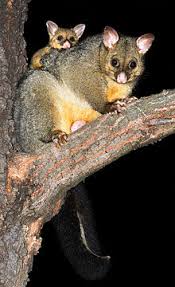
Attention everyone! Opossums are NOT possums. They live on entirely different continents! Apart from both being marsupials, they are only distantly related! Look…

Possum. Poss-um.

Opossum. O-poss-um.

Now, why do I bother so much? Because as the Lorax speaks for the trees, I speak for the animals. Since they can not tell when someone is using the wrong name, (that ironically, humans gave them) I will have to do so. And today’s picture is full of this kind of mistake.

The mailbox at the beginning is the only time the creatures are given the correct name. Seeing as how they all have American accents, they are clearly opossums. Though, honestly, you can’t really tell. The two parents look like some subspecies of kinkajou and their son looks like Hippety Hopper. (  At least he’s another marsupial)

Speaking of the son, his mother is upset to find him sleeping. (I am also upset. Opossums DON’T sleep upside down! They don’t even hang that way! They’re too heavy to do so!) Her reason is a lot more poignant. He’s got chores to do! But the kid is so lazy, that as soon as he hangs down, he sleeps again. (I understand his motives at least. The best part of life is being unconscious.) Ma threatens to sic his father on him, but Junior doesn’t care and sleeps once more.

Ma makes good of her word and tells Pa. He agrees that their son needs some discipline, but reasons that talking will net no results. Good thing he has a hunting dog costume on standby. (Don’t we all? I can’t count all the times I’ve needed to dress up as a dog.) One session of son scaring will keep the kid awake for days! Seems to work too, as one look sends Ma into hysterics and has Junior running for his life. Still, lazy as he is, he doesn’t go far before he stops to sleep once more.  Run and sleep, run and sleep. It goes on like that for awhile before Pa gets his son cornered.

Junior decides to try something opossums actually do, and plays dead. Seeing as how he is one himself, Pa doesn’t fall for it and instead ties his offspring to a firecracker. (Wait, what is the point of this? I though you were trying to stop his nap habits, not KILL him.) Either way, Junior ties the rope around his dad’s ankles when he’s not looking and escapes again.

Finding him at the top of another tree, Pa ties another one down with a rock so he can use it as a bridge to get to his sleeping son. Of course, said son cuts the rope just when his dad is crossing and flings him miles away. Pa proves his Olympic training was worth the effort, and he runs back immediately to catch his kid.

Back home, Pa tells his wife that Junior is finally doing the potato peeling he was supposed to be doing this whole time. The scare tactic didn’t work, so Pa just tied a balloon around his son. Now, forced to be upright, Junior can’t fall asleep anymore.

Personal Rating: 3

The Hole Idea

“Inventive genius makes great discovery!”

Directed by Robert McKimson (One of his favorites, in fact); Story by Sid Marcus; Animation by Robert McKimson; Layouts and Backgrounds by Richard H. Thomas; Voice Characterization by Mel Blanc (June Foray); Music by Milt Franklyn. A Looney Tune released on April 16, 1955.

Of the many great scientists that have existed throughout time, (and for that matter, the ones who have yet to exist throughout time) I think the greatest is: Calvin Q. Calculus. Because he specializes in making paradoxes a reality. In the past, he’s made everything from dry water to round squares. (There wasn’t much of a market for them, so they can no longer be found today, but it’s fascinating to imagine) And he did all of that without the support of a loving wife. (Gertrude is not the patient type. But she has good qualities. I mean, there must be SOME reason he married her)

His latest breakthrough is really a wonder: portable holes! (And it’s hard to be impressed in the crazy city he lives in. I think one of the bridges has a row of buildings on top of it) Nevertheless, he is granted instant acclaim! This hole thing is really a marvel! You can duck out of responsibilities, cheat at golf, and get the children you locked in a safe, out before the authorities arrive! (That’s an interesting picture on the wall. Not really a picture, but random farm related words and even a math equation. 4×4=4, huh? Math never was my best subject.)

Calvin has only one hope for his invention: that no one shall use it for nefarious purposes. (Minor mistake, but his award pokes out of the screen he is projected on. Minus one point) Ah, but you see, temptation is a powerful thing. And if there is an easier way to get what one wants, you can bet at least one person will try and ruin things for everyone. In this case, a (Man? They could be a very ugly lady.) person takes the professor’s case of holes while he sleeps and begins committing crimes. Using the holes for easy access into banks, jewelry stores, and Fort Knox. They begin calling this mystery person “The Holey Terror.”

They eventually move on to living targets, and break into a burlesque house. (Based on how sexuality is, that still gives no concrete evidence to the gender) But the cops are on their tail, and the thief is running out of holes to use. Down to one left, they use it to escape through a wall, just as the cops grab it. Said wall lead into a prison. (Never panic in these situations, it’ll always spell your undoing) Calvin is pleased to see things right in the world. (His sleeves are red in one scene then white in the next. Minus two points) Gertrude is still being a b*tch, and her husband finally decides to be rid of her. (Love his smile.) He tosses a hole in her path, and it must have been pretty deep. She ends up in hell. Satan sends her right back. (Even he doesn’t want to put up with her crap.)

Personal Rating: 3 bordering on 4

Wild Wife

“A giant chocolate malt, please.”

Directed by Robert McKimson; Story by Tedd Pierce; Animation by Rod Scribner, Phil DeLara, Charles McKimson, and Herman Cohen; Layouts by Robert Givens; Backgrounds by Richard H. Thomas; Voice Characterization by Mel Blanc; Musical Direction by Carl W. Stalling.  A Merrie Melody released on February 20, 1954.

Our week long commercial is finally over, now back to “Amazing animals, exciting encounters, interesting ideas, obscure oddities and unique uh…ther things!” With your host, Gabby Yacksby.

Welcome back to our show. Today, we have been fortunate enough to obtain a transcript sent in by my creator, Dr. Foolio. In it, he recounts an encounter he had studying wild Homo sapiens in their natural habitat. His words, are as follows:

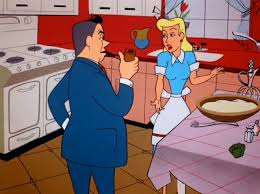
In a lovely house, the matriarch of the group has just collapsed from a very stressful day. (I won’t lie. She is hot! She definitely matches my description of a MILF. That means, a “mother I’d like a sandwich from”, right?) Having had followed her through out it, I can confirm. Her mate arrives shortly afterwards, and they exchange pleasantries. In this species, all members of the family have certain jobs to do. While the adult male goes out into the world to secure the means necessary for food and shelter, and the children prepare their minds for their own futures, the adult female is left in charge of many much smaller, but no less important tasks. Seems she forgot to do one: mowing the lawn. Upon hearing this, her mate flies into a rage and accuses her of never contributing to the upkeep. Standing her ground, she regales him with what transpired earlier in the day.

6:00 A.M.: After a night of trying to sleep through her mate’s constant snoring, the adult female awakes to prepare breakfast for the family. It is also her responsibility to wake all the members of the family up. Her offspring do not thank her for the sustenance, and her mate hardly looks her in the eye. He must leave to fulfill his role in society. He leaves while kissing his offspring, mate, and dog. (And the mailman.)

7:00 A.M.:  A clean habitat is a healthy one, so the female gets out a vacuum that was a gift from the male. It looks too complicated for me, what with all the attachments. She manages to get it running, but neglected to attach a bag, and now must sweep up all that she sucked up.

9:00 A.M.: She leaves the house and heads to a bank. She is to deposit some checks for her mate. Upon arriving, she finds a massive line leading up to the teller. To her luck, a new line opens up. Unfortunately, she doesn’t make it to the front in time, as an elderly female beats her to the punch. Said woman plans to deposit $200.00 in pennies. It takes so long that the other line diminishes. By the time she tries to take advantage of the now empty other line, she finds herself behind another woman depositing pennies.

12:30 P.M.: Having just finished purchasing a few things, the subject goes to eat. Her diet of choice is simple sugars served in liquid form. Like the noble hummingbird, she needs all the energy to keep up with her demanding workload.

1:00 P.M.: Not forgetting the rest of the family, she buys enough to keep them well fed for the upcoming week. After filling up her automobile, the food empties onto the pavement when she opens up the other door.

2:00 P.M.: To keep her mate attached to her, the female of the species regularly pretties herself up so he won’t be attracted to younger species who have larger breasts, and rounder buttocks. She pulls up to a beauty parlor, (doing a much better job at parallel parking than I could ever hope to achieve) and learns all the latest gossip. A pivotal skill that all her kind must learn. Of course, she must make repeat trips outside to feed more nickels into the parking meter.

3:00 P.M.: Unbeknownst to the female, two guys from the city have arrived to remove the parking meter. (One of which is capable of teleporting himself out of their vehicle) They put a fire hydrant in place of the meter. When the female exits, she finds her vehicle being ticketed by a police officer.

5:00 P.M.: And so we come back to where my notes began. Despite her tough day, her mate does not cut her any slack. As it turns out, she also bought him a present: A rolling pin that she whacks him with.

Conclusion: This species seems dangerous when provoked. (Just like the best animals) Seeing as how I scare easily and provoke on a daily basis, I doubt I shall ever attempt to take a mate of my own. End notes.

That was interesting. I don’t think I’ll ever show up again. I didn’t really contribute anything, and have my own things to do on Sundays. Good night.

Personal Rating: 3

It’s Hummer Time

“I tawt I taw a putty-tat.”

Directed by Robert McKimson; Story by Warren Foster; Animation by Rod Scribner, J.C. Melendez, Charles McKimson, Phil DeLara, and John Carey; Layouts by Cornett Wood; Backgrounds by Richard H. Thomas; Effects Animation by Harry Love; Voice Characterization by Mel Blanc; Musical Direction by Carl W. Stalling. A Looney Tune released on July 22, 1950.

The plot for this picture: a cat trying to catch a hummingbird of all creatures. (It’s like chasing a chicken nugget. I want a short where a spider tries to catch one of these birds, as flies won’t cut it anymore.) The bird isn’t dumb enough to swim in the birdbath the cat is holding, and flies off after squirting him in the face. The cat (who can also be found in “A Fractured Leghorn” and “Early to Bet.”) gives chase, but ends up sinking his claws into a dog. Much like in the latter of the two shorts up there, the dog subjects the cat to various punishments. Only here, the cat doesn’t get any say in things. First up: being pulled through a hole in a fence.

As the cat hunts with net in hand, the bird flies close to the dogs head. With them both being on one side of a wall, the cat swings but gets the dog. Now he must attend a birthday party for himself. He doesn’t even have to share the cake! (The candles are explosives though) Next, he ties a flower onto a balloon and tries to fish for the bird. Said bird paints the cats face on it and brings it to the dog’s attention. When he pulls the string, the cat reels him in. This earns him a trip down a drain pipe.

Is this really worth all the trouble? Well, given a hummingbird’s diet, I suppose they are the cat equivalent of candy. (Like a flying Bit-O-Honey) So the cat chases the bird over near the dog’s house. There, he makes the mistake of laying a paw on the dog’s bones. That’s earned him a trip into a cement mixer. (Normally, that would be horrific way to go, but here it just freezes him in cement.)

Now really, in a universe where a dog can collect monetary rewards, why can’t the cat just go BUY something to eat? You know, that is an excellent question. So, the bird sticks one of his feathers into the dog’s mouth and so the cat has no other option but to take a peek inside and see if there is anything left. (He’s not dumb enough to open the mouth on his own. He uses sneeze powder. But really, why is he afraid of the dog? Notice how he phases out of existence when doing this.) The dog has had enough, and prepares to subject the cat to “the works.” Here, the cat has a rope tied around his tail, that will take him through the fence, through several other obstacles (including a drainpipe) and landing him in the cement mixer once more. Neither of them notice the bird who ties some extra rope to the dog’s leg and the cat’s body. Unaware, the dog ends up dragged into the machine with his victim. The bird then sets it to birdbath, and gets a nice new place to bathe.

Personal Rating: 3

The Oily American

“Your thomashawk, sir.”

https://www.topcartoons.tv/the-oily-american/

Directed by Robert McKimson; Story by Sid Marcus; Animation by Phil DeLara, Charles McKimson, Herman Cohen, and Rod Scribner; Layouts by Robert Givens; Backgrounds by Richard H. Thomas; Voice Characterization by Mel Blanc; Musical Direction by Carl W. Stalling. A Merrie Melody released on July 10, 1954.

One of the reasons I love cartoons so much, is that they are weird and can get away with it. But sometimes, they’re less “weird” and more “odd.” In other words, the cartoon is weird, but you can’t necessarily just write it off as cartoon logic. That brings us to today’s featured short.

Moe Hican is as his name suggests, a Native American. And as the title suggests, he is something of an oil baron. He has so much of the stuff, he has at least two decorative fountains on his property, spouting the black gold instead of water.  So what does a multi-billionaire do to occupy his time? He hunts, but he does so in a rather “unique” way. He has animals shipped to his house, and released inside. That way he doesn’t have to… actually, it’s not said WHY he does it this way, but I suppose it means he doesn’t need to drive anywhere.

Joined by Jarvis the butler, he turns on a stream in his house and heads to the forest room. (He is rich enough to afford that, AND replace the furniture the water is going to ruin. I suppose if I had as much money as him, I’d do random dumb crap too.) Today’s game is a moose. (Which seems rather redundant, seeing as he already has a deer head on his wall. And last I checked, moose are deer!) The moose is question looks a lot like he escaped from a Disney cartoon, as he is a midget if ever a moose was one. (There isn’t really anything in the story that requires him being so small, but this way he matches Moe in height.)

Our American hero tries to lure his prey out with a moose call, but his prey has a call of his own that calls out to Native American, oil-drenched, bachelors. (You’d be surprised at how many of those things get sold on a yearly basis.) Moe follows it up a tree, whereupon the moose saws it down with his antlers. And just because he is an animal, that doesn’t mean that he is going to stay in the forest room. There is a whole mansion to tear through! (But the majority of the rest of the short takes place back in said room. Why not take advantage of it?)

Jarvis helps out as best as he can, but all of Moe’s weapons come back to hurt him. He dutifully returns them as a good butler should and gets to keep any injuries he gets for his troubles. Ultimately though, he decides that he has had enough, and resigns. Moe doesn’t care much. With as much money as he has, he can easily buy another Jarvis. (Or at least pay someone to change their name to Jarvis.) He chases his prey outside and shoots one last arrow. Somehow, it hits Jarvis’s plane and sends it to the ground. Now that he is no longer employed by the man, Jarvis has every right to spank him. So he does.

Good thing the premise is plenty… original I guess. Otherwise, this would have been a fairly basic chase cartoon.

Personal Rating: 3

Hollywood Canine Canteen

“I’m a baaad bowwow.”

Directed by Robert McKimson; Story by Warren Foster; Animation by Cal Dalton, Don Williams, and Richard Bickenbach; Backgrounds by Richard H. Thomas; Musical Direction by Carl W. Stalling. A Merrie Melody released on April 20, 1946.

TADA! Welcome to the new and improved Wackyland2! When I said I was cancelling the blog, I just meant that I was giving Squarespace the boot. That place sucked. Here is a lot more space for me to stretch my creative wings. It’s the same great taste, but with a whole new package! With still hundreds of shorts left to address, we’d better get started!

Dogs are some of the greatest animals on the planet! Hollywood seems to think so too. As all the biggest stars (at least of the 1940s) all seem to own one. What’s more, they look a lot like their owners too, making it easy to tell who is who. So what do these dogs do when their owners are out being caricatured in Warner Bros. cartoons? They decide to start a nightclub all their own! And everyone of the canine type is invited! Upon entering, patrons can drop their (fur) coats at the entrance. And one doesn’t need to worry about filling your belly: Dogwood himself is on hand making some tasty bone sandwiches, and cleanup is nothing to worry about. We’ve got Laurel and Hardy’s dogs on cleanup duty. (Our dishes wind up extra clean. Seeing as how Laurel’s pooch, keeps accidentally dropping what he just dried back into the sink.) A young dog tries to call home, but has to wait as there are quite a number ahead of him. Not to worry, there is plenty of entertainment to keep one occupied. Why not listen to Leopold Bowwosky conduct? His musicians are playing the Hungarian Dances. (Taking reading breaks when waiting for their part, and breaking violins when performing their part) But some aren’t taking things too seriously. Lou Costello’s dog can’t be bothered to stay with his instrument and will leave in the middle of a performance to get a drink. (And more amusing than that, acting like a jerk when people tell him to get back to work) He just might ruin the song too, as he’ll mistake any flies on his sheet music for actual notes. And our young friend is still waiting to call. But there’s only one ahead of him now! Some dog’s try to make connections. Bing Crosby’s dog is serenading the pet of Dorothy Lamour. But he can’t quite compete with Frank Sinatra’s dog. (Mostly because the latter’s singing is too irresistible for Bing’s pooch to try and top) With a fresh batch of music (and the occasional box of fleas) everyone is really getting into the dancing groove. Well, almost everyone. Our young friend is finally allowed to call home. Hope his voice is strong enough. Since dog’s can’t use telephones, he has to make do with a megaphone.

Personal Rating: 2

Hippety Hopper

“A mouse as big as me!”

Directed by Robert McKimson; Story by Warren Foster; Animation by Pete Burness, John Carey, Charles McKimson, and Phil DeLara; Layouts by Cornett Wood; Backgrounds by Richard H. Thomas; Voice Characterization by Mel Blanc; Musical Direction by Carl W. Stalling. A Merrie Melody released in 1949.

I just love how many shorts titles were just a characters name. It wasn’t even their first appearance when it happened. Anyway, a mouse is about to commit suicide. Since it’s not being treated as a joke, it’s not funny. Luckily for him, he is saved. Hippety may be young, but he knows that ending yourself is never the answer. The mouse (Who needs a name. I’ll call him Mini. Mini the mouse. Completely original) asks his new friend (who he thinks is a giant mouse)  to help him get even with the one who caused his depression in the first place. Sylvester the cat. Hippety agrees. Mini wakes Sylvester up and threatens to take vitamins and grow to match his size. Sylvester laughs at this, but soon sees the joey and freaks out. Mini kind of ruins things by coming back to say he warned him. (I guess mice just fluctuate in size? Is that what rats really are?) Whatever. Sylvester tries to fight off the “mouse” anyway and it goes about as well as you’d expect. A bulldog witnesses this and refuses to let Sylvester be treated as such. If the dog has a job of protecting the house, the cat has to do his job of mousing. Sylvester is thrown back in. He tackles Hippety and goes for a bumpy ride before once again ending up outside. He tries to explain that a giant mouse is doing this to him. The dog sends him back with some glasses to prove he’s seeing things. Besides, no one hits a guy with glasses on. Oh wait, Australians have no qualms about such things. (Or at least babies don’t) The dog finally decides to take care of things himself. He sees Sylvester wasn’t kidding, but refuses to let a “mouse” kick him out. Hippety tries, but the dog has some great upper body strength and doesn’t budge. It takes a bite from Mini to get him to lose his footing and become kick-able. Mini threatens to pin his ears back if he comes back in. Despite what just happened, the dog calls his bluff and says he’ll take ballet up the day a mouse pins his ears back. And then he ends up with pinned ears. He does keep his word, but the jerk is so insecure that he forces Sylvester to do it with him. The two dance off into the distance.

Personal Rating: 3

A Ham in a Role

“Temper, hasn’t he?”

https://www.b98.tv/video/ham-role/

Directed by Robert McKimson; Story by Sid Marcus; Animation by Charles McKimson, Phil DeLara, J.C. Melendez, and Emery Hawkins; Layouts by Cornett Wood; Backgrounds by Richard H. Thomas; Voice Characterization by Mel Blanc; Musical Direction by Carl W. Stalling. A Looney Tune released in 1949.

And here we are with another of the 100 greatest. And the only one starring the Goofy Gophers. Good thing too, those guys are so underrated.

Our story begins with the ending of your classic Warner Bros. cartoon. A dog (who has no name, so let’s call him Hammy) is hit with a pie and flaps his lips. The end. It’s the brevity of this short that makes it work so well. It’s the soul of wit. All right, I’m done pretending you’re actually falling for this. In reality, he is fed up with cartoons. He thinks it’s degrading. (He is clearly an idiot. Well read, but still an idiot.) He decides to quit. (Before doing so, he is subjected to gags without even leaving the room. You’re making so many of us smile. Why would you want to quit?) He decides to pursue more “noble” acting and heads off to his country house to recite some Shakespeare. (Yeah, the man was talented, but animation is entertaining. To everyone.) It’s been awhile since he’s been here it seems, as there are gopher holes everywhere. But I suppose Mac and Tosh realized the house was empty at some point and decided to move in. Hammy finds them asleep in one of his books. He throws them out and gets to work. Not taking kindly to their forced exit, the two began planning some pranks to get back at him. And cleverly enough, they will all allude to what line the dog is reading. Mentioning “tormenting flames” results in a hotfoot. Asking to “drink the joy of life” gets him a tub of water poured on him. And when commenting on how “a rose by any other name would smell as sweet,” he finds Limburger cheese dropped on his head. But these are annoyances at best, the gophers next dress one of them (I can’t tell them apart. I’ll just guess it’s Mac) as a skeleton just as Hammy is lamenting on “poor Yorrick.” (Poor Hammy.) While reciting some lines from “King George and the Dragon” he dresses as a knight. Now covered in metal, the gophers have the chance to fling him around with magnets. And for their grand finale? “A horse! A horse!” Hammy is kicked out of the house and flies all the way back to the studio. They appear to have been waiting for him, as they are ready to start shooting. He opens with his best “To be…” but is silenced by a pie in the face. Welcome back to the fun side. We’ve missed you.

Okay to be fair, I don’t hate Shakespeare. Those are some really well written stories. I just don’t think it fair for Hammy to call animation “degrading.” It’s art. That’s not up for debate.

Personal Rating: 4

Raw! Raw! Rooster

“I won- I say, I wonder what the poor chickens are doing.”

 Directed by Robert McKimson; Story by Tedd Pierce; Animation by Russ Dyson, Ted Bonnicksen, George Grandpre, and Keith Darling; Layouts and Backgrounds by Richard H. Thomas; Film Editor: Treg Brown; Voice Characterization by Mel Blanc; Musical Direction by Carl W. Stalling. A Looney Tune released in 1956 Directed by Robert McKimson; Story by Tedd Pierce; Animation by Russ Dyson, Ted Bonnicksen, George Grandpre, and Keith Darling; Layouts and Backgrounds by Richard H. Thomas; Film Editor: Treg Brown; Voice Characterization by Mel Blanc; Musical Direction by Carl W. Stalling. A Looney Tune released in 1956

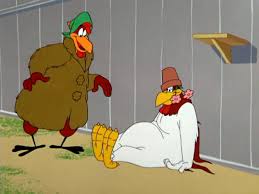
Life is good for Foghorn. As the only male in the chicken yard, he has many hens to love and worship him. But it appears that the good times will only last so long, as he receives a telegram from an old college buddy, Rhode Island Red. (Based on the names roosters have here, I can only assume that their other friends were named Chantic-Larry and Plymouth Rocky) Foghorn isn’t happy to hear this. He had enough of Red in college. (Am I the only one who would be interested in seeing some shorts based on his college days?) He barricades the place, but whoops! Red was the telegram man the whole time. And he greets Foghorn with joy buzzers and squirting flowers. Then he heads right over to Foghorn’s hens. That was a fun visit, time for Red to leave. (I feel for Foghorn here. I’ve had to put up with old “friends” from school that thought I wanted to talk to them again after all those years. How wrong they were.) Foghorn sets up a trick camera that will knock Red into a pit when the “picture is taken.” Naturally, it doesn’t work until Foghorn gets in front of it. After climbing out of the pit, Red still asks for a photo and Foghorn obliges to shoot him. Red isn’t as daft as you’d think, and puts his fingers in the “lenses” of Foghorn’s “camera.” Later, Red shows off his football skills to the hens with Foghorn’s help. Foghorn puts a firecracker in the melon they are using as a ball and throws him a pass. But the funny thing about football is, you can pass the ball back you know. But Red is a sportsman of all types and accepts Foghorn’s game of golf next. Foghorn tries to use trick exploding balls on Red. But the first one doesn’t go off until Red hits it towards him and the second one goes off when Foghorn hits it. Finally though, he comes up with a working plan. He puts on his own telegram man outfit and delivers a note to Red informing him of inheritance to pick up. While Foghorn could just win like this, he has to one up Red again by presenting him with some parting gifts. A time bomb that he calls an electric bowling ball, and an electric clock that will tell him when to bowl. With friends like him, why would Red need any enemies?

Personal Rating: 3

Crowing Pains

“Where are we taking me, boy?”

 Directed by Robert McKimson; Story by Warren Foster; Animation by John Carey, I. Ellis, Charles McKimson and Manny Gould; Layout by Cornett Wood; Backgrounds by Richard H. Thomas; Voice Characterization by Mel Blanc; Musical Direction by Carl W. Stalling. A Looney Tune released in 1947. Directed by Robert McKimson; Story by Warren Foster; Animation by John Carey, I. Ellis, Charles McKimson and Manny Gould; Layout by Cornett Wood; Backgrounds by Richard H. Thomas; Voice Characterization by Mel Blanc; Musical Direction by Carl W. Stalling. A Looney Tune released in 1947.

Still being early in Foghorn’s career, (this was only his second appearance) this short is starring Henery Hawk. In fact, Foghorn isn’t even trying to annoy the dog here. It’s Sylvester of all characters. After a chase has left the dog hanging by his neck, Sylvester readies an axe. (Geeze! Foghorn was never this bloodthirsty.) Proving to me that he finds heckling the dog all in good fun, Foghorn appears in the nick of time and takes the head off the axe. He berates the cat who, frustrated that he can’t get a word in edgewise, smacks him over the head and departs. Enter Henery. Wanting a chicken to eat, he grabs Foghorn and makes for home. Foghorn points out a mistake. He is not a chicken. As we all know, Chickens have black fur. Sylvester has black fur. Sylvester is therefore a chicken. To help him get close, Foghorn gives Henery a plastic egg to wear and sends him on his way. Finding the egg underneath his person, Sylvester is overjoyed to find he is a mother. There’s something wrong here. Males can’t be mothers. Sylvester is male. Sylvester is therefore no mother. He tries to run away, but Henery is on him like white on snow. (Not all rice is white you know) Henery shows himself when Sylvester tries to hammer him dead. He wants the chicken to come quietly but Sylvester claims to not be a chicken. I’m pretty sure he is. If he’s not, then who is? Foghorn? That’s just silly. Sylvester, Foghorn, and the Barnyard Dawg (for no real reason) all argue over who is supposed to be dinner. (Me personally, I prefer cats.) Henery then gets an idea. Roosters are supposed to crow at dawn. Those three are males. Roosters are males. Therefore, if one of them is a rooster (which is a chicken) all they have to do to find out is watch the sunrise. Come the next morn, we find crowing coming from the rooster: Sylvester! Henery drags him away. Not seeing the ventriloquism book Foghorn has. (Wait… Darn it! I had it all backwards! The dog was the chicken!)

Personal Rating: 3

Don’t expect an update next Tuesday. No, I’m not going anywhere again. My work schedule has changed and I’m sick of working around my blogging. So, from now on, I’ll be updating on Sunday’s like I should have been doing since day 1. So if you enjoy this place, (and I know you all do) you’ll be pleased to find the next post earlier than next week. Dr. Foolio, out.