Wild Wife

“A giant chocolate malt, please.”

Directed by Robert McKimson; Story by Tedd Pierce; Animation by Rod Scribner, Phil DeLara, Charles McKimson, and Herman Cohen; Layouts by Robert Givens; Backgrounds by Richard H. Thomas; Voice Characterization by Mel Blanc; Musical Direction by Carl W. Stalling.  A Merrie Melody released on February 20, 1954.

Our week long commercial is finally over, now back to “Amazing animals, exciting encounters, interesting ideas, obscure oddities and unique uh…ther things!” With your host, Gabby Yacksby.

Welcome back to our show. Today, we have been fortunate enough to obtain a transcript sent in by my creator, Dr. Foolio. In it, he recounts an encounter he had studying wild Homo sapiens in their natural habitat. His words, are as follows:

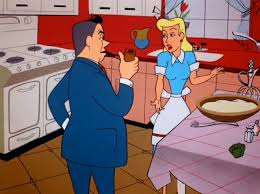
In a lovely house, the matriarch of the group has just collapsed from a very stressful day. (I won’t lie. She is hot! She definitely matches my description of a MILF. That means, a “mother I’d like a sandwich from”, right?) Having had followed her through out it, I can confirm. Her mate arrives shortly afterwards, and they exchange pleasantries. In this species, all members of the family have certain jobs to do. While the adult male goes out into the world to secure the means necessary for food and shelter, and the children prepare their minds for their own futures, the adult female is left in charge of many much smaller, but no less important tasks. Seems she forgot to do one: mowing the lawn. Upon hearing this, her mate flies into a rage and accuses her of never contributing to the upkeep. Standing her ground, she regales him with what transpired earlier in the day.

6:00 A.M.: After a night of trying to sleep through her mate’s constant snoring, the adult female awakes to prepare breakfast for the family. It is also her responsibility to wake all the members of the family up. Her offspring do not thank her for the sustenance, and her mate hardly looks her in the eye. He must leave to fulfill his role in society. He leaves while kissing his offspring, mate, and dog. (And the mailman.)

7:00 A.M.:  A clean habitat is a healthy one, so the female gets out a vacuum that was a gift from the male. It looks too complicated for me, what with all the attachments. She manages to get it running, but neglected to attach a bag, and now must sweep up all that she sucked up.

9:00 A.M.: She leaves the house and heads to a bank. She is to deposit some checks for her mate. Upon arriving, she finds a massive line leading up to the teller. To her luck, a new line opens up. Unfortunately, she doesn’t make it to the front in time, as an elderly female beats her to the punch. Said woman plans to deposit $200.00 in pennies. It takes so long that the other line diminishes. By the time she tries to take advantage of the now empty other line, she finds herself behind another woman depositing pennies.

12:30 P.M.: Having just finished purchasing a few things, the subject goes to eat. Her diet of choice is simple sugars served in liquid form. Like the noble hummingbird, she needs all the energy to keep up with her demanding workload.

1:00 P.M.: Not forgetting the rest of the family, she buys enough to keep them well fed for the upcoming week. After filling up her automobile, the food empties onto the pavement when she opens up the other door.

2:00 P.M.: To keep her mate attached to her, the female of the species regularly pretties herself up so he won’t be attracted to younger species who have larger breasts, and rounder buttocks. She pulls up to a beauty parlor, (doing a much better job at parallel parking than I could ever hope to achieve) and learns all the latest gossip. A pivotal skill that all her kind must learn. Of course, she must make repeat trips outside to feed more nickels into the parking meter.

3:00 P.M.: Unbeknownst to the female, two guys from the city have arrived to remove the parking meter. (One of which is capable of teleporting himself out of their vehicle) They put a fire hydrant in place of the meter. When the female exits, she finds her vehicle being ticketed by a police officer.

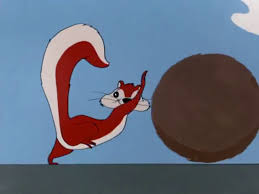
5:00 P.M.: And so we come back to where my notes began. Despite her tough day, her mate does not cut her any slack. As it turns out, she also bought him a present: A rolling pin that she whacks him with.

Conclusion: This species seems dangerous when provoked. (Just like the best animals) Seeing as how I scare easily and provoke on a daily basis, I doubt I shall ever attempt to take a mate of my own. End notes.

That was interesting. I don’t think I’ll ever show up again. I didn’t really contribute anything, and have my own things to do on Sundays. Good night.

Personal Rating: 3

Goo Goo Goliath

“He’s a heavy one, isn’t he?”

https://www.b98.tv/video/goo-goo-goliath/

Directed by I. Freleng; Story by Warren Foster; Animation by Art Davis, Manuel Perez, Ken Champin, and Virgil Ross; Layouts by Hawley Pratt; Backgrounds by Irv Wyner; Musical Direction by Carl W. Stalling. A Merrie Melody released on September 18, 1954.

Time for another delivery, courtesy of the stork. (Did you think babies came from outer space? What idiot told you that?) The bird in charge of the latest baby doesn’t look like he’s the best candidate. Having recently finished one delivery, and given glasses of champagne for his troubles. Nonetheless, he takes his bundle and flies off. It’s a rather large baby, as he is intended for the giant couple who lives at the top of the beanstalk. The inebriated bird gives up by the time he reaches Greentown and opts to just drop the child off at the only pink house located for miles.

Luckily for everyone, the stork’s logic of “never seeing any couple not want a baby” pulls through and our couple (Ethel and John) happily take the kid in. (We’re never explicitly told whether or not they actually were supposed to have a kid) And the majority of this picture is showing the hi-jinks that ensue with a baby who is born large, and soon grows larger.  Bouncing him on your leg will break every bone in said leg, he feasts upon gallons of milk and when he moves on to solid food, it is delivered via cement mixer, and they sidestep any tasteless gags they COULD make by just showing a delivery of a diaper that needs two men to carry. Although I must admit, I’ve always wondered similar things about Clifford the dog. I can’t help it, I’m a zoologist! And going back to that last point, isn’t it a little TOO big? How much is needed? I’m no expert on kids!

Dᴀᴅ? I ᴛʜɪɴᴋ I’ᴍ sɪᴄᴋ.

Just wait it out. If you die, that means you were too weak to survive.

More gags follow. The baby (who does look cute, I’ll give him that. But I’m not naming him. That’s a job for his parents.) gets bathed in the pool, uses tires as teething rings, and can push his dad to work when the car doesn’t start. (I guess it just gets towed home each night?) But babies will be babies, and our outstanding parents leave the gate open one day, so he wanders off on his own. (At least they do have the sense to call the police.) It’s like “Honey, I blew up the kid.” (Going off on another unrelated tangent, that movie annoys me. The kid was a danger to countless people as well as himself! Why shouldn’t people be allowed to tranquilize him? Plus, shooting annoying children is always a plus in my book)

Tʜᴀᴛ ᴇxᴘʟᴀɪɴs ᴀ ʟᴏᴛ ᴀʙᴏᴜᴛ ʏᴏᴜ.

*gunshot*

Despite the fact it’s been several weeks if not months by now, the stork is just BARELY going after the kid. (And apparently is going to keep his job. I bet you could write a fascinating book about the stork’s labor union.) And I think they sneak in a subtle reference to why some people are infertile, as the stork says no more babies are to be delivered until this is fixed. He finds the kid asleep in the arms of lady liberty. Impressively, he manages to hoist the titanic toddler up to his real home. (Mr. Giant has been having to make do with a miniature baby. It’s like trying to raise a Lego figurine.) The stork then finishes up by giving the smaller baby to what his still tipsy body identifies as its new home: a kangaroo. (Despite how slimy it probably is in there, the baby seems happy. What a trooper!)

Personal Rating: 3

Rocket-Bye Baby

“Somebody goofed.”

Directed by Chuck Jones; Story by Tedd Pierce; Animation by Ken Harris, Abe Levitow, and Ben Washam; Layouts by Ernie Nordli; Backgrounds by Philip DeGuard; Effects Animation by Harry Love; Film Editor: Treg Brown; Musical Direction by Milt Franklyn. A Merrie Melody released on August 4, 1956.

Back in the year of 1954, the planets of Earth and Mars got a little too close to each other. Because of this, two babies, both of whom were heading towards the planets got intercepted and each ended up heading to the other one. (That’s right! Babies come from space. You didn’t really think a stork delivered them, did you?)

Enter Joseph Wilbur. He’s about to become a father. While nervous, he is also quite happy. So when he is called to see his new child, he is quite excited. His kid is really cute. (When Jones draws something that is supposed to be cute, it is DANG cute.) Chubby body, little eyelashes, big smile. Oh yes, and green skin and antennae. (Perfectly normal for that age. I’m sure it will clear up by his teens.)

Father is a little bit ashamed to of his offspring. But Martha, the wife, won’t have any excuses and sends the two off for a afternoon stroll. Those antennae are marvelous things! They allow the infant to communicate with insects and act as an extra pair of limbs. Perfect for taking an old ladies glasses off, and giving them a try. For some reason, the broad goes into hysterics. Maybe Dad had a reason to be so wary?

Martha also soon sees that the kid is much more different than your usual baby. He does income tax, builds molecule models, and predicts the possibilities of hurricanes thirty years into the future. You’d think most parents would be over the moon to find their kid gifted with such intelligence, but they are more in the “worried” camp. Considering we humans don’t especially like strange things that can’t be explained, it’s probably for the best that they try to make him take up more age appropriate activities: like TV watching. Seeing “Captain Shmideo” holding up a toy spaceship inspires the lad to make his own. (I’d think that the parents would freak out again, but this time they are more impressed than anything. Hypocrites.)

Later, they get a message. From Mars of all places! Turns out, they have the wrong baby. The Martians would like to exchange the two. (Given how self-sufficient the Mars variety is, they are probably going insane with all care they have to supply the Earthling with. On another note, at least the Martians bothered to give both babies names. Joseph and Martha couldn’t even be bothered to do that. So from now on, our green baby is Mot and the one we never see is Yob)

Wouldn’t it be interesting if it turned out that the Wilbur’s actually decided they loved the kid they were given? Well, that’s not happening. It’s the 1950s! What makes you think a white suburban couple would want to look after a child who dared to be part of a different race? Sign them up for the exchange! Only one problem: Mot’s ship he was building actually works, and Joseph has to chase after him. The Martians aren’t going to give him squat if he doesn’t hold up his end of the bargain. Despite Jo’s efforts, the chase ends with him missing his chance to grab the baby and falling out of a open window several stories up. Mot meanwhile, makes his way aboard the (in this case probably literal) mother ship. They got what they came for, they leave. (They’re probably just going to eat Yob)

But Joseph doesn’t die, because it was all a dream. He is back at the hospital and goes to look at his normal human baby. But before you get upset for the use of the most cliched of twist endings, do note the band on the babies wrist. It must be in some kind of foreign language. I mean, what on Earth does “Yob” mean?

Personal Rating: 4

It’s Hummer Time

“I tawt I taw a putty-tat.”

Directed by Robert McKimson; Story by Warren Foster; Animation by Rod Scribner, J.C. Melendez, Charles McKimson, Phil DeLara, and John Carey; Layouts by Cornett Wood; Backgrounds by Richard H. Thomas; Effects Animation by Harry Love; Voice Characterization by Mel Blanc; Musical Direction by Carl W. Stalling. A Looney Tune released on July 22, 1950.

The plot for this picture: a cat trying to catch a hummingbird of all creatures. (It’s like chasing a chicken nugget. I want a short where a spider tries to catch one of these birds, as flies won’t cut it anymore.) The bird isn’t dumb enough to swim in the birdbath the cat is holding, and flies off after squirting him in the face. The cat (who can also be found in “A Fractured Leghorn” and “Early to Bet.”) gives chase, but ends up sinking his claws into a dog. Much like in the latter of the two shorts up there, the dog subjects the cat to various punishments. Only here, the cat doesn’t get any say in things. First up: being pulled through a hole in a fence.

As the cat hunts with net in hand, the bird flies close to the dogs head. With them both being on one side of a wall, the cat swings but gets the dog. Now he must attend a birthday party for himself. He doesn’t even have to share the cake! (The candles are explosives though) Next, he ties a flower onto a balloon and tries to fish for the bird. Said bird paints the cats face on it and brings it to the dog’s attention. When he pulls the string, the cat reels him in. This earns him a trip down a drain pipe.

Is this really worth all the trouble? Well, given a hummingbird’s diet, I suppose they are the cat equivalent of candy. (Like a flying Bit-O-Honey) So the cat chases the bird over near the dog’s house. There, he makes the mistake of laying a paw on the dog’s bones. That’s earned him a trip into a cement mixer. (Normally, that would be horrific way to go, but here it just freezes him in cement.)

Now really, in a universe where a dog can collect monetary rewards, why can’t the cat just go BUY something to eat? You know, that is an excellent question. So, the bird sticks one of his feathers into the dog’s mouth and so the cat has no other option but to take a peek inside and see if there is anything left. (He’s not dumb enough to open the mouth on his own. He uses sneeze powder. But really, why is he afraid of the dog? Notice how he phases out of existence when doing this.) The dog has had enough, and prepares to subject the cat to “the works.” Here, the cat has a rope tied around his tail, that will take him through the fence, through several other obstacles (including a drainpipe) and landing him in the cement mixer once more. Neither of them notice the bird who ties some extra rope to the dog’s leg and the cat’s body. Unaware, the dog ends up dragged into the machine with his victim. The bird then sets it to birdbath, and gets a nice new place to bathe.

Personal Rating: 3

The Oily American

“Your thomashawk, sir.”

https://www.topcartoons.tv/the-oily-american/

Directed by Robert McKimson; Story by Sid Marcus; Animation by Phil DeLara, Charles McKimson, Herman Cohen, and Rod Scribner; Layouts by Robert Givens; Backgrounds by Richard H. Thomas; Voice Characterization by Mel Blanc; Musical Direction by Carl W. Stalling. A Merrie Melody released on July 10, 1954.

One of the reasons I love cartoons so much, is that they are weird and can get away with it. But sometimes, they’re less “weird” and more “odd.” In other words, the cartoon is weird, but you can’t necessarily just write it off as cartoon logic. That brings us to today’s featured short.

Moe Hican is as his name suggests, a Native American. And as the title suggests, he is something of an oil baron. He has so much of the stuff, he has at least two decorative fountains on his property, spouting the black gold instead of water.  So what does a multi-billionaire do to occupy his time? He hunts, but he does so in a rather “unique” way. He has animals shipped to his house, and released inside. That way he doesn’t have to… actually, it’s not said WHY he does it this way, but I suppose it means he doesn’t need to drive anywhere.

Joined by Jarvis the butler, he turns on a stream in his house and heads to the forest room. (He is rich enough to afford that, AND replace the furniture the water is going to ruin. I suppose if I had as much money as him, I’d do random dumb crap too.) Today’s game is a moose. (Which seems rather redundant, seeing as he already has a deer head on his wall. And last I checked, moose are deer!) The moose is question looks a lot like he escaped from a Disney cartoon, as he is a midget if ever a moose was one. (There isn’t really anything in the story that requires him being so small, but this way he matches Moe in height.)

Our American hero tries to lure his prey out with a moose call, but his prey has a call of his own that calls out to Native American, oil-drenched, bachelors. (You’d be surprised at how many of those things get sold on a yearly basis.) Moe follows it up a tree, whereupon the moose saws it down with his antlers. And just because he is an animal, that doesn’t mean that he is going to stay in the forest room. There is a whole mansion to tear through! (But the majority of the rest of the short takes place back in said room. Why not take advantage of it?)

Jarvis helps out as best as he can, but all of Moe’s weapons come back to hurt him. He dutifully returns them as a good butler should and gets to keep any injuries he gets for his troubles. Ultimately though, he decides that he has had enough, and resigns. Moe doesn’t care much. With as much money as he has, he can easily buy another Jarvis. (Or at least pay someone to change their name to Jarvis.) He chases his prey outside and shoots one last arrow. Somehow, it hits Jarvis’s plane and sends it to the ground. Now that he is no longer employed by the man, Jarvis has every right to spank him. So he does.

Good thing the premise is plenty… original I guess. Otherwise, this would have been a fairly basic chase cartoon.

Personal Rating: 3

Chow Hound

“I’ve gotta get more food!”

https://dai.ly/x6dz8g3

Directed by Charles M. Jones; Story by Michael Maltese; Animation by Phil Monroe, Ben Washam, Lloyd Vaughan, and Ken Harris; Layouts by Peter Alvarado; Backgrounds by Philip DeGuard; Voice Characterization by Mel Blanc (Bea Benaderet); Musical Direction by Carl W. Stalling. A Looney Tune released on June 16, 1951.

One of the hundred greatest, and possibly Jones’ darkest picture ever!

Butch the cat is put out for the night after a nice steak dinner. But as soon as he is outside, he appears terrified. And he has good reason to be. A dog demands the steak that it turns out, he didn’t eat. You’d think that’d be it, but the dog (who I will name after his voice actor, John T. Smith, who we’ve seen in “Water, water, Every Hare”, “Homeless Hare”, and “Bunny Hugged”.) is not through with him.

They stop at a different house. John pretties up Butch and sends him to the door. The woman living there identifies the cat as Harold. (Which leads me to wonder what his name REALLY is. And while I’m on this tangent, if animals could talk, would they name themselves?) Despite how loving the lady sounds, she must secretly want the cat dead as she gives him some chicken bones with his dinner. He doesn’t get a bite, John takes it again.

What’s the next stop? Some crummy place where John has another animal held hostage: a mouse. Now the cat (now going by Timothy) will get another meal for his master, by pretending to be a mouser. The mouse doesn’t like this arrangement anymore than the feline, (although he actually begs to be free. Unlike the cat who just takes it) The old man living in the building gives the cat more food, the dog takes it, and the mouse is put back in the can.

The next part of the plan requires it to be daytime, as the local zoo isn’t open at night. (A very pretentious establishment, as they use the term: “Zoological Park” Nice touch guys, wanna give the animals actual environments next?) Feeding time is going on and a keeper tosses various meats to various cats. There appears to be a newly discovered species today: The Saber Toothed Alley Cattus. (Felidae chuckmeat) The keeper isn’t entirely sure about this, but he is paid to feed, not think, so the cat is given another steak. (He tries to hide a firecracker in this one, but it only registers a burp with John)

Seems this has been going on for weeks, and it’s finally getting to John. He’s not getting a conscience or anything stupid like that. He’s just annoyed with how little meat each place actually gives. (In the case of the zoo, I agree. A 10 oz. steak won’t do much for a full grown tiger) I guess this “zoological park” has a history of animals trying to find greener pastures, because they actually have a sign offering rewards for missing animals. This gets John thinking…

The four places mentioned notice their lack of cat and soon they are offering money for its safe return. Read the paper carefully. Not only does the park offer a “liberal” reward, but the first guy is apparently animator Lloyd Vaughn (living at Termite Terrace of course) and the old guy is animator Ken Harris. (Which just strikes me as hilarious for some reason) John puts his master plan into action and returns the cat to each place, and taking away when he leaves. (And these people don’t bat an eye at giving a dog money. I love cartoons) John is clearly enjoying this too, as he returns the zoo animal in the guise of a hunter. (The mouse is humiliated to be roped in again. This time as a racially insensitive pygmy. On another note, John looks awesome with that mustache.)

Success! That liberal reward really must have helped, as the dog now has enough money to ensure he never need worry about food again. His purchase? A meat market of course. Self control? Never heard of that. A cut to an animal hospital reveals that John couldn’t control himself, and ate as much as he could fit in his belly and then some. He is now nearly obese as Piggy Hamhock. The doctors leave, and the dog receives two visitors he really doesn’t need: his slaves.

See, if forcing them to collect food wasn’t enough, he was also constantly berating them for not bringing him any gravy. Well, they got plenty of it now. And John can only stare in horror as they stick a funnel in his mouth, and force feed him the stuff. Ooh! Deliciously dark! No better way to end things. (Not surprisingly, that dog never made another appearance. Dead hounds don’t appeal to many audiences.)

Personal Rating: 4 (Although if we are just grading the ending, that’s a 5)

Yankee Dood It

“How can I run my business without elves?”

https://www.dailymotion.com/video/x6z2bzu

Directed by Friz Freleng; Story by Warren Foster; Animation by Gerry Chiniquy, Virgil Ross, and Art Davis; Layouts by Hawley Pratt; Backgrounds by Irv Wyner; Film Editor: Treg Brown; Musical Direction by Milt Franklyn. A Merrie Melody released on October 13, 1956.

Last of the shorts trying to teach. I promise. (Private Snafu doesn’t count. Those weren’t intended for anyone but soldiers)

We begin in Smurf Village. Or I guess right next door, as we look in a hollow tree that is close to the mushroom houses. Inside, we see elves. (Actually, it’d make sense that they would live in trees. It’s where they make their cookies) The leader looks an awful lot like Elmer, so let’s just call him what we all thought of: Elver.

Clever, but not what I meant. He’s just got done reading the roll call. Despite making it past the Z’s he decides now is the time to question where all the missing W’s are. (I think that’s what he’s looking for. He says it as “wouble u’s”) One little elf, (who we will call Joey. Joey the elf) knows where they went: to help the shoemaker. (Either that or Santa mistook them for his. Just naming all the jobs elves do, today) Elver is upset. That was over one hundred years ago. (No, they never explain how the shoemaker is still alive. It’s one of three options: 1. The shoemaker takes really good care of himself, and has surpassed the average human life expectancy. 2. Eating an elf every year makes you immortal. 3. Elver is exaggerating and is full of crap.) Joey is sent to go retrieve them. As he leaves, he is also reminded that the word “Rumplestilskin” is a magical word for elves and can save them from danger. The elves are indeed at the shoemakers. (From Keebler to cobbler.) The owner, (who I’m naming Sherm) really enjoys it. Mostly because he doesn’t have to pay them. (Slave labor is less wrong when you’ve got an entirely different species doing your work.) Joey arrives as a tiny glowing ball. (Since when can he do that? Is this another elf fact we’re learning today? While I’m on it, why do they have antennae?) Sherm smacks what he thinks is an insect (The antennae aren’t helping make it any easier) but finds it’s another elf. Joey wants his people back, but Sherm is hesitant. He’d have to hire humans then. And they’d probably want *gulp* payment! Or worse, breaks! He also says “Jehosophat” and it turns out this is another one of those magic words that affect elves. It slowly turns them into mice. Now spouting a tail, Joey begs for that word to not get spoken again. Sherm just so happens to have a Sylvester the cat around who is looking at Joey with great interest. The cat leaves and the phone rings. The caller asks for a Jehosophat. Now Joey has matching ears. Then, a telegram is delivered that Sherm reads out loud. It was a birthday greeting for a Jehosophat. That’s done it. Joey is now full on mouse and Sylvester is on the hunt. The new mouse runs into a giant hole. (Seriously, that thing is huge! Sylvester could just follow him in! And for that matter, who made it? They must have rodents of some kind around!) Despite the easier option, Sylvester tries to reach him with a coat hanger, but only nabs some exposed wires. Joey has forgotten the word that will help him and rushes to the phone book, as he at least remembers it was a name that started with R. He finds it just in time and is reverted back to normal. For some reason, this stops Sylvester from eating him. (I’m not an expert on house cats, but aren’t elves responsible for a good 45% of their diet?) Shem tells him to knock it off, and Elver decides to come see why he is still missing elves. (As long as he knows where they are, why does it matter if he has them back or not? We could learn so much about the Elf race, but no, instead we’re going to get another economics lesson.) Elver is here to tell how Sherm can run his business without elves. The main reason he can’t keep up the enslavement isn’t because it’s morally and ethically wrong, it’s just too old fashioned. According to Elver, older methods are destined to fail and must be modernized. (I get what he’s saying, but what if you have a really good way of making your product? One that doesn’t need upgrading.) If he buys better equipment with his profits, he can increase his production, and get an even bigger profit. But the cycle never ends, and he will have to keep using some of his gains to upgrade again and so on. (When, you put it that way, it just sounds depressing.) Nevertheless, Sherm is convinced and agrees to do it the modern way! Six months later, his shop is a much larger building, he has nicer clothes and his own office. Elver shows up again to check in on him. Sherm is doing quite well for himself. He only has one problem now: he needs a name for his new line of boots. Without any reason why, he dubs them “Jehosophat boots.” Turns out, tagging boot on the end of that word instantly turns an elf to a mouse. And Sherm still has Sylvester. Elver runs for his life from the cat, trying to remember the word that will save him, having forgotten it himself.

Well, it was an interesting experiment, but I’m not sure how well it worked or was received. Luckily, Friz would go back to directing comedy, which I feel is where he shined best.

Personal Rating: 2

Heir Conditioned

“You, doll!”

https://www.dailymotion.com/video/x6z2bzo

Directed by Friz Freleng; Story by Warren Foster; Animation by Art Davis, Gerry Chiniquy, and Virgil Ross; Layouts by Hawley Pratt; Backgrounds by Irv Wyner; Voice Characterization by Mel Blanc; Music by Milt Franklyn. A Looney Tune released on November 26, 1955.

The second of the shorts designed to teach economics. Figured I might as well get them all taken care of. This one has a bit more comedy over education I feel. It starts off with a cat in an alley. (Quite the dapper one too. He’s got a little vest and hat.) Glancing at a newspaper, he finds out that a friend of his has just inherited some money. He tells friends who tell friends, and the story gets exaggerated. (Considering the total goes from “a fortune” to one million to three million.) Such news even convinces a cat in a cage to put Tweety back in one piece. There are sure to be much tastier things in the future. Sylvester is said friend and it looks like he’s all for spending the money frivolously. But I guess his late owner foresaw that as he is stuck with the company of Elmer as his financial advisor. It’s probably a good thing he’s around. There’s a whole army of moochers (cats) outside coming to help spend the loot. Elmer throws them out, but they stick around. Watching and waiting for a chance to snag their prey. Elmer notices the saw going around the bag and switches it with a firecracker holding one instead. He tells Sylvester they are going to invest the money. (Really now, can’t you let him have some of it to have fun with? I’m not surprised the putty tat tries to make a run for it) His pals are still trying to help too. Dressing as a phony mother, with a phony kitten, in a phony snowstorm asking for pho- I mean real cash. Elmer buys this and is all set to hand over at least a few dollars, but the “baby” ruins it for asking for 5,000. His “mother” beats him for speaking. Why not send in their smartest cat, Charlie? Posing as a salesman, he at least gets in the house and demonstrates a cleaner for metal. He succeeds in dissolving Elmer’s watch. Even if it worked, I guess all that would happen is Elmer would buy some. Either way, he shows himself out. Elmer locks the door so he can finally get the lesson going. Starting up a slideshow, (again, don’t try and learn this stuff from me.) He explains how life used to be much harder. Specifically, the work world. People would work long hours for little pay. But thanks to investing, new products were made. Which led to more jobs to make said products, and higher wages. With more people working, shorter hours could also be allowed. The cats (most of whom I think are voiced by Stan Freberg) saw all this, and wouldn’t you know it, they reform. Sylvester is not so easily swayed, and while Elmer’s back is turned, he runs the money over to his pals. In turn, they scold him and demand he puts it back. The economic structure depends on it! Sylvester finally agrees to invest it. Bitter that his owner didn’t take the money with her, saving him the headache. (Seriously though. That’s three million dollars. During the fifties, yes, but still a goodly amount. Like I said, I’m not an investor, but you really can’t let him have maybe 10,000? At least let him have one party.)

Personal Rating: 2

By Word of Mouse

Is good, yes!

Directed by I. Freleng; Story by Warren Foster; Animation by Gerry Chiniquy, Art Davis, Ben Washam, and Ted Bonnicksen; Layouts by Hawley Pratt; Backgrounds by Irv Wyner; Voice Characterization by Mel Blanc; Musical Direction by Milt Franklyn. A Looney Tune released on October 2, 1954.

During the 50’s there was a time where Mr. Freleng directed some shorts teaching about America’s economic systems. Sponsored by the Sloanne Foundation, all three of them had Sylvester in them to keep them relatively humorous. This is the first of them.

In a German town called Knokwurst-on-der-Rye, (I hear they have good taste) a mouse named Hans has returned from America. His family eager to hear about his trip. It started off simply enough, he greeted his cousin, Willie and they set off to see the sights. Hans is amazed by all the technological advancements this new land has compared to what he’s familiar with. Surely, these are all very rich people to be able to afford all these wonderful things. Actually, no. But Willie isn’t exactly the best one to explain how the system works and so they visit a mouse at a university to explain things. Basically, the people who make these products, sell them for cheaper than it costs to make them. In such a competitive market, you have to cut prices to give the customer reason to take your product over theirs. Seeing as a cat is stalking them, the professor (who doesn’t really have a name, so I’m just going to call him that) slams Sylvester’s head in a book before continuing the discussion in a drawer. When the cat peeks in, he burns his whisker on the lighter they were using as a light source and as he goes to put it out, they relocate to a filing cabinet. To continue the discussion, selling things without making a profit, can work to the producers favor. If enough people want to buy his product, then in the end he will still make a good amount of money. Sylvester is able to find them easily, because they foolishly hid in the folder about mice. Luckily for them, it was also clearly about mallets. They hide in a water cooler. Can’t have a meal without a drink right? I like how Sylvester actually bothers to drink all the water he’s emptying to get them out. (No sense in wasting it.) But now he’s too waterlogged to catch up to his prey, and the professor is able to lure him into an open manhole. Hans finishes up his story. (Because I guess he came home after that.) His family now knows the ways of mass production. Correction: they always were quite aware of it. Mice have many offspring, after all.

Hope you aren’t trying to actually learn economics from me. I’m an animation historian/zoologist. I’m just summarizing what I got from this short. If you really want to know more, visit your local library. So you can use their computers to study. In today’s day and age, is there really any point in doing it the old way?

Personal Rating: 2

Boyhood Daze

“Dr. Living-son, I presume.”

 Directed by Chuck Jones; Story by Michael Maltese; Animation by Abe Levitow, Richard Thompson, and Ken Harris; Effects by Maurice Noble; Backgrounds by Philip DeGuard; Film Editor; Treg Brown; Direction by Milt Franklyn. A Merrie Melody released in 1957. Directed by Chuck Jones; Story by Michael Maltese; Animation by Abe Levitow, Richard Thompson, and Ken Harris; Effects by Maurice Noble; Backgrounds by Philip DeGuard; Film Editor; Treg Brown; Direction by Milt Franklyn. A Merrie Melody released in 1957.

Tomorrow is Christmas, the epitome of childlike wonder. So which short to discuss better than one with Ralph Phillips? The little lad has just broken a window and is sent to his room to await what his father will say about things. Left alone, he begins daydreaming. Like most kids in trouble, he daydreams about his parents getting into a situation. Specifically, with them captured by cannibals. Ralph comes to the rescue. (Love that goatee) The natives are clearly afraid of him, but still try to fight him off as best as they can. Ralph has no choice but to kill them all. (Off screen naturally.) Coming back, he scolds his father for being out in the jungle in the first place. His dad walks off sulking as Ralph returns to reality. He figures besides saving their lives, another way he’d never be punished is if he did something fantastic with his life. Like being part of the Air Forse. (sic) He flies a ship that looks a bit like a paper airplane, through a sea of areas that look like his bedroom. He best be on the look out for Martians. Not only do they hate Earthlings, but they all got A’s in arithmetic. They shoot him down, but Ralph is a skilled pilot and manages to come back at them with his secret weapon, a lasso. He catches them all, (and his ship can hold all of them? Of course! It’s imaginary!) And he is honored by the President himself, as his parents watch in awe. (His dad’s hair is now red. Why was it black earlier? Imagination still needs consistency, Ralph.) Speaking of, his father has just gotten home and is making his way towards him. Ralph imagines himself in prison awaiting his sentence. But he needn’t have worried, his father is a fair man who has a fair punishment. Ralph will have to pay for the window out of his allowance, but as long as he is more careful with his play, he’s free to go. Ralph happily rushes outside. But his imagination starts to run away again. He sees a young tree, and an axe that is just a little too tempting…

Personal Rating: 3