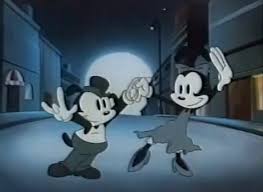
Hollywood Canine Canteen

“I’m a baaad bowwow.”

Directed by Robert McKimson; Story by Warren Foster; Animation by Cal Dalton, Don Williams, and Richard Bickenbach; Backgrounds by Richard H. Thomas; Musical Direction by Carl W. Stalling. A Merrie Melody released on April 20, 1946.

TADA! Welcome to the new and improved Wackyland2! When I said I was cancelling the blog, I just meant that I was giving Squarespace the boot. That place sucked. Here is a lot more space for me to stretch my creative wings. It’s the same great taste, but with a whole new package! With still hundreds of shorts left to address, we’d better get started!

Dogs are some of the greatest animals on the planet! Hollywood seems to think so too. As all the biggest stars (at least of the 1940s) all seem to own one. What’s more, they look a lot like their owners too, making it easy to tell who is who. So what do these dogs do when their owners are out being caricatured in Warner Bros. cartoons? They decide to start a nightclub all their own! And everyone of the canine type is invited! Upon entering, patrons can drop their (fur) coats at the entrance. And one doesn’t need to worry about filling your belly: Dogwood himself is on hand making some tasty bone sandwiches, and cleanup is nothing to worry about. We’ve got Laurel and Hardy’s dogs on cleanup duty. (Our dishes wind up extra clean. Seeing as how Laurel’s pooch, keeps accidentally dropping what he just dried back into the sink.) A young dog tries to call home, but has to wait as there are quite a number ahead of him. Not to worry, there is plenty of entertainment to keep one occupied. Why not listen to Leopold Bowwosky conduct? His musicians are playing the Hungarian Dances. (Taking reading breaks when waiting for their part, and breaking violins when performing their part) But some aren’t taking things too seriously. Lou Costello’s dog can’t be bothered to stay with his instrument and will leave in the middle of a performance to get a drink. (And more amusing than that, acting like a jerk when people tell him to get back to work) He just might ruin the song too, as he’ll mistake any flies on his sheet music for actual notes. And our young friend is still waiting to call. But there’s only one ahead of him now! Some dog’s try to make connections. Bing Crosby’s dog is serenading the pet of Dorothy Lamour. But he can’t quite compete with Frank Sinatra’s dog. (Mostly because the latter’s singing is too irresistible for Bing’s pooch to try and top) With a fresh batch of music (and the occasional box of fleas) everyone is really getting into the dancing groove. Well, almost everyone. Our young friend is finally allowed to call home. Hope his voice is strong enough. Since dog’s can’t use telephones, he has to make do with a megaphone.

Personal Rating: 2

The Ducktators

“Tutti frutti and all-a kind of whips cream and a wall-a nuts!”

Supervision by Norman McCabe; Story by Melvin Millar; Animation by John Carey; Musical Direction by Carl W. Stalling. A Looney Tune released in 1942.

Just want to remind everyone that this comes from a time where the country was at war. So naturally, we Americans made fun of our enemies. (Instead of today where we casually make fun of everyone)

Why do all the poultry in the barnyard have cigars? Seems that a pair of ducks are expecting! Wait, why is their egg black? Unless you’re a fish, I don’t think that’s a healthy color for your egg to have. Well, it may not be dead, but it IS rotten. Out hatches a duckling with a familiar looking mustache. Welcome to the world little Hitler Duck. He grows up quickly enough and seems he hasn’t got quite the right mindset. He gives some speeches to other birds about his ideas for the future. (They sound nice on paper… actually they don’t. He’s evil.) Sadly, some poor souls were taken in by his words. Especially one goose in particular. (He’s not given a name, but he is Italian, so it’s safe to assume we all have given him the same name. You were thinking “Goosalini,” right?) I would also like to note, that this cartoon is not so single minded as to think all “ducks” and “geese” are like this, and it offers an apology to those whose countries names are being tainted by these a-holes. They begin amassing a good number of soldiers. (One of whom, is a black duck from south Germany. Unlike the depictions of Nazis, this guy is still pretty offensive today. I give it a pass due to its time period, but it is still sad it was once considered perfectly acceptable) Not all the birds are agreeing to the way things are going. A dove (naturally) wants things to go in a more peaceful direction. The two leaders agree to a peace conference, but then go and shred the treaty. (Not cool guys. And after you even bothered to hand a banner saying “Peace iss vonderful”) But aren’t we missing someone? Wasn’t there one other enemy we had? And here he is now, Tojo the duck. He tries to label an island as Japanese mandated, but the island was really a turtle and he isn’t quite pleased. He chases the bird to beat him. The duck tries to get out of it by showing off his “I am Chinese” button, but the subtitle saying it was made in Japan doesn’t convince anyone. The gang’s all here, and they begin marching. (By this cartoon’s logic, they’re Italian stepping) The dove tries once more to get them to stop, but they just walk over him. Having enough, the dove begins to fight back. Others join his side, including “Hare-y Colona” and a sign advertising war bonds. They are victorious! Later, the dove, (who has two children named Peace and Quiet) admits that he still hates fighting, but he had to so something to stop those fowl types. And he really gave it to them, he mounted their heads on his wall.

Personal Rating: 3

Birth of a Notion

“I have no duck, Leopold.”

Directed by Robert McKimson; Story by Warren Foster. A Looney Tune released in 1947.

During the Autumn, ducks tend to fly south to warmer temperatures. Daffy is not like most ducks, and instead has a plan to get himself a warm home for Winter. It all hinges on the bone he’s holding. He leaves it on a house’s porch and calls for the dog that lives there. (I suppose he’s been scouting to find a home with a dog. It’s needed for his plan.) The dog prepares to feast on that bone, but Daffy stops him. He claims that the bone is poison and that he saved his life by keeping him from eating it.

Leopold, (for that is the dog’s name) is grateful and tells Daffy that in return, he’ll get him anything he can. Daffy requests sharing the house. Leopold doesn’t think his master would like him doing that, but eventually gives in. His master is a familiar face: it’s that scientist that looks like Peter Lorre. (Who from this day forward, shall be known as Pete Lorry.) He is working on some sort of experiment that is requiring something he does not have: a duck’s wishbone. Leopold, meanwhile, sticks Daffy in the closet promising to bring him food and water.

If Daffy wasn’t Daffy, his plan would have definitely worked. But he’s not one to stay there, and naturally leaves. Just in time to overhear Pete tell his dog about his duck loss. Daffy isn’t scared as one usually would be in this situation, but is instead angry. He tries to goad Leopold to join in on the Pete-killing, but the dog is loyal to his master and won’t partake. Daffy throws stuff at Pete’s head and succeeds in hitting him once with a bat, just as Leopold grabs it. Pete is very calm (while breaking the bat into many pieces) and tells Leopold that he will do horrible things to him, should he get hurt.

Daffy is not through, and heads into his bedroom with a knife. He takes a stab at taking a stab, but Pete happens to sleep with a shield and is unharmed. But he is now very much aware that there is a duck on the premises. A chase ensures with trapdoors, a door that leads to a countryside speeding by, and arms coming out of the walls. (Intermixed with a shot of Leopold complaining about his “role” in the short. Best joke of the cartoon, right there.)

After having many sharp objects thrown at him, Daffy goes for the obvious solution and just leaves. Who knew it was that easy? To Leopold’s horror, Pete begins wondering if a dog’s wishbone would work in whatever he’s working on. Why is Leopold scared when dogs don’t have wishbones, you ask? Well, clearly Pete won’t figure that out until he’s dug through Leopold’s neck. That’s how mad scientists work.

Daffy meanwhile is preparing to try the bone scheme at a different house, but another bird has beaten him to the punch and kicks Daffy away into the sky. Well, it’s easier than flying yourself, so Daffy kicks back and enjoys the ride. (Leopold joining him with fan powered flight.)

Personal Rating: 3

Don’t expect a post next week. While I can’t promise that I won’t have time to write one, I also can’t claim to have the time to do it. So for just once in your life, don’t expect the unexpected.

Wholly Smoke

“I ain’t a p-puh-puny puss!”

How bout ditching that ceegar?


Supervision by Frank Tashlin; Story by George Manuell; Animation by Robert Bentley; Musical Direction by Carl W. Stalling. A Looney Tune released in 1938.

You know, you really shouldn’t smoke. It’s bad for you, makes you unpleasant to be around, and eats up funds you could be using for something more important. And don’t give me any of that: “It’s too addicting” crap. You don’t want to learn the hard way. My pal Porky did.

Another of the 100 greatest and my personal favorite from Tashlin.

It’s a lovely Sunday and Porky’s momma calls her offspring down. (Hilariously voiced by Ted Pierce.) She sends him off to church with a nickel for the collection plate. Why isn’t she going too? I guess she just doesn’t want her child to be an atheist like herself. On the way, Porky comes across some kid smoking a cigar. He points out that it’s bad, but the kid doesn’t take him seriously. Instead, he shows off some tricks he can do with the smoke. Making a target and hitting it with an arrow, creating a duck that flies, and kicking his cigar like a hackey sack and catching it again in his mouth. (Set to an ominous “Merry Go Round Broke Down”)

With his masculinity threatened, Porky bets the thug 5 real cents that he is just as tough. They’re children and this is the thirties; that’s some serious dough right there. The kid accepts and hands over his cigar, taking the nickel. He hasn’t won yet, but he doesn’t need to stick around really. Porky is practicing. He tries to show off some tricks with the smoke. He makes a target but hits his own behind with an arrow, creates a duck that flies and lays an egg on his face, and kicks his cigar like a hackey sack and catching the lit side in his mouth. (Set to an adorable “Merry Go Round Broke Down”.)

But all that tobacco takes its toll on poor Porky and he woozily blunders around, coming to a stop in a smoke shop. There he is spotted by some kind of smoke gremlin. He has the power to shrink Porky in size and wake him up with a snap of his fingers. He is a little shocked Porky doesn’t know who he is. All smokers know his name: Nick O’ Teen. Who is one of the scariest things Looney Tunes has to offer. With his soulless eyes, magical powers, and soft voice. (Again, brilliantly portrayed by Pierce.) Nick ties Porky up and prepares to go “Pigs is Pigs” on him. With musical accompaniment.

There are some singing matchsticks who look like they have blackface, (but you could say its debatable since they are extinguished) some literally chewing tobacco, and the three stogies. All singing a frightfully creepy version of “Mysterious Mose” about how little children shouldn’t smoke. (No one should, but they don’t want to come across as preachy.) Porky is forced into smoking more cigars, and given chewing tobacco, (which the poor guy swallows) as all the mascots come to life to scold him. (I would say it’s a nightmare version of “Foodfight”, but the original already earned that title, so this is the family friendly version by default.)

Bing Crosby and Rudy Vallee are there as some “Crooner” brand cigars. (Corona.) Cigarettes march, snuff boxes are drums, and even a pipe cleaner gets in the fun by imitating Cab Calloway. Porky does manage to get free and wakes up from this trippy… “pipe dream?” (Screw you, it’s funny) Hearing the church bell, he hurries over. Except, he still needs that nickel. He takes it back from the bully, shoves the cigar in his face and goes back to church to donate it. He vows never to smoke again. Except he did in “Rocket Squad.” And “Deduce, You Say.” And “The Awful Orphan.” And… Well, at least he never smoked a cigar again. So take it from me and Porky: Don’t smoke. Or we won’t be your friend.

Personal Rating: 4 (But if “Pigs is Pigs” never had never come out, it’d get the 5.)

Porky’s Preview

“Hi g-gang!”

Supervision by Fred Avery; Story by Dave Monahan; Animation by Virgil Ross; Musical Direction by Carl W. Stalling. A Looney Tune released in 1941.

Oh boy oh boy! Of all the Looney Tunes that don’t get their just recognition, this is at the top of that list. It’s the my number one pick for a short that I feel should have been on the list of the 100 greatest Looney Tunes. (Replace “Acrobattty Bunny” or “The Stupor Salesman” with this masterpiece.) It’s so funny! It’s so creative! What else can I say but, watch it while you can! I found the footage! Hurry and view it before it’s too late! You could die before you get another chance!

Did you watch it? I’m still going to talk about it, so I really hope you viewed it first. It’s magical.

Porky has a show going on that all the animals are eagerly heading into. A hen takes her eggs, a kangaroo takes the tickets. (And one guy’s arm.) He’s a male one with a pouch. This short’s only shortcoming. But I do like that “Professor Porky” Poster behind him.  And a firefly acts as an usher. A skunk would love to get in, but he can’t pay the 5 cent admission fee, as he only has one scent. (“Get it?”) As he walks off, he finds the exit. Seeing as how he read my ravings up there, he has no choice but to sneak in. (Considering he sounds just like Bugs, I can just picture him going “Ain’t I a stinker?” before heading in.) Porky gets on stage to address the audience. Even though, he’s still a boy in this short, he drew the whole cartoon by himself. (It wasn’t hard. He’s an artist.) So let’s see his magnum opus!

 “PoRKy PiG’Ƨ FUNNy PictUReƧ” DRAwed by PoRKy PiG. (ARtiƧt) (7 yeaRƧ oLD) 2ND GRaDE. DRAFt No. 6 7/8 (FUNИy)
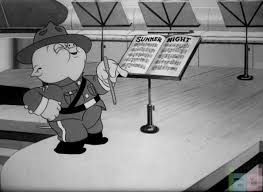
The little drawing labeled “me” always kills me. That’s the real troll face. There’s even an off key version of “The Merry go Round broke down”! After Porky’s awesome intro. We get to the StaRt of FUИNy PictUREƧ

CiRCUƧ PaRADe:  It’s a lovely day for the title. The animals include a lion, an elephant train, and a giraffe. They in turn are followed by a street sweeper.

CHoo-Choo tRAiN: (I love how he put a picture labeled “you’ up there next to his. It looks just like me!) A character drives a train and pulls the whistle to the tune of “California here I Come”. Puling back, we see that the engine stays level no matter what, and that the wheels stretch down to the tracks. And then we run out of background.

SoldiERƧ (MARcHIИ): What he said. A little soldier is continuously kicked in the rear, and when two groups of soldiers meet, they walk straight up into the sky and back down again. (Even turning gray when they do it.)

HoRƧE RAcE: (and now there’s a labeled horse too.) It’s a beautiful day for a horse race! All the horses and jockey’s are really tearing up the track. Except for that last one. That’s CRoƧBy’Ƨ HoRƧE.

DAИCEƧ: (With a picture of Porky, me and the horse too.) A hula dancer hulas. Her skirt comes down, probably giving us the first frontal nudity in a cartoon. (Porky!) A Mexican prepares to dance, but Porky keeps scribbling him out. Eventually, he manages to do a couple flips. (Before being scribbled out again.) A chorus line contains one tiny dancer amongst the others, and a ballerina stretches her legs out during a split.

GRAND FIИALE: A stick figure Al Jolson sings “September in the rain.” (The rain cloud keeps jumping back to him when its cue is heard.) Yes, there is some blackface. Get over it. Porky is just an impressionable youth who saw “The Jazz Singer”

With that, Porky’s masterpiece is complete. He goes on stage to ask how it was, but finds the audience fled when the skunk decided to sit down. (Judging by his enthusiasm though, they would have loved it just as much as me, the skunk, and you.

Personal Rating: 5 (And I think it deserves it too!)

Gold Diggers of ’49

“YEEOOWHOOPEE!”

Supervision by Fred Avery; (His directorial debut at this studio, in fact.) Animation by Bob Clampett and Charles Jones; Musical Direction by Carl W. Stalling. A Looney Tune released in 1936.

In the year that the title names, we see a town so poor they have crossed the “Gold” part out of their name, leaving the place known as Ville. But one brave youth dares to go out and dig for the stuff needed to rebuild their economy: Beans the Cat! His girlfriend, Kitty believes in him and rushes home to tell her father the news. Her father is Porky. (This is still Beans’ short, I wasn’t lying last week.) Being so early in Porky’s career, he is really fat. And his voice isn’t sped up. Also, I can’t tell if he’s wearing pants or not. His legs are a different color than his arms here. Plus there’s the fact that he is somehow Kitty’s father. (I guess he adopted?)

But let’s check in on Beans and see how he is doing, shall we? Well, he finds the stuff and alerts the whole town. Porky may love his food, but that won’t stop him from joining in the fun and he joins everyone for a day of digging. I love the cars the people had in 1849. So retro. At their digging spot, we get some pretty dang good gags. (Thank you, Avery. Never stop.) Porky finds a nugget fast, and puts it in his pocket. Reaching into the hole again, he keeps grabbing the same nugget. Beans meanwhile has found a chest. It only contains a book though, titled “How to find gold.” (Which comprises of one sentence: “Dig for it!” Brilliant!)

While everyone digs the honest way, the Billy Bletcher Bandit spies a bag of Porky’s and takes it for his own. Porky must have that bag back and promises Beans Kitty’s hand in marriage if he succeeds. Porky will stay behind and go with him in spirit. Plus, this is a great time to convince Warner Bros. that he is more star material than Beans is. (I mean…he’s too distraught to go!) Beans likes the idea and drives off after the thief. His guns don’t have much effect though, as the crook is wearing an armored butt cover. (“Also known as a “Steel Seat.”) To make matters worse, Bean’s car runs out of fuel. What’s a feline to do? Pour some firewater in the tank!

Properly juiced up, the car is now fast enough to catch up to the burglar and grab him and the bag, turning back to get Porky and heading to his home. He is true to his word and lets Beans get his hands on that puss- …actually, I’m above that joke. Beans in return gives Porky his bag of gold. Gold? Nah, Porky loves his daughter. She’s worth way more than a sack of rocks. That was his lunch bag that was stolen.

Personal Rating: 4

Porky at the Crocadero

“Today… you are a ham!”

Porky, from the north woods.

Supervision by Frank Tashlin; Story by Lew Landsman; Animation by Volney White; Musical Direction by Carl W. Stalling. A Looney Tune released in 1938.

No relation to the also awesome “Quasi at the Quackadero.” (Wish that was a Looney Tune, so I could blog about it) The Crocadero in question is based on the “Trocadero Ballroom.” Porky is outside and excited to see that many conductors are scheduled to be performing that night. It’s Porky’s dream to be a conductor! (Isn’t a conductor what you do when you can’t play an instrument? Like how a coach can’t play a sport and someone who can’t draw blogs about animation?)

His heroes include Leopold Stokowski, Rudy Vallee, and Benny Goodman. He idolizes them so much, he imitates them all. But there is one thing to dampen his glee: It’s $25.00 for a plate at this place. (Fifty cents more gets you food on the plate.) Porky can’t afford that, so he slumps off. But God is on his side, as Porky finds that the club is hiring and he rushes in. He gets the job because why wouldn’t he? And he begins washing the dishes. His boss is some sort of aquatic mammal. (I’d like to say walrus, but he has too much neck and no tusks, so maybe he’s a sea otter.)

He tells Porky to get his work done, and he just might be able to watch the music as a reward. But there’s a fly in the ointment. Actually, in the kitchen. Porky tries to get it which results in him breaking many dishes. He is fired. (And I begin sharpening my aquatic mammals carving knife.) But God is still on Porky’s side as there are no conductors for the eager crowd and the boss has received a telegram saying that they won’t make it. The boss has a good idea! Get Porky back! His fly swatting did look an awful lot like conducting. He heads out to get him back “Schnell!” (Which, a randomly appearing narrator tells us, means “fast.”)

He catches up to the pig and brings him back. Of course, since the crowd is expecting other people, Porky will have to be in several disguises. Good thing he takes to impersonating his heroes so much! He acts as Paul Whiteman (with some added gut) and gets some jazz going. A penguin waiter (there is no other kind in cartoons) has his drink stolen by a trombone player, and some lesbian kangaroos dance. (They both have pouches!) As Guy Lumbago (Guy Lambardo) Porky has his “Boiled Kanadians” sing “Summer Nights” rather shakily. (The audience dances to the beat.) And as Cob Howlaway (Cab Calloway) Porky puts on some blackface. Which… actually doesn’t look too racist here. Maybe it’s just because I’m a Porky worshiping fanboy, but he looks pretty tame. The lips aren’t too exaggerated and it’s always fun to see Cab referenced. Good work Porky!

He sings Chinatown (even dressing up as a Chinese Stereotype at one point. Less charming.) while the band plays along. A turtle makes his body a banjo, a rabbit plays two pianos at once, (with his paws and ears) and a goat plays his beard when his violin breaks. The penguin waiter meanwhile, (who has been having his drinks stolen throughout the whole time) finally one ups the thief by drinking the drink himself.

Personal Rating: 3 (Unless you really know old conductors. Then it’s a 4.)

I’ve Got to Sing a Torch Song

“One, two, one two. Breathe Deeply!”

Supervision by Tom Palmer; Animation by Jack King; Music by Bernard Brown and Norman Spencer. A Merrie Melody released in 1933.

Once upon a time, there was an invention called the radio. It was THE form of entertainment back in the day. In fact, entire families would do their aerobics in front of it. While others got their exercise in more creative ways like tightening their wife’s girdles or rocking their children to sleep. But there was more than just exercise programs on the radio. Here, many singers who are legends today, got their starts on the radio. Like Cros Bingsby who would sing in the tub to the delight of women everywhere. (This was how many people “viewed” porn before the internet.)

And the radio wasn’t only popular in America. Wherever there were people, there were radios. In Shanghai, the police listened to it to be aware of any crimes being committed. (And tying it into a knot if it disturbed their naps.) Cannibals would tune in to listen to recipes about how to prepare celebrity soup. And even up in the frozen north, the Inuits listen to it while they fished. If they caught a whale by accident, their radio could become lodged in the creature’s blowhole. (They didn’t seem to mind though.) The radio was so popular that people would rather listen to it, than watch scantily clad women dance in front of them!

The title of this post was the name of a song that was sung by many female celebrities at the time, like Greta Garbo and Mae West. Even Lady Liberty couldn’t help but join in. Finally, the time was even told by a man who looked an awful lot like Ed Wynn. But I guess this was when he was much younger as he doesn’t even SOUND like Ed Wynn. Or maybe it could be his father? The entire family looks exactly the same.

Personal Rating: 2

Eatin’ on the Cuff or the Moth who came to Dinner

“♪ Here comes the groom, straight as a broom. All purtied up with ten cent perfume.♪”

Supervision by Robert Clampett; Animation by Virgil Ross; Story by Warren Foster; Musical Direction by Carl W. Stalling. A Looney Tune released in 1942. (This is Clampett’s last B/W short.)

This short is sung to us by Leo White. (Well, he’s providing the lip movements. It’s Mel doing the actual lines. It’s always Mel.) I’ve heard this is Clampett’s answer to the Disney short “The Moth and the Flame” seeing as how he liked doing a parody of Disney every now and again. It’s also considered one of the top 100 Looney Tunes. Since the plot is in rhyme though…

“Oh, walk with me to the altar.” Said a moth to a honeybee.

“And a happier insect, you shall never, I mean ever, see!”

(Though by all biologic logic, this won’t work, don’t try.)

She loves the Moth and so agrees to give marriage a try.

I like this moth; (whose voice has got that squeaky Mel Blanc style)

I’ll name him Bucky due to his cute little buck toothed smile.

The day of his wedding arrives. (To the bee that I’ll name Rose.)

And as a cartoon moth, his diet’s naught but human clothes.

While passing by a bar, he notes a ton of “pre-war cuffs”.

And though a stop could make him late, he goes to try the stuff.

Now plump and fat, he a’slumps back, to rest his tired nipper.

(He liked the food, but could have done and gone without the zipper.)

But time has passed, and now alas, where is his dear bee bride?

Sitting alone, on steps (alone) and yes, ALONE, she cried.

Seeing the time, he tries his best to take off and head down.

But it seems that this here bar, is part of the wrong town.

Though he may be a fly…er, moth to complex human eyes,

To arthropods of female types I guess he’s quite a prize.

For this moth, who’s sloshed inside, with what he’d call hard cider,

(A tad bit forced, but still) he’s spotted by a hungry spider.

Man-hungry to be precise. A black widow, is she.

Disguised as Veronica Lake, so that her prey won’t flee.

But her nose is quite the turn-off and he’s (a soon) to be married man!

And I guess he’s still too full to fly, since running is his plan.

She trips into a bowl of punch. Time for a trick! This dame

exploits his biggest weakness: he can not resist a flame.

Now gotten what she wanted from a husband hunt and chase,

She lacks eight limbs. Er, no, I mean, she goes back to her place.

Rose heads home too, awash in tears. Wait! That’s her “honey’s” yelp!

And making like a “Bee 19” she flies on in to help.

She brandishes her stinger, and then- wait a minute… what?

What is that that’s now sticking out of the spider’s butt?

Why does she have a stinger too? Tell me, Clampett. Why?

I know it’s a cartoon, but still, it’s such a stupid lie!

We will all ignore that. And the moth’s lack of four wings.

Rose wins of course, because she gives the spidery broad a sting.

“My hero.” says she. “Tweren’t nothing” says he. (Yeah, that’s true. He’s right.

He was hiding under a table, while the ladies had their fight.)

And so they moved into a vest to live happ’ly ever after.

Won’t be long; they’re insects! *Cue uncomfortable laughter*

So Leo ends his story ( and I end my rhyme) but he can’t help but confide to us that he has no idea what that bee saw in that moth. She is cute and sexy and benefits the environment, whereas Bucky is a dope. The moth responds by showing how tough he can really be, and eats Leo’s pants.

Personal Rating: 4

A Tale of Two Kitties

“HEY, BABBIT!”

Supervision by Robert Clampett; Story by Warren Foster; Animation by Rod Scribner; Musical Direction by Carl W. stalling. Released in 1942.

This short was supposed to introduce the world to new characters who would be stars for Warner Bros. But someone else stole the spotlight. The two supposed stars are two kitties. (This is their tale.)

The taller one is named Babbit (Tedd Pierce) and the stout one is Catstello. (Mel) His name is never mentioned in the short, but come on. He’s a cat and if you have any idea who Abbot and Costello are, then you know who these two are based on and you’ve made the pun yourself. (That and the studio model sheets labeled him as such.) It’s time to eat and Babbit tells his comrade to go get a bird out of a nest so they can eat. Catstello is reluctant even after he’s told of how small it is. (I guess they’d each get a mouthful, but I have a feeling Babbit would hog it all.) Turns out hes got “Heightrophobia” and it takes a pin to his backside to finally get him up the ladder.

Scared sightless as his partner is, Babbit has to angrily demand that he gives him the bird. (Catstello laments that the Hayes office is what is keeping him from fulfilling that desire. I just didn’t know the term existed in the forties.) He makes a swipe at a sleeping bird but misses. This is the birthplace of Tweety. (Inspired by nude baby photos that Clampett’s mother had and he resented.) The ladder breaks and Catstello begs to be rescued from atop the remainging pole. So scared is he that he doesn’t notice Babbit saving him until he is in his arms.

For the next attempt, Babbit shoves his pal into a box against said pals protests. He’s also afraid of the dark. Babbit lets him out and the springs on his feet bounce him up to the nest. Here, our little baby Tweety (model sheets had him labeled as Orson) utters his first words: “I tawt I taw a putty tat.” Seeing as he did taw a putty tat, Tweety has no choice but to defend himself. And does he ever! Using an arsenal of guns, clubs and even TNT sticks, he continues to beat the crap out of the poor putty tat. Catstello cries over his failure while unbeknownst to him, he sits on an explosive. When Babbit detonates it he flies up towards the nest again. But he flies past it. (Tweety helps himself to Catstello’s apple. Or rather, the worm that was inside.)

When gravity kicks in, the cat falls and is able to cling onto a telephone wire. Tweety comes over to play “This ittle piddy.” A sequence that would be reused, essentially verbatim, in “Roger Rabbit“. Even down to Tweety resembling his old design.  The bird isn’t totally heartless, as he throws the cat a rope. It’s attached to an anvil, though. Said anvil crushes the cat into the ground and drags all the surroundings towards it. This includes Babbit and his victory garden. (I really like how concerned he sounds for his friend. Turns out he really does care.) The final attempt is launching Castello with wooden wings strapped on. Wouldn’t you know it, it works. (Human beings have been trying to fly for years, and it took a simpler mind to figure it out.)

Tweety calls the “fourt interceptor tommand” to report the disturbance and the cat is blasted out of the sky. He manages to avoid landing on a pitchfork in favor of his partner. (While they didn’t become the stars, they did appear in a couple more shorts after this. But they were mice. How humiliating.) Tweety is now on the ground and initiates a blackout. Seeing their chance, the two cats stalk their prey with faces that haunted my childhood.  Tweety doesn’t freak out, though. He yells at the two to turn out the lights like he told them too. Their glowing eyes instantly dim. (As does the moon.)

Personal Rating: 4