Crazy Cruise

“Monotonous, isn’t it?”

Supervision uncredited; begun by Fred Avery, completed by Robert Clampett; Story by Michael Maltese; Animation by Rod Scribner. Musical Direction by Carl W. Stalling. Released in 1942.

You know, Clampett is still my favorite director, but I find more and more lately that I wish Avery never was fired. It would have been great if he had stayed on the Warner’s team the whole time. Who knows? Maybe he would have gone on to still create Droopy, Screwy Squirrel, and Red?

This short contains a bunch of spot gags that Avery had a real talent at. We see a tobacco plantation and take a peek at an animal that does untold amounts of damage to the plants: the tobacco bug. (Which looks more like a species of worm to me.) It talks like an auctioneer and spits. Our cruise then heads to Havana and Sloppy Joe’s bar for some refreshments. After getting “tanked up” we head for out next destination in the most direct route possible. (When you’re as drunk as that, spiraling IS the most direct you can be.)

During this time of war, our ships are camouflaged so well, that all you can see are the sailors, flags and smoke. After stopping by the Swiss Alps (Where our plane slides over the mountains.) and an oil derrick, (Where we have our second spitting tobacco joke.) we come to an African Jungle. We see a species of carnivorous plant: the Eatemus abuggus. Or as it’s known in English: the Carnivore Flower. It tries to make a meal out of the bee that flies into its “mouth”, but it is stung. A line of animals wait for a turn to drink at a water hole. (Wait, why is there a pronghorn in Africa?) You might be wondering why the elephant is being so patient, as in the wild they tend to use their size to bully their way in first. Why, it’s because a zebra mother is helping her young to take a drink from the fountain. Isn’t that precious? (What? You thought it was going to be a lake? You clearly are new to these shorts.)

Past Veronica Lake (which is shaped like Veronica Lake) is a land of giant cannibals. Two hunters and their racially insensitive guide are heading that way to try and capture some. (I think that freckled one is supposed to be a caricature of Friz Freleng.) Their guide (who only speaks in scat singing) is excited to show they were captured. (Was he a spy? Or is he happy because he escaped?) The cannibals are so giant, that the hunters are nothing but mere candy bars to them.

Next we see some baby rabbits. Awwwww! (My favorite one is the one whose back is turned to us.) But they have been spotted by a Japanese vulture. (Also depicted in an unflattering way, just because he’s from another country doesn’t make him any less of a bird.) The rabbits respond with an anti-aircraft gun. The one whose back was turned turns around and… Hey! That’s no baby bunny! It’s Bugs Bunny! Before the short ends, his ears make a victory V. (Sad to say, there are no victors in war. Only losers.)

Personal Rating: 3

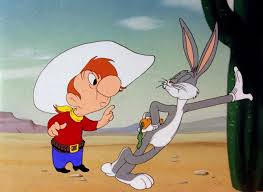
Buckaroo Bugs

“He wants to play cops and robbers, eh?”

That’s a cowboy, yessir he is!

Directed by Robert Clampett; Story by Lou Lilly; Animation by M. Gould; Voice Characterization by Mel Blanc; Musical Direction by Carl W. Stalling. Released in 1944. (By the way, I love how the short feels the need to inform us that this short stars Bugs. If the title wasn’t a dead enough giveaway, Bugs’ face shows up before the title card)

Wow. A short where Bugs is the straight up villain. We’ve seen him be a trickster before, but I think this might be the only time where he is the antagonist. What’s his crime? He’s stolen all the carrots out of people’s victory gardens. (The fiend!) Only one person can stop him! (No, not Cecil Turtle.) Brooklyn’s own cowboy: Red Hot Ryder. By the way, the narrator calls Bugs a rodent, but I will correct him as rabbits are not rodents! They are lagomorphs. And this had already been established by the 1940s, thank you.

Ryder is sad to say, not my favorite opponent for Bugs. He’s a little too dumb for my tastes. Why does that bother me? Well, why did anyone think he’d be a match for Bugs? What has he done to deserve such credit? Is everyone who knows him even dumber than him? Not to mention I’m just not much of a fan of really dumb characters. You gotta work really hard to make me enjoy them. Leni Loud is a good example. Appearance wise, Ryder looks like someone made a clone out of Yosemite Sam and Captain Ollimar. That’s not a complaint though, its just an observation.

His horse won’t stop for him, so he has to club it unconscious. He begins hunting for “The Masked Marauder.” Bugs is not fazed and decides to play along with him. Using a magnet, he robs Ryder of all his coins, bullets, sheriffs star and belt buckle causing his pants to fall down. I’m pretty sure those coins shouldn’t have been magnetic, but toon magnets don’t have to follow our world’s logic. (Lucky.) Only after Bugs leaves does Ryder catch on to his identity. He asks a stranger if he’s seen the bandit. (Bugs without his mask) Bugs asks if the guy is the one who not only wears a mask like his, but robs him like so! Well, this time he takes more. Including the pin of Red’s diaper, (Wait, wasn’t he wearing ladies underwear before? I don’t get the switch.) and all the filings of Red’s teeth. (Ooh! That looks painful!)

Red confirms that that is the guy. Too bad Bugs hasn’t seen him. But he has to excuse himself to rob a train. I think? He fakes the whole thing, but then he still has loot when he comes back. And it’s not just carrots this time, but tons of war time luxuries like meat, gas and a color changing can of pineapple. He gives Ryder phony directions to go after the Marauder and the little guy heads back to his horse. He hops on and the horse runs off. Ryder however just hopped on a fence post and is yet to discover he’s not moving. (Best part of the short is his horse coming back and angrily waiting for him to discover he’s not moving. He doesn’t catch on.)

The horse glues him to the saddle and they’re off! Bugs trips the two and then disguises himself as a telegram deliverer. He gives Ryder an insulting poem whose last line is censored. Ryder is too dumb to figure it out. And then they teleport back to where this started. I’m not joking! That’s totally the same background! Bug’s hole is there and everything! Bugs tells Ryder where the Marauder went which was apparently over steadily increasing-in-size gorges. The one the horse can’t make it over is the Grand Canyon, and the two plummet down. Ending up underground, Red finally deduces that Bugs and the Marauder were one and the same. Bugs confirms this and gives him a kiss.

All in all, I don’t hate this short. But I’m just not a fan of Red. If I had written it, he’d have had no publicity and just be some guy Bugs stole from and he was trying to get revenge. Clampett, I love ya, but this was my least favorite of your work.

Personal Rating: 3. I have to be fair. I don’t think people will dislike it for the reason I do.

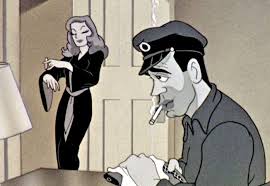
Bacall to Arms

“Anybody got a light?”

Care to help a fellow American who’s down on her luck?

Directed by Robert Clampett (uncredited); Animation by Manny Gould, Don Williams, Rod Scribner and I. Ellis; Layouts and Backgrounds by Thomas McKimson and Philip DeGuard; Musical Direction by Carl W. Stalling. Released in 1946.

One of Clampett’s last shorts and it feels like his heart wasn’t really in it. Many scenes are reused from “She was an Acrobat’s Daughter,” including the crowd switching seats, the fat hippo, and the young goose annoying his father. A wolf is shown his seat by a female usher. (I swear that’s Porky sitting behind him.) He rushes off to flirt with her but is slapped. A news reel is shown that radar has a new purpose: alerting a family to the mother-in-law coming. The film then starts. A parody of the real picture “To have and have not” called “To have…To have…To have…” (etc.)

It stars parodies of the stars of the actual film, Humphrey Bogart and Lauren Bacall (to arms) played by thier Toontown counterparts: Bogey Gocart and Laurie Bee Cool. The rest of the cast’s names scroll on the screen. They’re not important. The movie itself says they are the “cast off characters.” The wolf (who shall hence forth be known as Winchell) starts to doze off. (After the cartoons, I would too) The Tex Avery hippo is told by Gocart to sit down and stop inconveniencing people as the film is starting.

When Laurie shows up on the screen, Winchell pays attention. She’s so hot, that she leaves little flame trails wherever she walks. As she kisses Gocart, the wolf is in heaven. (The whites of his eyes disappear at one point even.) Winchell continues to go nuts. Kissing the back of the head of the patron in front of him, whistling so hard someone’s wig flies off and jumping out of his clothes. (Apparently the audience left to go smoke at that point as the theater seems deserted.) When Laurie is finished with her cigarette, Winchell dives after it and takes a puff. Not amused, Gocart shoots the wolf and takes it for himself.

It blows up leaving him in blackface. (Yes, this part was cut for television.) He exclaims that he can work for Mr. Benny now. (It’s a little known fact that there were at least 12 Rochesters and that Gocart played the 3rd one)

Personal Rating: 3. There’s just barely enough new here to keep it a little interesting.

A Gander at Mother Goose

“Remember Little Hiawatha and his bow and arrow?”

They’re just a bunch of foney’s.

Supervision by Fred Avery; Story by Dave Monahan; Animation by Charles McKimson; Musical Direction by Carl W. Stalling. Technical Advisor; Mother Goose. Released in 1940.

Sing a song of 10 cents, A.K.A. a dime. I felt it best to make another post, entirely in rhyme. Nursery rhymes are what our featured short is all about. So let’s not waste any more time, and just go check it out.

Mistress Mary, quite contrary, how does her garden grow? Not so well is what methinks. “Confidentially, it stinks.”

Humpty Dumpty sits on a wall, and soon poor Humpty takes a great fall. But he lands just fine; sees no drawback. (Unaware that we can see his “crack”.)

Jack and Jill climb a up hill to fill their little pail. Jack should now come falling down, but not this version’s tale. “To heck with the water” he doth speak, with lipstick markings on his cheek.

Miss Muffet sits on her tuffet, eating curds and whey, when a spider comes down beside her, to frighten the girl away. (Why does he have three legs on each of his spidery limbs?) But Muffet’s just so ugly that it’s she that frightens him.

The three little pigs are all on the run. (They could be Porky’s nephews, but he already has one.) They hide in a brick house, away from the wolf’s hungry jaws, (Yes, this isn’t a nursery rhyme. That’s the short’s biggest flaw.) They surrender to the lupine who’s wishing their death. But only because he’s got terrible breath. They offer him mouthwash. (That’s got to sting) He takes it. “Why don’t my friends tell me these things?”

Star of light, star so bright, a dog wishes on a star at night. His wish comes true. What could it be? Well he IS a dog. He wished for a tree.

Jack is nimble and Jack is quick, he jumps over a candlestick. It’s basically the same as the Humpty joke, just with burning butt rather than yolk.

There is an old lady who lives in a shoe, she has so many children, what can she do? She does have a husband, but he’s not there. He’s off relaxing in a lawn chair.

Finally, “‘Twas the night before Christmas, and all through the house, not a creature was stirring,” except for a mouse. “Merry Christmas” he whispers to his mouse friend, “QUIET!” he shouts. And thus the short ends.

Personal Rating: 3

Tom Thumb in Trouble

“You’re so little and helpless.”

Supervision by Charles M. Jones; Story by Rich Hogan; Animation by Robert Cannon; Musical Direction by Carl W. Stalling. Released in 1940.

For quite awhile, Warner Bros. would attempt to win the audience by doing what Disney was. As soon as they got their gag-filled style however, they gave up on that. This was their last try and it is probably the most Disney a W.B. short was. So as such, I’ll be making as many Disney references as I can.

I hope you don’t like backstory, as there is none. A wood chopper has a son who is small as a thumb. Thus earning him his name: Tom. I don’t know how this all happened. There’s no mom in this story. Maybe his dad just wished upon a star and his dreams came true in a cruel fashion. Tom, (voiced by Marjorie Tarlton) is too small to shut their alarm clock off, but his dad doesn’t mind and is quite all right turning it off himself. Being so small, Tom bathes in the water his father has cupped in his hands. (Well, I shouldn’t say bathe, so much as dunk.)

Getting dressed, the two sit down to breakfast. Afterwards the father (voiced by Shepperd Strudrik) hi ho’s as off to work he goes. Leaving Tom behind to do the dishes. At least he doesn’t mind. He happily sings as he works. (He’d whistle, but that might get him sued.) At least his song is original. But he carelessly steps on a bar of soap and lands in a tub of sudsy water. (Which doesn’t ripple or anything while he’s in it. Maybe it’s soap mud?) Good thing there is a friendly bird outside. Although Tom is not singing like the birdies sing, it understands that he needs help and crashes in through the window. (Either a very weak window, or a very strong bird.)

This noise does alert his father though, and he slowly starts home. He does pick up speed, but if my only child was home alone and I heard a window break, I’d run the whole way. The bird gets him out but at the worst possible time, daddy gets home. He sees a broken window, and a potentially bloodthirsty bird standing over his unconscious son. That’s enough evidence for him. Screw the circle of life! The bird is a savage! He’s barely even human! It flies away narrowly escaping dad’s grasp. He apologizes for leaving Tom alone and assures him that everything is all right.

Despite Tom’s lack of consciousness earlier (in other words, he didn’t let his conscious be his guide) he knows that the bird saved him. His dad won’t listen though and tucks him into bed. But later that night, Tom leaves the house leaving a note explaining to his dad everything. Despite the fierce snow, he heads on. He wants the bird to be part of his world. When his dad wakes up he yells for Tom, but doesn’t really bother going to look for him. (Well, it’s frozen outside. Let it go.) But his yelling does manage to wake the bird who flies out to look for the lad.

Despite the fact he’s not an owl and should have a pretty hard time finding him, he finds him immediately and gives him a lift home. I’ve seen a peanut stand, heard a rubber band, and seen a needle wink its eye. But I’ve never seen a Tom fly. The father cries his eyes out until the two return safe and sound. Now that everyone is back home safe and sound, they all go to sleep. The little bird nesting in Dad’s beard. It’s a tale as old as time, a song as old as rhyme: Beardy and the beast.

Personal Rating: 2. At least it looks nice.

The Trial of Mr. Wolf

“I’m innocent. Really, I am. ”

Supervision by I. Freleng; Story by Michael Maltese; Animation by Richard Bickenbach; Musical Direction by Carl W. Stalling. Released in 1941.

An owl judge is preceding over the titular trial. On one hand we have Miss Red Riding Hood, and on the other, we have the wolf. It looks like it’ll be a one sided trial too, as the jury is nothing but wolves. (And one skunk.) The wolf’s lawyer says that we’ve all hear Red’s side of the story and that we should hear the other side as well. (Besides, Red literally has guilt written all over her face.)

The wolf explains it all started when he was coming home from the pool ha-… Sunday School! He was dressed in Donald Duck’s sailor suit with a pair of Mickey’s pants. (Dyed blue.) He was picking flowers for his mother and communing with nature. Namely a bluebird…that flies like a hummingbird…what? But Red was creeping around and keeping an eye on the wolf and started to pretend to cry. Being such a nice guy, he asks her what the matter is. She claims to have lost her way. The wolf decides to help and pulls out a compass. (Which among Grandma’s house, also can help one find the 3 bears house, the 3 pigs house, and Jack’s house. Which he built, you know.)

But Red just needed the wolf to come along quietly, she has a motorcycle that she uses to get them both there. Good thing the wolf can’t read, as it looks like Grandma is every wolf’s worst nightmare: A FURRY! (No, wait. That’s every wolf’s second worst fear.) A FURRIER! She is having a good time dancing, but upon the duo’s arrival, hides the evidence of her profession and gets in bed. Red wants the wolf to go and comfort her as she’s hungove-…ILL! Yes, she’s quite ill. The wolf goes in to cheer her up. (While Red locks the door.)

Grandma admires the wolf’s beautiful coat, and he admires her giant mallet. Getting wise, he runs for his life, but finds the old woman behind every door with a variety of weapons. When he finds an exit, she bonks his head and wrestles him back in. The wolf finishes his story saying it was a miracle he got out at all. But what’s this? Even though the jury is nothing but wolves, (and one skunk) they aren’t buying his story. He claims that if it’s not true, he hopes to be run over by a streetcar. His wish is immediately granted. Coming out of the rubble, he admits he might have exaggerated just a tad. (The bird gave him away. What was that?)

Personal Rating: 3

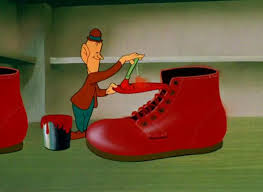
Holiday for Shoestrings

“*Unintelligible squeaking*!”

You can’t go around painting other people’s tongues!

Direction: I. Freleng; Story by Michael Maltese, Tedd Pierce; Animation by Gerry Chiniquy, Manuel Perez, Ken Champin, and Virgil Ross; Layouts and Backgrounds by Paul Julian, Hawley Pratt; Musical Direction by Carl Stalling. Released in 1946.

A fairy tale that everyone seems to know but no one talks about is “The Shoemaker and the Elves” Here’s Warner Bros. take on the tale. (Their first one, anyway.)

Help is wanted at “Jake’s Shoe Repairs.” (These places don’t exist anymore do they?) But no one is coming by and poor old Jake is stuck lying in bed, sick. But wait! Elves seem to be popping out of every possible hiding place. (To “The dance of the Sugarplum Fairy”) They immediately get to work. One elf nails a sole onto a shoe, but it comes back to hit him and knocks all of the nails out of his mouth and just barely missing another. Other elves are using a waffle iron to make golf shoes. (I think that’s what they are. I know fish, not shoes. I can tell you about soles, but not soles.) Another uses a jack to lift up a rejected 4F shoe to a beautiful 1A. All the while, Jake is watching in amazement.

A Stan Laurel elf paints some shoe tongues red. (And accidentally paints the tongue of an Oliver Hardy elf.) Then, to Strauss’s “Tales from the Vienna woods,” (which we heard previously in “A Corny Concerto“) a bunch of big elves (big for elves, anyway) all hammer a nail while taking the occasional break to let a little elf feel like he’s helping with his tiny hammer. They eventually end up flattening him. And two mentally challenged elves try to hit a nail into a shoe, but the one with the hammer hits his partner’s foot, springing back, and ends up hitting himself in the head.

Another tries to button up a boot, (to the “Chinese Dance” from “The Nutrcracker.”) but keeps finding one button left over. (I always hated that kind of thing as a kid.) He does it many times and the only difference is that the extra button seems to end up on different sides of the boot. Eventually he gives up and cuts the extra off. Many elves work on an ugly old boot. (To Chopin’s “Minute Waltz”) and transform it into barely a shoe. (At least it looks pretty.) And the two “speci-elfs”are still trying to get the nail in with no success. One elf uses a pair of razor blades like skates to cut out some insoles.  He ends up falling through the (leather?) into the water below. (There was a mop and bucket underneath.) And then an Indian looking elf charms a shoelace to lace itself up to The Nutcracker’s “Arabian Dance.” (And this part was cut when shown on TV. That’s pathetic.)

Back to the “unique” elves, they finally have an idea. The one with the hammer aims for his partner’s foot this time. He ends up finally hitting the nail much to their joy. And to Strauss’s “Voices of Spring” an elf punches out a design in a shoe. (The “Eat at Joe’s” sign is a nice touch.) And then we get my favorite part from “The Nutcracker,” the “Russian Dance.”  A big elf hits a nail into a shoe and a little one hits it back. They go back and forth a bit before the little one hammers the nail’s sharp end down and hits the big one’s head. Some more hit nails to the music while a couple dance in boots. (That’s not really helping guys.)

Seeing the elves have it all under control, Jake picks up his golf clubs and prepares to leave. I can’t tell if he was faking it all along or not, but I choose to think he was. It’s funnier that way. Unfortunately for him, the elves catch sight as he tries to leave. They pick him up and tuck him back into bed, hammering his sheets down so he can’t leave. As they leave, one little elf takes his clubs and hat as payment.

Personal Rating: 3

Don’t expect a new post on the 15th. I’m going on one last trip before summer vacation ends. And my work schedule has changed, so updates will once again be on Tuesdays

Foney Fables

“The bad boy of the fairy tales: The boy who cried wolf.”

Supervision by I. Freleng; Animation by Richard Bickenback; Story by Michael Maltese; Musical Direction by Carl W. Stalling. Released in 1942.

Disney had already parodied Fairy tales wonderfully, (if dated) with “Mother Goose in Hollywood.”, so why wouldn’t W.B. give it a shot?This short consists of nothing but gags, so I hope you weren’t expecting any story.

We begin with Sleeping Beauty (which isn’t a fable by the way.) The prince shakes her awake. Tom Thumb has grown huge thanks to taking Vitamin B-1. The grasshopper and the ant is next. (Which is a fable by the way.) The ant tells the grasshopper that he’ll starve since he didn’t work, (The ant meanwhile will probably work itself to death. Much preferred) but the grasshopper has bought war bonds. Then a boy cries wolf and laughs at the poor schmuck who tries to save him.

Jack runs from a two headed giant, who nearly captures him but has to take a breather because his other head has been sick. A wolf disguises himself with a sheepskin but only finds another disguised wolf, and Aladdin calls for his genie but finds him on strike. The boy is still crying wolf and the narrator tells him to give it a rest. The boy tells him to piss off. A goose is said to lay golden eggs, but now lays aluminum eggs for the war effort. (And is obviously Daffy. Listen to that voice and tell me it’s not Daffy.) Mother Hubbard goes to get her dog a bone, but finds it bare. The dog finds her hidden stash and lets the whole town know she is a hoarder. (This one is a nursery rhyme.)

Then we are treated to “This little piggy.” (Which isn’t even a story!) A thick accented mother plays the game with her infant. And you know how I point out very tiny errors? Well, this one is barely unnoticeable. One of the baby’s leg’s disappears! How’d anyone miss that? Oh yeah, the joke is that the mom accidentally hurts the baby by touching his corn. (Sorry, but I’m not forgetting that leg.) We are about to hear a variation on Cinderella, when the boy starts calling wolf again. The man comes to see (you’d think he would have given up after try #2) but is too late and only finds a wolf picking his teeth.

Personal Rating: 3

The Bear’s Tale

“Isn’t this where the three bears live?”

Supervision by Fred Avery; Story by J.B. Hardaway; Animation by Rod Scribner; Musical Direction by Carl W. Stalling. Released in 1940.

This short begins by showing us the cast. Papa is played by Papa Bear, Mama is played by Mama Bear, etc. The only exception being that Goldilocks is playing herself. In the beautiful, green, forest, there is a cottage where three bears live. They sit down to their porridge but find it too hot. Papa tries to cool his mouth down with a gulp of water, but drinks from the hot tap. I just want to point out that I love this guy. He won’t stop cracking jokes and laughing heartily at them. It’s Tex Avery voicing the bear, and he’s loving every moment of it.

Deciding to let it cool, the family goes for a ride on a tandem bike for three. (The little bear being forced to do all the pedaling.) While they’re gone, someone else is waltzing through the beautiful, green, forest. It’s little Goldilocks. (Is that her real name?) She comes to a cottage and enters. Whoops! There’s somebody else’s story going on here. A wolf in a bed lets her know that she’s at the wrong place. He sends her on her way, but figures that she is no different from Little Red Riding Hood, and so he takes a taxi to the Bears place to surprise her. (The bears in question, are still biking. Papa is having a grand time pretending to be a siren. Have I mentioned I love this guy?)

Goldilocks gets to the cottage and begins eating. At the same time, Red gets to her location and finds a note from the wolf saying he got tired of waiting for her and went to find food elsewhere. Red phones Goldie, (on her way to the bedroom) and lets her know of the plan. Goldie leaves just as the family returns. They are sad to find their food gone. The wolf sneezes and the trio panics, thinking there is a robber in the premises. Papa tells the two to stay put and he’ll go get the crook. As he climbs the stairs, he laughs once more and tells us he knows full well that there is no robber. He read this story in Reader’s Digest and is prepared to find Goldie. (Okay, it’s official. If I was a gay cartoon bear, I would marry this magnificent creature.)

Imagine his surprise when he finds an angry wolf in the bed instead. Scared, he takes his family and they run off into the sunset. Papa, Mama, and the little bear’s bare behind, behind. (Yes, they end on a butt joke. But I’ll forgive it for the spectacular wonder that is Papa. It’s a shame he never got his own series.)

Personal Rating: 4

Don’t expect a post next week. I will be on a trip. I’ll resume the week after next.

Paying the Piper

“And th-th-there’s what’s left of the last rat.”

Directed by Robert McKimson; Story by Warren Foster; Animation by Manny Gould, John Carey, Charles McKimson, and Phil DeLara; Layouts by Cornett Wood; Backgrounds by Richard H. Thomas; Voice Characterization by Mel Blanc; Musical Direction by Carl W. Stalling. Released in 1949.

Today is the Summer Solstice, which means it’s been at least four months since my fight with my good pal, Porky. I went to him recently and asked what it would take to earn his forgiveness. He’s a good guy and he didn’t ask for much: Just a short starring him that ends with him being the victor being talked about. Done and done! (Or it will be in about one summary later.)

The town of Hamelin has been cleared of rats. Good news, right? Not for the cats of the town. (It’s not like they could eat mice or birds or fish or lizards or…) They go to complain to the supreme cat. (Just like their wild cousins the lions, domestic cats have a monarchy.) Supreme there looks familiar doesn’t he? He looks an awful lot like the cat who would appear about seven months later in “Swallow the leader.” But since they are calling him “Supreme”, maybe he is just Miles’s brother. Anyway, he vows to help his people. The piper who got rid of the mice is going to get paid. But if for some reason there was still at least one rat in the town, he’d get gypped. Putting on a rat suit he heads out.

Said piper is none other than Porky. Playing a rather catchy rendition of “Little Brown Jug” he was able to successfully drive the rodents away. All except that large one. (Who asks if they were expecting Bugs Bunny.)  The mayor refuses to pay until it’s gone, and so Porky sets off. You know how in the original story, the mayor refuses to pay the piper anything and so said piper just drives the children out of town? Don’t think Porky isn’t bass enough to do that too. He’s just a nice guy.

Porky loses track of the rodent, instead bumping into some rude cat who says the pig’s sister “smokes corn silk.” (What?) Porky mentions that he’s wrong. His sister works in a butcher shop and smokes hams. Make of that what you will. Finding a labeled rat hole, Porky tries to lure it out. He gets scolded by the cat for bothering a sick baby. (“I’m not long for this world.”) The rat then shows up and whips his tail at the pig. Porky chases again, but loses him once more.

He tries luring him out again, and the rat pretends to fall for it. But when Porky notices it’s not following him anymore he runs back and crashes into the cat again. This time he remarks that Porky’s brother “eats jellybeans.” Porky wonders how he knows so much about his family. (That’s just one fact though. He got the other one wrong, didn’t he?) When Porky does manage to grab the rat, Supreme jumps out of the suit, leaving the piper with an empty skin. Porky has killed it! But supreme has stolen all the cash in town. (Which is Porky’s new reward. He’s earned it.)

Losing the slippery feline again, Porky “figures” he might as well bring the rats back. Or rather he plays the very specific record that I left for him to find: “Rat stampede to fool cats on the other side of the fence with.” Taking the bait, Supreme rushes out to what’s sure to be a feast. Porky pounds him and gets his money. But not before telling the cat that his sister “… drives a pickle wagon.” (Yeah! Tell him! It makes sense when you say it!)

Personal Rating: 3