You were never Duckier

“Brother, could I use 5,000 sthmackereenies!”

 Directed by Charles M. Jones; Story by Tedd Pierce; Animation by Ken Harris, Phil Monroe, Ben Washam, and Lloyd Vaughan; Layourts by Robert Gribborek; Backgrounds by Peter Alvarado; Boice Characterization by Mel Blanc; Musical Direction by Carl W. Stalling. Released in 1948
He craves something, but doesn’t know what this is.

Directed by Charles M. Jones; Story by Tedd Pierce; Animation by Ken Harris, Phil Monroe, Ben Washam, and Lloyd Vaughan; Layourts by Robert Gribborek; Backgrounds by Peter Alvarado; Voice Characterization by Mel Blanc; Musical Direction by Carl W. Stalling. Released in 1948

Daffy is at a Poultry judging. The best rooster wins $5,000, and the best duck wins $5.00. (Sorry duck farmers, but best ducks are still just food.) Daffy is angry but figures that all he has to do is disguise himself as a chicken and he’s on the road to cash. He slips on a red rubber glove as a comb (If it’s good enough for penguins…) and then grabs some cock tail. (And by that, I mean he takes the tail feathers off of one of the cockerels there, thank you very much.) His disguise complete, Daffy goes to snooze while he waits for the judging.

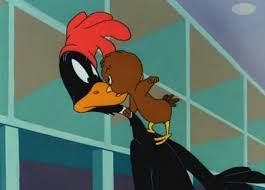
Up in a tree meanwhile, a little chicken hawk  is going to bed himself. His dad is reading him his favorite bedtime story, “The book with pictures of various different breeds of chickens and no words.” (I hear it’s getting a movie soon.) It’s Henery and his dad, George. For once in my blogging career I have to come up with a middle name for a character rather than a first one. His middle initial is K, so the only logical name is ‘Ketuckyfried’. Henery is just amazed at how much his dad knows about chickens. He’d love to get him one. So he heads off to the show.

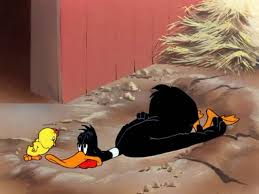
Finding a sleeping Daffy, he tries to take him home for dinner. When Daffy demands an explanation, Henery tells him that he’s being taken to his dad: the greatest judge of chicken flesh. Well, Daffy wants to be judged right? He happily comes with. Once at home, he finds out the name of his would be judge: George K. (entuckyfried) Chickenhawk. (Red-tailed, that is.) In a refreshing twist, Daffy doesn’t do the ‘ole “repeat the name and then realize what’s been said. He immdiately realizes that he’s pretty much a goner. While George prepares the pot, Daffy tries to prove that he is really a duck. I don’t care which answer is right. Both are tasty.

But giving a swimming demonstration doesn’t cut it, and he can’t get his disguise off. When he tries to just flee, George grabs hold of his “comb” and when it snaps back, George now has it on. So you can’t really blame Henery for accidentally hitting his old man with a hammer in the ensuing chase. Daffy leaves and remembers that he still has a contest to win. Donning a new glove he gets to the podium with dollar signs in his eyes. But he loses to George of all birds. (Still wearing the comb.) Well, 5.00 is five bucks and Daffy strips down to try and win something. (With cent signs in his eyes.) He loses once more, this time to Henery in duck disguise.

Personal Rating: 3

Hollywood Daffy

“The sthity of the sthinema at lastht!”

A cop isn’t just beer and skittles, you know.

Directed by I. Freleng; Story by Michael Maltese; Animation by Ken Champin, Virgil Ross, Gerry Chiniquy, and Manuel Perez; Layouts and Backgrounds by Hawley Pratt and Paul Julian; Voice Characterization by Mel Blanc; Musical Direction by Carl W. Stalling. Released in 1945

Well folks, a new job is going to make it difficult for me to post on Wednesdays anymore. So the only logical thing to do is move to Mondays. (Which my previous job prevented me from doing.)

Our story today takes place in Hollywood. (Naturally) There are plenty of wolves here as it’s a perfect environment for them. Plenty of hot babes, nice climate, and delicious toons to eat. Daffy has just arrived and much like his Disney counterpart did in “The Autograph Hound”, wants to see some celebrities. Despite the fact there are plenty of signs saying he can’t, he waltzes into the studio anyway. He is thrown out by a studio guard dressed like a klassic keystone kop (Or a kkk member for short.) Considering Daffy is a black duck, that could be part of the reason why Rolly, there (that’s what I’m calling him) refuses to let him in.

The chubby cop (portrayed hysterically by Mel) may be fat enough to snack on two popsicles at once, but he isn’t an idiot. He does his job well. (You know Daffy’s apprentice, Plucky, would also have a hard time getting past Ralph the guard in Tiny Toons to get in the studio years later.)Daffy tries various disguises. Charlie Chaplin, Jimmy Durante, and Bing Crosby don’t get him in. But he is able to slip by as an Oscar. Even though Rolly can’t tell what he’s supposed to be, he does have a button that is to be pressed when gatecrashers disguised as Oscars come in. His disguise revealed, Daffy flees into the lot.

He pretends to be a tour guide and shows Rolly some of the stars dressing rooms. Abbot and Costello’s are fat and skinny, and Durante’s has extra space for his nose. He even shows off the studio guard and shows that his head is so thick, you can repeatedly hit it with a stick and he won’t feel anything. (Physically; mentally he will feel angry.) He chases once more as they run past Jack Benny trying and failing to get an Oscar out of a claw machine. “I’ll never get one of those.” And he didn’t. (A regular Nostradamus.)

Daffy pretends to be a director and flatters Rolly into being in his film. He gets him to jump off a cliff. The chase continues (and Daffy is saying his trademark laugh, strangely quietly) and the cop tries to stop him with a painted backdrop of a path. (Daffy runs into it, and Rolly runs through it.) The duck thinks he’s finally rid of him, but Rolly grabs him anyway. Daffy says that he is not leaving because he wants to see stars. Rolly asks why he didn’t say so. He can show him stars. He beats him on the head and tosses him out. But Daffy is happy. He’s seeing more stars than Carl Sagan ever did.

Personal Rating: 3

The Up-standing Sitter

“I’ll face the world alone!”

 Directed by Robert McKimson; Story by Warren Foster; Animation by Phil DeLara, Manny Gould, John Carey, and Charles McKimson; Layouts by Cornett Wood; Backgrounds by Richard H. Thomas; Voice Characterization by Mel Blanc; Musical Direction by Carl Stalling. Released in 1947
That’s, ah say, that’s no sitter.

Directed by Robert McKimson; Story by Warren Foster; Animation by Phil DeLara, Manny Gould, John Carey, and Charles McKimson; Layouts by Cornett Wood; Backgrounds by Richard H. Thomas; Voice Characterization by Mel Blanc; Musical Direction by Carl Stalling. Released in 1947.

Daffy works for a babysitting service. (Are those still around?) Not only that, but apparently he’s the best sitter the place has. He has just gotten a job and heads off. As he goes, he sings about how this job is full of abuse but he puts up with it as the pay is pretty good. He arrives at his location. The mother is a hen and she wants Daffy to keep watch over her unborn child. (With birds, the term babysitter is literal.) He sits and the chick almost immediately hatches. That’s gotta hurt. Not having your mom around to witness your birth. (You and Dr. Doofenshmirtz are kindred spirits kid.)

He tries to guess Daffy’s relation to him, but runs out of relatives and deduces that Daffy is a stranger. Since kids shouldn’t talk to those, he runs off. Sitter or not, Daffy is technically still a stranger. (He’s plenty strange.) I don’t know what this kid’s problem is, but he now goes out of his way to make Daffy suffer. He hides in the mouth of a bulldog named Spike. (Bulldogs are always named Spike. It’s an unspoken rule.) He leaps out as Daffy reaches into the beast and it wakes up. He won’t let go of Daffy’s arm/wing, until he’s backed him up a ladder and off the barn’s roof. The chick (who needs a name. How about Spencer?) finds another hen and goes under. Daffy reaches once more only for the hen to spot him. Trying to play it cool, Daffy pretends he was miming a train the whole time. (Don’t you hate being in those situations?)

Spencer hops out before Daffy spots him and comes back for more hen groping in a barrel disguise. She puts a TNT stick under a feather duster for him to find. Spencer meanwhile has now run onto a wire high above the farm. Daffy tries to tightrope walk over but the chick blows him away. (Rooster’s are known to have really strong lungs, regardless of age.) A slingshot launches him into the side of the barn, and a rocket ends up taking him on a ride that ends up crashing into Spikes house. After it explodes, the dog spanks Daffy with what’s left of his domicile. Spencer gives Daffy a phone, and he calls his employers. A sitter he may be, but he’ll be standing from now on.

Personal Rating: 3

The Stupor Salesman

“Thith guyth gonna be a tough nut to crack.”

Directed by Arthur Davis; Story by Lloyd Turner, William Scott; Animation by J.C. Melendez, Don Williams, Emery Hawkins, and Basil Davidovich; Layouts by Don Smith; Backgrounds by Phlip DeGuard; Voice Characterization by Mel Blanc; Musical Direction by Carl W. Stalling. Released in 1948

Here’s another entry on the list of “The One-hundred Greatest Looney Tunes.”

The last national bank is robbed one night. Not in the traditional “This is a stick-up” sense. This had some thought put into it. The criminal blows up the vault and makes off. The police have identified this villain as Slug McSlug. (Who is not actually a slug) He’s not too bad of a mastermind either, seeing as he paints his Sedan just after the cops identify its color. (I’m guessing they couldn’t get his license plate number.) Driving away from it all, McSlug hides out in a cabin. (I don’t know if it’s his or not, but is that really the question here?)

He covered his tracks well, but the cops still pull up right outside. But they’re not stopping. They are just dropping somebody off. Daffy, to be precise. What McSlug doesn’t lack in brains, he makes up for with his lousy shooting. He can’t hit the constantly moving towards him target. (Daffy mistakes the bullets for mosquitoes.) When he finally reaches the door, we find out that he’s merely a (stupor) salesman. And he’s not taking “not interested” for an answer. He demonstrates some of his wares: gun polish that makes McSlug’s gun so shiny it melts, a mini helicopter that breaks through the roof, and an elevator that crashes through the floor.

Daffy refuses to leave until Slug buys something. Surely there must be something he wants/needs? Well, he could do with some brass knuckles. Daffy has those. (What hasn’t he got?) Slug tries to test them, but they break upon the iron Daffy holds to protect himself. Slug tries firing his gun at him again, but quickly runs out of bullets. Being the stand-up guy he is, Daffy offers him a free sample of bullets. When fired at again, it’s revealed that he was also demonstrating his bullet proof vest.

He also has a lighter that he wants to show off. He turns on the oven and attempts to demonstrate. The darn thing doesn’t seem to work and if that wasn’t enough, Slug loses his patience and tosses the duck out. Once alone, he tries the lighter himself. What compels him to do that? Does he just want to prove he can make it work? Did he actually need a lighter? Does he have some weird kind of fire fetish that he can’t indulge in until he’s alone? But the oven has been on the whole time and the cabin is full of flammable gas. He gets it to work just as Daffy is coming back for another round. He’s finally got something to sell that Slug needs: A house to go with his remaining doorknob.

Personal Rating: 3

A Pest in the House

“Poor fella. Sthure is sthleepy.”

Directed by Charles M. Jones; Story by Tedd Pierce and Michael Maltese; Layouts and Backgrounds by Richard Morley; Voice Characterization by Mel Blanc; Musical Direction by by Carl Stalling. Released in 1947.

There is a labor shortage, and this means anyone will be hired. And that includes Daffy. At Elmer’s hotel, a guest is checking into Suite 666. There’s just one thing to keep in mind: This man (voiced by Arthur Q. Bryan, Fudd’s voice actor, speaking in his regular voice) has quite the temper. He’s tired and demands peace and quiet. If he’s disturbed, he’ll pound Elmer. (A-hole. You paid to stay here. If it’s not comfortable enough, leave.) Bellhop Daffy loads the guest up with his own luggage, and leads him to his room. All the way, yelling about how much peace they have. He then picks through the keys one by one as the man (who I’m naming Duffy) strains. Daffy finds the right key and if you pay attention, you’ll see the door was already unlocked. Inside, he tells Duffy to just drop the bags and gives him a tip.

Only outside does the man remember HE’S the guest. He angrily storms in to find Daffy trying on his clothes. (Daffy’s not disturbing him while he’s sleeping, so Elmer wouldn’t be hurt in this case.) But he calms down as he see’s the bed inviting him to rest awhile. He leaps in and Daffy takes his leave. But he is considerate enough to nail a “Do not disturb sign” on the door as loudly as possible. Elmer is punched. Later, Daffy feels the room could use some fresh air and opens a window. The sound of traffic has Duffy leaping out of bed. (And getting a mild case of white ear.) To add to his problems, some drunk has starting loudly singing in the next door room. Daffy assures him, he’ll take care of it. Daffy gets drunk and joins in. Elmer is punched.

Later, Daffy is cleaning a window. There’s a speck on it though. (I hate when these kind of things happen.) He tries scratching it off which continues to disturb his exhausted guest. He punches Elmer through the phone this time. Some time later, (again) Daffy hears a great joke and just has to tell it to somebody. He chooses Duffy. (I love his face as he sits up in bed. That’s the same face I wore many times in High School.) While Daffy continues to try and spit out the humor while still laughing, Duffy goes to hit Fudd again. Even Elmer’s knight helmet doesn’t protect him and Duffy goes back to his room to find Daffy finishing the joke. Too bad he forgot the punchline. (At least Duffy can supply plenty.)

Daffy then feels the room is too cold and tries to turn the heat up. Fudd, not wanting to be hit again, muffles the radiator with pillows. It still whistles though and it looks like he’ll be punched again. But he removes the whistling part and hides it under the pillows. Safe right? Not quite. Daffy heard the whistle and busts in yelling and berating his boss for disturbing their guest.  Duffy wakes and Elmer flees for his life. He’s got a plan though. He makes it to the front desk and rings for Daffy. (Who is obviously practicing his ventriloquism. I didn’t see his beak move.) Elmer is promoting him to manager and takes his place as the bellhop. Duffy arrives and makes straight for the manager. He still ends up punching Elmer in the face. (A-hole.)

Personal Rating: 4

Buccaneer Bunny

“Have a nice dip, drip?”

Directed by I. Freleng; Story by Michael Maltese and Tedd Pierce; Animation by Manuel Perez, Ken Champin, Virgil Ross, and Gerry Chiniquy; Layouts by Hawley Pratt; Backgrounds by Paul Julian; Voice Characterization by Mel Blanc; Musical Direction by Carl W. Stalling. Released on May 8, 1948.
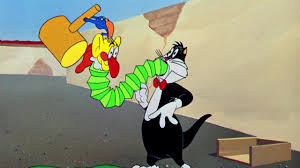
He may be remembered as a cowboy, but Sam had many different occupations in the shorts he appeared in. This was his second appearance even! (Unless, you count “Along came Daffy” but there is no concrete evidence that either of the men in that short were Sam.)

As a pirate, Sam is burying his treasure so that no one will know where it is. (His eyebrows turn pink. It’s that tropic sun, I tell ya.) But as he tosses it in the hole, Bugs tosses it back up. Sam decides to shoot him to keep his secret safe. “Dead rabbits tell no tales.” Bugs corrects him that it’s dead men. Sam figures he has no choice and starts to aim at his head. (Hysterical!) He quickly catches on and gives chase. Bugs hops in Sam’s rowboat and rows so fast, he ends up paddling himself out of the boat and onto Sam’s ship. Seeing this, Sam swims out to the ship, grabs the oars and swims back to the boat to row. (A good gag to be sure, but it makes sense. He might needs that boat later and he’ll want the oars.)

Once aboard, he runs into Captain Bligh from “Mutiny on the Bounty.” (Bugs of course.) He gives Sam several orders and chuckles while Sam does so. He soon wises up and Bugs hides. It would work, but Sam’s parrot keeps obnoxiously pointing out the rabbit’s hiding places. Bugs shuts him up by giving it a (fire)cracker. Taking the birds place, he tells Sam the rabbit is in the cannon. BOOM! Bugs takes the crow’s nest like an elevator and is well out of Sam’s reach. Sam orders him down, and Bugs yells for him to catch him as he tosses an anvil which causes the whole ship to submerge, (save Bugs) until Sam lets go of it.

After some hilarious cannon gags and the brilliant many doors gag, (Bugs enters a door, Sam is about to follow when Bugs emerges from another door and enters a different one and Sam can’t catch up.) We get to undoubtedly the best part of this short. Sam comes over to Bugs who is standing by the stairs to the powder room. (By which I mean where the gunpowder is kept. It’s not a latrine. When you’re a pirate, the ocean is your latrine.) Smiling like a troll, Bugs lights a match and throws it down. Sam reacts how you’d think and runs after it. He manages to get it and berates Bugs for doing that. Bugs responds by doing it again. Sam grabs it once more, but tells Bugs that if he does it again, he’s not chasing after it.

Bugs does it again. This really is one of the best gags is all cartoon-dom. Sam is true to his word and tries to keep busy, but ultimately can’t take it and tries to retrieve the match. Too late. The ship is blown to pieces and Bugs and Sam are blown back to the Island. Sam chases Bugs back to his hole thinking he has him cornered. But Bug’s hole is really a buried cannon. Sam surrenders despite Bugs’s claim that he hasn’t even begun fighting. You don’t want to see him at full power. Our universe couldn’t handle it.

Personal Rating: 4

Swallow the Leader

“I came here for a swallow, and I’m not leaving until I get a swallow.”

Does anyone want to play Jacks after dinner?

Directed by Robert McKimson. Released in 1949.

I never mentioned, but last week’s post is one of my favorite Porky shorts. He was offended when he heard that, seeing as how he’s absent for about 80% of the film. To appease him, I’m sharing another one of my favorite of his films that has only him. Enjoy!

Personal Rating: 4 (unless you’re too immature to handle it. Parental discretion is advised.)

We’re not going to be on speaking terms for awhile. So why don’t I just move on to today’s short?

It’s that time of year again. The time when the swallows come back to Capistrano. (I don’t get why the narrator is so amazed that they find their way back every year. Don’t mention pigeons or salmon to him. He might crack.) Naturally, such a phenomenon attracts many bird lovers who come to see the event. And a bird lover is indeed there. A cat with no name is waiting. (I don’t know why he has that collar on. I guess to have some identity? I’ll solve that by calling him Miles. He looks like a miles.)

The scout swallow comes about making sure everything is ready for his flock to nest in. Miles quickly puts a nest together for him. The bird likes the new nest, but why are there teeth in it? He let’s his friend in first. A Mr. In the box, by name. Miles’ neck becomes elongated. He chases the little bird with a net, but has to stop at the edge of the building. The bird drops a brick in his net for him. How thoughtful. The bird finds a metal swallow and paints it to resemble him. Miles takes the bait and swallows it whole. Now he is at the mercy of the bird’s magnet. (One of those horseshoe kind. Has anyone actually seen one of those? Outside of cartoons I haven’t.) He ends up stuck around a pole thanks to the bird, and the bird puts a lever under him. He ends up turning into a test your strength game. Or rather, test the cat’s skull’s strength game. (Ouch.)

Wings, a superman costume, and a gun don’t work, and trying to bait an electric plate with corn, might’ve worked if the bird hadn’t turned it on first. The swallow finds a tooth free nest and jumps in. Jokes on him; the bottom was fly paper. (Or in his case, anti-fly paper.) Miles prepares to enjoy his snack, but it appears he took too long. The rest of the swallow flock appears and chase him out. Determined to get a swallow, Miles sees a sign advertising them. He rushes over and finally gets something in his belly: alcohol. At least he seems happy.

Personal Rating: 3

Porky’s Poor Fish

“To arms! To arms! The cat!”

Directed by Robert Clampett. Released in 1940.

It starts by telling us this is an adaption of the story “20,000 leaks under the ceiling.” (I’d read that. Couldn’t be as boring as its source material.) We see a mouse happily skipping and whistling down the street. A hungry looking cat is close behind. He’s not really trying to be quiet or sneaky, so I’m not too surprised when the mouse makes a sudden turn and the cat ends up in mud. Stupid cat, mice are snake food.

Elsewhere, we see a pet fish shop run by my good friend Porky. (He owns the place, but it’s under new mis-management? I’ll just take that to mean that the fish are in charge of themselves.) Peeking in the window shows a fish that is somehow resting at the bottom of its bowl with its eyes closed. (Must be a new species. I’ve never seen a 14 karat gold fish.) Inside, Porky and the fish serenade us with a song about why they are good pets. And fish puns abound! There are A.C. and D.C. electric eels, (Which aren’t really eels. I know about fi… oh forget it.) a perch on a perch, a mackerel full of holes, and some soles tapping along to the music. There’s even a chorus line of legs dancing. This is what I’m talking about! Maybe I should buy me some of these sexy fish.

The curtain goes up revealing a disturbing octopus is the owner of all of them. (And I take back my comment. Sexy fish are one thing, but sexy mollusks are out of the question. You’d think I’d learn. This gag was used two years earlier in the short “Porky’s five and ten.”) After the song ends, it’s lunch time. Porky goes on his way and I wish I could join him. (That octopus won’t leave me alone now.) As he leaves, the cat from earlier walks by. He happily enters this all you can eat buffet. He reaches into a tank, causing an oyster that looks more like Cecil Turtle than a bivalve, to hide under it’s bed. (Clever pun.) The cat does get his mitts on a cute little fish who is powerless to resist. If only she was a piranha.

Good thing the eels saw the whole thing, and flash a message to the rest of the store. A turtle mounts a seahorse and warns of the danger, a tuna lays an infant-try, (That’s my joke. The tuna clucking is theirs. Chicken of the sea, you know) and a flying fish takes off like a plane. The cat is scared and backs into another tank that contains a hammerhead shark, who bonks him on the head. (Don’t question why you can buy it, purchase today!) One of the eels shocks the cat, and he flings the fish into the air. The flying fish grabs her. I’m really just guessing it’s a her. It has eyelashes, and since fish don’t usually have those, its probably the only way to tell its gender. At least the tuna laid eggs. …That were already fertilized… That’s not how it works!

The cat falls into a tank where he is punched by a mussel. (Another good joke.) I bet you didn’t know those creatures had Popeye’s arms.  The cat flies out of the shop just as Porky returns. Back in street, the cat is pleased to see that mouse from before. He rears to attack, but the mouse growls at him. The cat regresses into the kitten he was on the inside the whole time. Go back to milk, junior. Fish are big-cat food.

Personal Rating: 3

Dough Ray Me-ow

“Louie is my friend. Yes sir, my best little pal.”

Directed by Arthur Davis. Released in 1948

One of Warner Bros. best one shots! This short stars two pets. The parrot, Louie and the cat, Heathcliff. (Who predates the comic strip Heathcliff by about 25 years. Speaking of, have you ever read it? It’s the most surreal bizarre comic I’ve ever seen. I can’t even tell half the time if there is a joke being told.) Back to the REAL star…

Heathcliff is dumb. He’s so dumb that he actually forgets to breathe! That… is flucking hilarious. No, that’s not a typo. I’m not swearing. Louie helps him out though, despite the fact he is clearly annoyed. (That’s so sweet.) Heathcliff (who actually got make a cameo in “Looney Tunes back in Action“) finds a piece of paper that he wants Louie to read. Turns out, it’s their owner’s will, and when they go, Heathcliff will inherit everything. Once he’s gone, Louie gets the dough. (Makes sense. Parrots tend to live longer than cats.) Louie tells him that instead of reading, he should go on a vacation. The cat returns half a second later due to being homesick. Looks like he’ll have to be permanently removed.

Louie bribes a bulldog to come kill the cat when Louie calls for help. Heathcliff is as strong as he is stupid and saves his chum while holding the dog in one paw. While the cat cracks nuts, (with the nut in his mouth and his head in a giant nutcracker) Louie tries playing a game of “William Tell.” (Which he unhappily seems to be a master at.) He rips a wire out of the wall and invites the cat to play “Radio.” You’ve never played? It’s a wonderful game! All you do is stick two live wires in your ears. Music will then play. (Warning! This only applies to mammals. If you are a bird, then the basic rules of electricity WILL apply to you.) Even putting a can on the cat’s head and having walk into an upcoming train doesn’t kill him. He should have just let Heathcliff do himself in. Besides his breathing problem, he seemed pretty close to crushing his head when he was playing with his nuts. (Don’t try to find an innuendo there by the way; there is none.)

Louie then surprises Heathcliff with a birthday cake. With 3 real candles, and a stick of dynamite. (It’s the thought that counts.) Heathcliff is apparently smart enough to know about numbers as he claims that he is only 3 and hands the explosive back saying it’s unneeded. (So depending on how old Louie is, he probably couldn’t wait another 10-11 years.) Despite Louie claiming he IS four, Heathcliff refuses to accept it and takes the cake and runs. (Why didn’t Louie make all the candles explosive? Your face, that’s why.) After a chase scene, Heathcliff finds his birth certificate that literally says he’s four. He takes the candle back, and wouldn’t you know it, Louie’s scheme works. Heathcliff bids him farewell, as his nine lives fly up to cat heaven.

But Louie just can’t keep his big beak shut, and tells him about the money he can’t take with him. Life number 9 calls the other back, and they all fly back into the body. If Heathcliff can’t take the money with him, then he’s not going. (I didn’t know death was that easy to get out of. I guess every time we sleep, we technically die. We just choose not to permanently die yet. Death is considerate like that.)

Personal Rating: 4

The Aristo-cat

“Good grief, I’m all alone!”

Directed by Charles M. Jones. Released in 1943.

Why am I doing a post a day earlier than I usually do? Well, my dear readers, tomorrow happens to be White Wednesday. The last day where you should remember November. Since come Thanksgiving, people seem to recall that there actually are 11 months. It’s also a great day to be miserable, since society demands you be “merry” and “bright” for the Christmas season. Besides, I’m going to the movies tomorrow, and I can’t promise I’ll have time.

Don’t worry about that title, you are at the right place. I didn’t go all Disney on you. This short came out 27 years earlier. Besides, I think “The Aristocats” is my least favorite Disney film anyway. No way I’d be wasting a blog post on it.

A cat named Pussy (No immature jokes, please. None of them will be clever.) has got it made. He’s the pet of a rich lady and therefore gets a comfy bed, breakfast brought to him in it, and complete control of Meadows the butler. He’s a bit of a dick though. Squirting grapefruit juice into Meadow’s eye and letting him slip on bars of soap. It’s no surprise that Meadows quits. The cat panics as he realizes that as a pet, he has no clue how to fend for himself. (Look at those backgrounds courtesy of a one John McGrew, they are a beautiful abstract masterpiece. Best part of the picture, no question.)

In his panic, he finds a book about cats. (Written by a one F.E. Line.) To his luck, it opens up to the chapter that details the eating habits of the cat. It says that they feed on mice. Sounds easy enough, but never having seen an actual mouse, the cat runs in terror when he finds one. The mouse in question is Hubie, making his debut here. (You could say this cat is Claude, but the appearance is all wrong and his bed says Pussy remember? Although he does have a similar voice.) Hubie calls his friend Bertie, (just called Bert here) and shows him that the cat is no threat to them. The mice (whose colors will switch for later appearances) happily feast on cheese.

They refuse to share with the cat, telling him he should eat mice. He admits he doesn’t know what they look like, and the two point him out to a nice large one named Rover. Pussy tries to make a sandwich out of him, but that goes about as well as you’d expect. (One should never try to eat something alive that can open it’s mouth wider than you.) The cat is thrown back into the house, where he slides into the book again. Conveniently, he finds himself looking at the part of the book that clearly labels the cat’s prey and enemies. With his new knowledge, he chases the mice. They run into Rover’s dog house just as the dog comes home and pounds them. Pussy wakes up back in his bed, as it was just a horrible dream. Rover agrees. (Keep your gay jokes to yourself please. They’re not funny.)

Personal Rating: 4 Those backgrounds are an abstract masterpiece, and are worth a point on their own.