Tweet and Sour

“You did sthee a pussthycat!”

Directed by Friz Freleng; Story by Warren Foster; Animation by Virgil Ross, Art Davis, and Gerry Chiniquy; Layouts by Hawley Pratt; Backgrounds by Irv Wyner; Voice Characterization by Mel Blanc (June Foray); Music by Milt Franklyn. A Looney Tune released on March 24, 1956.

Granny is heading out for the time being, but she assures Tweety that he will be safe as she is locking the door. But she makes the foolish mistake of sticking the key under the welcome mat, the very place cats like Sylvester tend to hide. As she drives away she waves what could potentially be her final goodbye to her bird, but she snaps out of it and gets the canary out of the cat’s mouth.

Time for a threat. Either Tweety is unharmed by the time she gets back from… wherever it is she is going, or Sylvester is sold to a violin string factory. (That isn’t what catgut is, lady! Leave the feline alone!) Her threat flies straight through those ears, as he is all set to try again once she’s gone. Only after Tweety reminds him of the very real threat does he reluctantly decide to behave himself. But Sylvester isn’t the only cat in town…

Hey! I recognize that orange cat! It’s the one-eyed fellow from “Puddy Tat Twouble“! I’ve heard people say this guy is Sam, but since he doesn’t talk and can’t tell them they are mistaken, his name is Lee. And he helps himself to the bird, despite Sylvester telling him that his life is on the line. Why should Lee care about something that doesn’t affect him? That’s the American lifestyle! Sylvester does his best to get Tweety away from this interloper, and vice versa.

Tweety, in turn is trying to keep away from the both of them. He hides under a hen that lives in a hen house. (Naturally.) The hen is a little spooked when she feels something slip under her, but she seems to get over it quickly as when Sylvester makes a grab, she has a huge smile. (Ew.) Once she sees the claws that were groping her, she runs to tell the resident rooster, Not Foghorn the leghorn. He prepares to wallop the intruder, when Lee comes back and chases Sylvester off. His paw ends up flat as a pancake.

Sylvester gets Tweety back in the house, who comments on how kind the putty-tat is. Sylvester isn’t pleased to hear his reputation referred to in such a kindly manner and points out this is all to keep his body alive. (Don’t you have nine lives, son?) Not like Granny is going to forget this threat after this one time. Lee is planning to come down via chimney, so Sylvester sends up some dynamite via balloon. Lee lets it pass, and slips back down. It’s at that moment that the balloon realizes it has no helium and it drifts back down. Lee flees.

Sylvester notices Granny has returned from… wherever it is she was, and rushes Tweety back to the cage. She comes in just at that moment where the cage door is still open and his paw is still touching the bird. Knowing she wouldn’t believe him anyway, (I’m not even sure the two can communicate) he falls into a violin box on his own. Umm… Tweety? This is where you speak up and defend your hero… Tweety?

Favorite Part: When Granny waves to Tweety in Sylvester’s grasp, Sylvester waves back. It’s funnily cute. Like a pig with a pail on his head, or an elephant taking someone’s lunch.

Personal Rating: 3

Circus Today

“It’s different from anything you’ve seen before, folks!”

After this, he’s gonna lie on him!

Supervision by Fred Avery; Story by Jack Miller; Animation by Sid Sutherland; Musical Direction by Carl Stalling. A Merrie Melody released on June 22, 1940.

I’ve had a pretty tiring week. I need a short to blog about that won’t require much effort on my part. (It usually takes SO much out of me.) Let’s see… “Joe Glow the Firefly?” Nah. “Freddy the Freshman?” Nope. “Corn on the Cop?” Mmmmm… What do you mean the title of this post means I’ve already made my selection? What if I’ve changed my mind?

Time for some more of those Avery spot gags his unit did so well. Just… not here. I’m sorry, but this might just be the weakest one of these cartoons he directed. (At W.B. at least.) Weak jokes, references common folk won’t get, and a setting that tends to make people uncomfortable these days.

Welcome to Jingling Bros. circus! Where you’re sure to have a good time, even if our performers don’t. Why not remember your trip with a genuine helium balloon? Not only are they powerful enough to lift a man into the air, but they change color constantly! What do we put in these things! (We won’t tell. It might talk you out of a purchase.)

We’ve got plenty of sideshow acts as well. Gamer the glutton will eat anything you put in front of him; so what if it makes him all jangly inside? Hot Foot Hogan can walk across burning coals. Sure it causes him great pain, but he can do it! (Pay no attention to his disappearing act.) And Captain Clampett can be launched from a cannon, go on a round-world trip, and have the postage to prove it! (Any relation to A.C. Gamer, Rich Hogan and Bob Clampett will be lost on the casual viewer.)

What kind of circus would be complete without exotic animals being housed in cramped, unsanitary cages? There’s a repeat of the person feeding the animal when they really shouldn’t joke that was seen previously in both “A Day at the Zoo”, and “Cross Country Detours”. At least the punchline differs slightly with the monkey being a narc. There’s also a large gorilla being referred to as an assassin of the jungle, terrifying brute, and all around vicious beast. It might have been a punchline to see it be so gentle back then, but nowadays it’s like “no crap.”

Inside the tent is where the REAL action is. The Flying Cadenzas are quite the amazing acrobats. Flying really is the perfect word to describe them. “Successful” and “Full set” are not. Then there’s Dixie Dare. A rather hot honey who attempts to grab a handkerchief off the ground with her teeth whilst horse riding. Maybe on the return trip, she can attempt to grab her teeth. Another performer, Madame Trixie, prefers to dance with her horse. He leads. (Is she supposed to look like Freddie Bartholomew?)

Elephants. A majestic animal that has been forced into this humiliating line of work ever since circuses took off. The trick is have a trainer who acts like one of their own. Hence, Ignatz Ignatzavich as part of their parade, a tail in his mouth. Still, the creatures have large developed brains, and just can’t bring to complete a trick that requires them to put all their bulk on his fragile, soft head. Instead, watch our performer who will do one of those death dives from an ungodly height, to a bucket of water. And I do mean “death”, quite literally. You’ve haven’t truly experienced our circus until you’ve heard our band play “Taps”.

Favorite Part: Lion tamer Clyde Binder (who you’re probably not recognizing as a nod to studio executive Henry Binder) has just put his head in a lion’s mouth and lived to show it. Seeing how much applause this gets, has the lion putting his head into the human’s mouth. (His envy is cute.)

Personal Rating: 2. I could see people laughing and enjoying this. But if you’re no stranger to Avery’s works, I can’t imagine you’ll think this is anywhere near his best.

Rabbitson Crusoe

“♫ Once I had a secret love… ♫”

Directed by Friz Freleng; Story by Warren Foster; Animation by Gerry Chiniquy, Virgil Ross, and Art Davis; Layouts by Hawley Pratt; Backgrounds by Irv Wyner; Voice Characterization by Mel Blanc; Music by Milt Franklyn. A Looney Tune released on April 28, 1956.

20 years is a long time to survive on your own, but that is exactly what Robinson CaruSam has had to do the past couple decades. He’s been shipwrecked on a tiny couple of islands. The largest portion of which, is where he sleeps, cooks, and keeps a lookout for rescue. The smaller one is where his food source comes from: a lone coconut tree. This is where things get difficult, for patrolling the waters is a hungry shark that lacks pectoral fins going by the name of Dopey Dick. (Which sounds like a villain you’d see in an ad for E.D.)

Maybe his disability has forced the fish to hunt easier prey, maybe a certain crocodile got him hooked on the taste of man flesh. Whatever the reason, the shark has been trying to get his jaws on Sam everyday for twenty years. He gets his chance whenever the man needs to get food off the tree, or grab some supplies from his wrecked ship, seeing as how the only way to get to them is via some small stones. For the past twenty years, Sam has been able to keep alive by making it to land, grabbing a mallet or bat, and beating Dick back into the sea.

Now, Sam has been on an all coconut diet for the past ten years. (Just kidding. It’s been twenty still.) He’s become quite the expert at preparing the fruit a myriad of different ways. But the problem with coconuts is no matter how you prepare them, they still end up tasting like coconut. (That and the milk changes color once it’s in the glass.) I’m impressed Sam was able to last twenty years before cracking. Enter Bugs, also playing a castaway. He’s a meaty prize well worth the trouble, so Sam calls for the rabbit to come over to his island.

Bugs finds himself in a pot, and does he like it? No, he does not. He pours water on the fire, which means Sam is going to have to get to the wrecked ship to get another match. This means another round of Dick dodging. Sam is able to distract him with a bone, get his match, and return to his pot. Where Dick was waiting for him. (Why Sam hasn’t just tried eating the shark by this point…) Bugs has hidden himself on the ship, and Sam attempts at getting there are thwarted by the Dick of the deep. (Why Sam isn’t using his weapons…)

Sam does get Bugs back in the pot once more, but the rabbit spies a tidal wave. Even if Sam did believe him, it wouldn’t make any difference: the entire island is now underwater. Luckily for Bugs, the pot floats. And luckily for Sam, Bugs is willing to save him from death by Dick. Seeing as how Sam isn’t really in a position for negotiating, he agrees to Bugs’s terms. Namely, rowing the two of them to San Francisco.

Favorite Part: Sam saying that dinner will be ready in a few minutes, barring accidents. That’s when Bugs puts out the fire. But watch Sam’s face. As soon as he hears Bugs take something out of the soup, he is horrified. The rabbit wouldn’t…

Personal Rating: 3. It could have been longer, and I’m kinda bummed we didn’t get a short of a shipwrecked sailor and a starving shark. Both wanting the other, but staying safe as long as they don’t leave the land/sea.

Birds of a Father

“I feel like an assassin.”

https://www.dailymotion.com/video/x84z5vf

Directed by Robert McKimson; Story by Dave Detiege; Animation by Warren Batchelder, George Grandpre, and Ted Bonnicksen; Layouts by Robert Gribbroek; Backgrounds by William Butler; Film Editor: Treg Brown; Voice Characterization by Mel Blanc; Musical Direction by Milt Franklyn. A Looney Tune released on April 1, 1961.

Sylvester can relax in a hammock with pride. His son is the kind of kit that most fathers can only dream about: the kind who is a natural at bird chasing. But wait! The bird is chasing Junior? That’s not how it should be. Could Junior really be afraid of his natural prey? No, worse. He’s friends with the bird! The shame of it all! Time to teach the kid about proper behavior.

Junior is kind of aghast to learn that he is to chase, catch and eat a bird in that order. Spike (for that is the bird’s name) suggests a plan though: a mock fight that will take place in a shed away from Sylvester’s judging eyes. (All said in tweet-ese. Where’d Junior learn to speak that?) It starts out perfect, but the two are really putting their all into their roles, and Sylvester is a bit concerned with how violent his kid is behaving. Especially if the cleaver in the door is any indication.

Sylvester comes in (The cleaver and Spike both disappear. At least we see the bird leave.) and tells his son that there is a much more humane, much more sporting way to hunt birds: searing hot lead that can reach speeds of 2000 feet per second. Guns. What a wonderful invention. Sylvester is quite the marks-cat as well; gets a birdie on his first shot! I’m impressed, but the badminton player isn’t as much. (Probably because he had to pay for it.)

Round 2. (Is it me, or is Sylvester’s tail unnaturally long in this picture? I can already tell its missing the white tip.) The next bird is most definitely a bird. It may have even been alive once. But as of now, it’s a hat ornament and the owner of said hat doesn’t take too kindly to a cat with a gun. (Me personally, I’d let a cat wielding a gun do whatever he pleases. It’s a good survival tactic.) So, maybe technology is the answer. Sylvester builds a cute little plane that will shoot at any target you instruct it to. What happens when you set it to bird? Do you know?

Did you say it goes after birds? You did? Good job! Spike is plenty maneuverable though, and is able to stay alive. But the plane is tenacious and doesn’t give up after one failure, and Spike flees, right towards Sylvester. He runs with the other two right behind him. Spike is able to dodge it once again, but Sylvester gets stuck with it in an explosives shed. After the blast, Junior scatters some feathers around to make his father feel good about himself. Then heads off to play with his new friend: Spike in cat disguise. (So sad that his father is species-ist.)

Favorite Part: After Junior learns of how nature intended for  cats and birds to get along, (With the hairs on his head disappearing very briefly, I swear!) He sadly asks his dad if they are cannibals. Sylvester says yes.

Personal Rating: 3

The Leghorn Blows at Midnight

“Ask a silly question; get a silly answer.”

https://www.dailymotion.com/video/x7xmnr2

Directed by Robert McKimson; Story by Warren Foster; Animation by Charles McKimson, Phil DeLara, Rod Scribner, J.C. Melendez, and Emery Hawkins; Layouts by Cornett Wood; Backgrounds by Richard H. Thomas; Voice Characterization by Mel Blanc; Musical Direction by Carl W. Stalling. A Looney Tune released on May 6, 1950.

Foghorn is enjoying a game of solitaire, I think. (I’m not an expert on card games. You can only expect so much of me.) He’s also cheating. Which the universe can’t handle as once he puts down the 3 of diamonds, the seven of spades disappears. And then that 3 vanishes when he puts down the ace of hearts. (Cheaters never win because they literally can’t!) Alas, the rooster should have found a better place to sit as he is well within B.D.’s leash length and is cymbal’d. (After the hound misses at first. Love the smile he wears when he succeeds the second time.)

This doesn’t set Foghorn back for long, as he swipes a pie from the windowsill and smushes it into the dog’s face. Then he plays barber, shaving the pie off and giving the dog a hot towel. (Love the expression of fear he wears when he sees it coming. This dog makes great faces.) The small stuff is not quite good enough, and Dawg sharpens up an axe. (Drama-queen.) Henery shows up and just decides the dog is a chicken. (Huh. Usually he has to be misinformed.) The dog points him toward Foggy. That’s his chicken.

In turn, Foghorn gives a sob story about how afraid he is of going into a dark oven. (Henery [with genuine concern]: “Would you rather be fried on top of the stove?”) Foghorn tells him that chickens ain’t worth a 99-cent value meal. (I’m paraphrasing of course. Those weren’t around at the time.) Now pheasant, that’s a tasty dish. Foghorn is even willing to give the kid a lift to pheasant territory. (They’re cute when they sing together.) Wouldn’t you know it, Henery had been talking to a pheasant earlier and didn’t even know it!

Foggy give the hawk some glass so he can enjoy the pheasant under it. (I want to say that the handle of which changes color, but since it was already transparent, maybe it’s the background behind it changing color?) Henery gets the “pheasant” under the glass, but has to run from the angry “bird.” The leash keeps it away, and Foghorn uses the opportunity to do like he did in “Walky Talky Hawky,” and use the dog’s stasis as an excuse to hurt him in comical ways.

Eventually, Henery calls B.D. a pheasant right to his face. Rather than correct him, he reminds the small bird that he is a CHICKENhawk. You think ANTeater’s ever vary their diet? Stick with what humans named you. Getting the hawk to untie him, B.D. fakes the sounds he usually makes when he is strangled and Foghorn is summoned. The two engage in good old fashioned fisticuffs, while Henery cheers them both on. The winner gets to see tomorrow. The loser joins Henery for dinner. (He still thinks that dog is a pheasant.)

Favorite Part: During Foghorn’s weeping, he tells Henery to feel how gristly his wing is. That’s not an empty request. As the camera zooms in for what is sure to be a heartfelt backstory, the chicken DEMANDS the child feel it. (I didn’t make that sound weird, did I?)

Personal Rating: 3 teetering on four. It’d make a fine introduction to Foghorn’s cartoons.

The Dixie Fryer

“I’m a rooster, not a roaster.”

Directed by Robert McKimson; Story by Tedd Pierce; Animation by Ted Bonnicksen, Warren Batchelder, Tom Ray, and George Granpre; Layouts by Robert Givens; Backgrounds by William Butler; Film Editor: Treg Brown; Voice Characterization by Mel Blanc; Musical Direction by Milt Franklyn. A Merrie Melody released on September 24, 1960.

Cold is bad. Cold equals death. Foghorn is the wisest chicken this side of Aardman, so he knew enough to get south once the weather turned on him. Since he can’t fly as well as a duck, he uses one to pull his balloon basket. Taking note of the magnolia scent in the air, he figures this must be his stop and he leaps out via the Mary Poppins approach. He came well packed with all one needs for a vacation: a comfy chair, and a table to hold a drink. (The mint julep is a cute touch.)

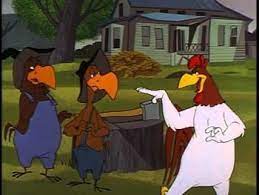
But predators are a worldly thing, and there is a couple in that tree just yonder. If you’ve watched every Looney Tune and Merrie Melody in chronological order, then you’d recognize these guys. If not, I’ll introduce you. They are Pappy and his son, Elvis, two raptors of indeterminate species. I call them that because they were turkey vultures in their first picture, but have shrunk down to chicken hawks for this, their final appearance.

They’ve been subsisting on black-eyed peas for some time now, and Elvis is really craving a chicken. The lack of them is all that is keeping his wildest desires from coming true. They take note of Foghorn and are ready to have themselves a good old fashioned BBQ. Foghorn isn’t too pleased to wake up to someone plucking his feathers off, but he finds even more to complain about once he finds out what is on the menu for dinner. (I hate hearing people complain on their vacations.)

With their dinner on the run, Pappy chases him down telling Elvis to shoot him with the gun they have. Elvis has been trained to fire when ‘fire’ is said, and unfortunately for his father, Foghorn knows this. This calls for dueling pistols. Foggy almost immediately gets the guns into the wings of the two, and tries getting them to duel. But what makes these guys fairly amusing is that they are fairly intelligent, and they both shoot their prey.

Foggy tries to get rid of them by claiming there is a tornado on the way, and nailing them in the storm cellar. Then the actual tornado hits him. Foghorn decides to take shelter in an explosives shed. The other two follow him and Foggy leaves them in there with a light. The resulting explosion sends the raptors back to their nest. They decide that the peas will make an adequate dinner after all.

Favorite Part: When in the shed, Elvis asks his father what T.N.T. spells. A very unique way to discover and announce your doom. I hope I can go in a similar way.

Personal Rating: I want to give it a four. There are some good jokes that even manage to subvert your expectations at times. But I don’t know, are the adversaries racial stereotypes? Let me clarify: offensive racial stereotypes? I enjoyed them and didn’t think they were hurtful, but I’m naive and scared of someone accusing me of being insensitive. It’s gotta stay a 3.

Captain Hareblower

“I’m taking over your ship!”

Directed by I. Freleng; Story by Warren Foster; Animation by Manuel Perez, Ken Champin, Virgil Ross, and Art Davis; Layouts by Hawley Pratt; Backgrounds by Irv Wyner; Voice Characterizations by Mel Blanc; Musical Direction by Carl W. Stalling. A Merrie Melody released on February 16, 1954.

The final of the three shorts featuring Yosemite Sam as a pirate. The first one was spectacular. The second one was very funny. This one manages to squeak by with a sea average. I apologize on its behalf.

Pirate Sam, (that’s really what he’s going by today) has his sights set on a ship just begging to be plundered. He’s got quite the reputation it seems, as just announcing his arrival is enough to send everybody on board overboard. Save for Bugs who was hanging out in a crate of carrots. Since he doesn’t know the meaning of this “surrender” word, he can’t very well do it, and decides to fight.

Sam gets cannoned to the face no matter how sneaky, slowly and slyly he sails. And Bugs isn’t above sneaking over to the opposing ship to get an extra shot on his assailant. While he’s loading the cannon, no less. Sam tries this trick out himself, but Murphy’s law is on the rabbits side, so it still doesn’t work. Even sending a keg of TNT with a sail fails, as Bugs has an electric fan to blow it right back.

Sam finally decides to just board the other ship and take it over, but Bugs has already vacated to the crows nest. Sam fails to chop him down, so he chooses his only other option and climbs up. Bugs dives into the water. Sam dives into a rock. Then its time to reuse the best gag from “Buccaneer Bunny.” The one where Bugs tosses matches into the powder room. It’s obviously not as funny here. Not just because we’ve seen it, but Bugs and Sam are on opposite ships. Part of what made the original work so well was Bugs acting like a total smug badass, totally confident that any misfortunes will only befall on Sam.

The new wrinkle they did add is Sam coming over to Bugs’s ship to do the same to his powder room. Bugs doesn’t react at all, causing Sam to flee for the horizon. (I do like how fast he left. That’s a great shot.) Bugs shows us that his powder room only contains the talcum variety, and that variety doesn’t explode. The following explosion makes me me doubt his validity.

Favorite Part: Sam trying to deliver a bomb underwater. (His eyebrows change color as he suits up.) Not only does the fuse stay lit with no explanation, but Sam is swallowed by a dolphacuda and when the explosion happens, all that is left is a skeleton. But the eyes are still in their sockets. (That’s disturbingly hilariously creepy.)

Really Scent

“Spring means nothing to you.”

Directed by Abe Levitow; Story by Michael Maltese; Animation by Ken Harris, Richard Thompson, and Ben Washam; Layouts by Samuel Armstrong; Backgrounds by Philip DeGuard; Film Editor: Treg Brown; Voice Characterization by Mel Blanc; Orchestrations by Milt Franklyn. A Merrie Melody released on June 27, 1959.

Isn’t romance great? I’m really asking seeing as how I’ve never experienced it. But I’m not worried. After all, I’m only 27, so accounting for age and my poor diet, I’ve got about a year and a half left. I mean, Pepe wasn’t one to give up. After 14 years, could his luck finally be on the up and up?

Apart from his Oscar winner, I’d say this is my favorite Pepe short. But I’m getting ahead of myself. Taking place in New Orleans with June Foray as our narrator, we see one Pierre Cat. He and his wife, Fifi, have just welcomed their two daughters to the world. We have Jeanette and Fabrette. (Though nowadays we know her as Penelope.) They’re both perfect in their parents’ eyes; save for one feature. Through the magic of genetics and Murphy’s law, Fabrette is born with a stripe of white fur down her back. Making her look an awful lot like a skunk.

Oh, her parents still love her. The problems arrive once the girls are old enough to start attracting mates. Jeanette has no problem. Fabrette on the other hand sends the males packing once they see what she’s packing. (At least they look at her. She’s doing better than me.) The poor cat mopes, but maybe luck is going to cut her a solid today. For a boat has just docked, and it was carrying none other than Pepe Le Pew. (He’d be every mammal’s dream man if only…)

The two are instantly smitten. (Which probably means Fabrette thinks Pepe is a striped cat.) They embrace, but it’s not long before Fabrette learns exactly why Pepe doesn’t already have scads of women fawning over him. She flees with the skunk following. It takes the envy of her sister’s romance, and the frightening prospect of what others would think of her should she die single, that gets her to try once more. They have a saying in Louisiana: “A true lady does not need to breathe.” Inhaling as much as she can, Fabrette returns to her man.

Pepe is glad to see her again and the two stroll. She lasts about forty full seconds before her lungs can’t take it any more, and she exhales all over the place. (It only sounds gross. I bet you just did it too. Hypocrite.) Even perfume can’t combat Pepe’s aroma, so the cat calls it quits. Pepe, meanwhile, finally decides to learn exactly what ‘pew’ means and why everyone says it when he is nearby. What he learns shocks, saddens, and embarrasses him. But I know Pepe. He’s a swell guy. (Despite what some idiots say.) He’s willing to make an effort  to make a happy relationship. He knows just how to do it too.

He heads for some deodorizing. That’s got to be an embarrassing surgery to reques- oh. He’s just going to expose himself to chloroform. So actually, maybe he isn’t willing to win back his lady? If that’s true, then things will be very awkward in the afterlife soon, as Fabrette is planning on drowning herself. The narrator talks her out of it, telling her that the much smarter solution is to make herself more like her partner. So, she exposes herself to Limburger cheese. (Because… if she stinks herself, she’ll be immune to all odors?)

When all is said and done, it is now the skunk that flees from the cat. I’m sure they’ll work things out.

Favorite Part: Their first hug. It was cute! And if you’re like me, (a hopeless romantic) you’ve been waiting for these two crazy kids to realize they are meant for each other.

Personal Rating: 4. A wonderful change-up to a very formulaic series. Before you tell me how bad it is with how fast the two are progressing. One: they’re animals. Two: they’re toons. Three: the story only had six minutes.

The High and the Flighty

“Ace, ah-say, Ace novelty Company?”

Directed by Robert McKimson; Story by Tedd Pierce; Animation by Ted Bonnicksen, Russ Dyson, and Keith Darling; Layouts by Robert Gribbroek; Backgrounds by Richard H. Thomas; Film Editor: Treg Brown; Voice Characterization by Mel Blanc; Music by Carl Stalling. A Looney Tune released on February 18, 1956.

Foggy’s really going to get that dog today! See, he’s made sure to clearly mark the limits of the dog’s rope, so he can stay out the jaw’s range, but still mess with him. Smacking him with a fence post is just part one. The rest relies on Foghorn’s beach ball. All the while, this fracas is being noticed by Daffy of all characters. He witnesses the rooster stick the ball in the dog’s mouth and popping it, and the dog retaliating with a watermelon to the beak.

All of this is very interesting to the duck. He’s once again in the game of novelty selling, and that chicken looks like he could make good use of his wares. Daffy introduces himself, and offers up a spring-loaded bone for $2.98. Foghorn naturally has the money. Being a rooster pays well. (No benefits, though.) He walks right up to the Barnyard Dawg and offers a bone as a sign of peace. No sooner does the canine put it in his mouth, does Foghorn undo the latch and put some spring in the dog’s step. (I hope Daffy’s clientele are all toons. That looks like it’d be horribly painful to a live-action dog.)

You know, that dog could probably make good use of Daffy’s ware as well. And Daffy isn’t afraid to play both sides in order to make a profit. The dog’s gag is an ear of corn that he deliver to Foghorn as a package. So excited to eat is he, that Foggy doesn’t take note that the cob is connected to some electric wires. All right, why don’t we call it a tie? -And Daffy is once more coercing Foghorn into purchasing another prank. A fake train that he’ll charge B.D.’s house with. The hound dodges, and Foghorn runs onto an actual track. Complete with actual train.

Daffy decides to offer up the big guns. He calls it the “Pipe Full O’ Fun Kit No. 7.” (Complete with instructions, even.) Daffy makes even more money, and Foghorn sets up what is sure to be the ultimate prank. (Bet you thought it involved “Invisible Spray.” Ignoramus.) Just as he’s putting the finishing touches together, Foghorn spies his adversary setting up the exact same prank, from the exact same company. The two put two together and realize they’ve both been played. Time for a real truce.

They purposely make loud threats to the duck, knowing full well he can hear them. Daffy probably would like to make more money off them, but he decides to cut his losses and leave while he still has his spine intact. He doesn’t notice he is walking right into the firing space of “Pipe Full O’ Fun Kit No. 7.”, (Complete with instructions, even.) until he gets the brunt of it. The gag is revealed to be nothing more than rubber band launching a poor schmuck through a pipe, and into a bottle. Despite the simplicity, the customers seem quite content with their purchase.

Favorite Part: It’s not much, but I really like that Foghorn didn’t need to be told he was getting ripped off. Let’s be honest, he’s kind of a meathead. (White meathead, that is.) Yet, he was the first one to figure out what was going on. Proving that he DOES have a brain. Peanut sized, though it is.

Personal Rating: I give it a 2. Daffy doesn’t really add anything that couldn’t be filled with some generic salesman character. But for the common folk, 3.

Bosko at the Zoo

“GET IN THERE!”

Animation by Isadore Freleng and Larry Martin. A Looney Tune released on January 9, 1932.

As someone who has loved animals from the moment he exited the womb, I’ve also always been a fan of zoos. Granted, as an adult I now know that not every one of them is on the up and up, but I still think they get a bad rap. Many of them are really trying these days, people! What I’m trying to say is, I’m envious that Bosko would rather take his girlfriend on a zoological outing rather than me. (Even if that does mean I’d have to ride on his handlebars.)

For the time being, it looks rather nice. The habitats are spacious enough, and it looks sanitary. Bosko’s nose even turns white. (That means it’s a good’un.) Honey’s a wee bit scared of the lion, (Wimp.) but she is fairly interested in the aquarium section. (Oh!… um… I… I’ll just wait for you over by the exit. I’m sorry I intruded on your alone time!) The fish inside the tank have lots of fun, playing leap-frogfish, and using an octopus as a maypole, but the sad reality is that they are just the fodder for the larger fish in the tank. (Nice touch making Bosko and Honey all wiggly. Really adds to the illusion of bent light.)

By this point, an ostrich gets a hold of Bosko’s hat. Since there isn’t any employees around, Bosko is free to chase the bird into the enclosure. He actually manages to keep pace with the bird, and grabs it. In turn, his hat is swallowed. Bosko ain’t having none of that, and forces the bird to lay an egg. Even though the black coloring suggests this ostrich is male, it manages to get an egg out, and Bosko’s hat is within.

The ostrich is upset, and probably humiliated by this, so Bosko plays a pipe to cheer it up. (Honey is just gone by this point. Either walked home, or was thrown to the bears.) This really gets the place jumping. The beavers beat their tails and the kangaroos in the same habitat, dance. (Is Bosko just in a zoo? Oh, yeah. He really is this time.) Some monkey’s scratch themselves to the beat, but they get serious when one of them really needs his friends help to remove his itch.

The friend pulls out whatever it was, and puts it on a plate. But he only pretends to eat it. So when the other monkey tries to help himself, he gets a fork in his hand. This really pisses Bosko off for some reason, and he marches into their enclosure to spank the monkey. (I still mean that literally after four years! Sheesh.) Just like the last time he did that, he angers a gorilla who shares the space. He ain’t happy and chases Bosko through the suddenly much larger area. (Watch the teleporting monkey!)

Even though I could have sworn this was on level ground, Bosko has to jump out of the enclosure, (Which just has an exit. That’s dangerous on so many levels, including ground and where we are now.) and he lands on a lion. No clue if this is the one from earlier, but it gives chase. Bosko runs along with the ostrich and walrus also in the habitat. (More fodder. On another note, that pinniped is keeping remarkable pace with the bird.) They have no choice but to stop at a wall. As zoo animals, they have no proof that anything even exists beyond it!

Bosko leaps atop the wall, and the lion crashes into the other two. In turn, the three animals are combined into some kind of horrifying chimaera that must live whatever short life it has left in bitter agony. And Bosko is quite cheery if his smile is any indication.

Favorite Part: The whole cartoon went by, and not once did they make the stupid joke about ostriches burying their heads in fright! It’s an animated miracle!

Personal Rating: 2