A Mouse Divided

“Let’s face it; I can’t fly any feather.”

Directed by I. Freleng; Story by Warren Foster; Animation by Art Davis, Manuel Perez, Ken Champin, and Virgil Ross; Layouts by Hawley Pratt; Backgrounds by Irv Wyner; Voice Characterization by Mel Blanc; Musical Direction by Carl W. Stalling. A Merrie Melody released on January 31, 1953.

We’ve seen a cat delivered to mice parents before, what if the situations were reversed? All thanks to Stupor Stork, making his first appearance, and not only being inebriated BEFORE any deliveries, but also sounding a bit more helium-ish. As fate is funny, he gives up at the house of Sylvester and his Mrs. She’s just been complaining to him about their lack of offspring. Something that she must have brought up before, seeing as how Sylvester mockingly imitates her as she weeps.

Stupor leaves them with the bundle, and even if Sylvester wasn’t too keen on the idea of having children, he’s still as excited as his wife to hear the news. (I like that.) To their shock, their son is a mouse. (To my shock, there was lot more bundle than what is needed for a mouse pup. But then, how else could anyone be fooled into thinking a kitten is in there?) Mrs. S. is a bit taken aback, but one “Mama” is enough to get her maternal instincts going. Her husband is more on the “He’s so cute, I could eat him up” train of thought. She won’t have it.

Foolishly enough, she even trusts her man with watching the kid while she goes out. As soon as the door shuts, Sylvester gives the baby a pepper powdering, a lettuce diaper, and two slices of bread to rest between. (I guess the safety pin is akin to a toothpick.) Before one bite happens, the infant identifies the predator as “daddy” and that’s all it takes. Sylvester is more taken with the child then I’ve ever seen him with his biological kid. It’s still sweet.

Well, it looks like father and son are going to get along swimmingly. The two decide to take a stroll around the block, and are almost immediately chased home by throngs of other cats. Seeing as how they are a species that is concerned about nobody’s happiness but their own, they have no problem trying to kill a child in front of its parent. They try anyway they can to get in. Disguised as a salesman, claiming to be a babysitter, even trying to break down the door. (You’d think these drama queens have never eaten before.)

Unlike most of his movie career, Sylvester succeeds in driving them all off. (I mean, if he didn’t, then Friz would have infant blood on his resume. I’m not even sure Parker and Stone can make such a claim. And I’m not looking it up.) But even though I’d say the family is happy together and can overcome these obstacles, the higher ups really got on Stupor’s case and he’s back to retrieve the kid. Rather than, pfft, I don’t know, knocking at the door to explain the mistake, he opts to use a baited fishing line.

Considering the kind of day he’s been having, it’s not strange that Sylvester thinks its just another cat trick. He pulls the line himself, and Stupor proves his strength by reeling him in. (As a stork, I’m sure he’s delivered his fair share of whale calves.) Still not clear in the head, he mistakes Sylvester for the mouse, and delivers him to the mouse parents. That’s going to be embarrassing to explain.

Favorite Part: When his wife says that the kid is theirs, Sylvester takes that as an excuse to share the meal. Even going so far as to hold a cleaver above the child.

Personal Rating: 4. It’s adorable. True the ending is a bit mean, but I choose to think that afterwards, the two cats got to keep the kid, and he learned to fight off all his would be predators.

The Hasty Hare

“That wasn’t at all nice!”

Directed by Charles M. Jones; Story by Michael Maltese; Animation by Ken Harris, Lloyd Vaughan, and Ben Washam; Layouts by Robert Gribbroek; Backgrounds by Philip DeGuard; Voice Characterization by Mel Blanc; Musical Direction by Carl W. Stalling. A Looney Tune released on June 7, 1952.

If they’re not coming to invade us, then people from other planets typically drop by just to examine the local life. That usually requires abduction, but it’s such an ugly word. They prefer “relocating.” Marvin is on one of these such missions, but he is only required to bring back a single specimen. (Don’t want to alter either habitat too much.) Interestingly, seeing as Marvin hasn’t received his official name yet, he’s known as “Flying Saucer X-2.” Not the best name there is. (Even if “X” is the coolest letter in the English alphabet.)

But you know, it pairs well with the assistance he has brought along, K-9. Maybe I should give myself a martian name that’s composed of a letter and digit. Let’s see… G-6? Nah, I’m not too religious. W-7? Sounds too British. F-0? Actually, that sounds a bit race-ist. Actually, this is harder than it looks. Maybe I should stop wasting your time with pointless crap. (But I get so much enjoyment at seeing your face furrow.)

Marvin just decides to take the creature that made the first tracks he sees and those tracks were made by Bugs. When Bugs catches sight of the two visitors, he instantly assumes that the two are nothing more than kids looking for Halloween goodies. He gives them bags of candy, (Hey! No fair! I never got such a haul as a kid!) and figures he’ll see no more of them. Marvin proves his power by using his disintegrating pistol to remove most of Bugs’ house. The rabbit finally catches on.

Marvin tells the bunny that all three of them will be returning to Mars, and Bugs demands to know what the martian will do if he refuses to comply. I love this: Marvin doesn’t get angry, I mean, he really is just doing his job, and he might as well convince the beast to come along as non-violently as possible. He merely disintegrates a boulder. Bugs is convinced and is the first one aboard. But he’s always thinking a step ahead, and immediately disembarks to play conductor and ushers his adversaries aboard without him. They make it halfway back home before realizing their error.

When they return to Earth, Bugs explains that the reason he doesn’t want to go is because he’d hate to get involved with mutiny. Another great moment here, with the suspicion and doubt being seeded. Marvin takes no chances, and gives K-9 a good shot. (Strangely enough, this was the last time the dog would appear. He doesn’t even get any lines in this one.) They finally manage to get Bugs by firing a strait-jacket ejecting bazooka at him, which wraps him up snug. Success!

As Marvin pilots his craft, K-9 is left to guard the prisoner. He’d better not try any funny stuff! Oh, nothing of the sort, it’s just that the jacket Bugs has on, it’s really not his size. Too much arm room. Surely the dog could get him a different one? Seems like a reasonable request. He complies, and Bugs slips it on, but ultimately decides it would suit K-9 much more. And just like that Bugs, has captured the capture-er. He manages to do the same to Marvin, by claiming they hit an iceberg, and the jacket is a life preserver.

Now in control, Bugs decides to fly back to Earth. Too bad he doesn’t know how to pilot one of these crafts. Worse yet, the anchor he threw over board has caught on to a crescent moon, which is catching planets, which are grabbing stars and dragging them all along. (And just making up their own laws about gravity. Newton would not be pleased.) As it so happens, an astronomer sits down at the observatory to marvel at the vastness of space. (Something I don’t like doing. I already know I don’t matter in the grand scheme of things. I don’t need the universe to rub it in.)

The short, red-haired, Friz Frelengesque man (who actually IS named I. Frisby.) takes one look at that mess of a galaxy and announces his retirement. He’s going to take up turkey farming. (A noble profession if I ever heard one!) And that is what led to the first Thanksgiving, and why I say a prayer of thanks to Mr. Freleng every night.

Favorite Part: When Bugs suggests the idea of mutiny. The little thumb motion Marvin does when saying “You mean, he against me?” is so freakin’ bass. It needs to be done in a summer blockbuster.

Personal Rating: 3

Two Crows from Tacos

“I am not a grasshopper.”

Directed by Friz Freleng; Story by Tedd Pierce; Animation by Virgil Ross and Art Davis; Layouts by Hawley Pratt; Backgrounds by Irv Wyner; Film Editor: Treg Brown; Musical Direction by Milt Franklyn. A Merrie Melody released on November 24, 1956.

About three years before Mr. Freleng would direct what many would consider to be the best Speedy Gonzales cartoon, he directed a short with a chubby character and a slimmer one named Jose and Manuel, respectively. But these guys aren’t cats; as the title promises, they are crows, and I guess they are from a place called “Tacos.” Which I looked up, and it apparently DOES exist in Bolivia. And Spanish is commonly spoken there, so I can buy it.

These two are enjoying life the way most smart people want to, but can’t. They’re lounging in a tree, lazily singing, and not giving a remote *$#@. But one can’t subsist on songs alone. And Manuel spies a tasty morsel on his amigo’s sombrero: a grasshopper. And Jose gets his head smashed. But he likes the idea of grasshopper guacamole, and joins in the chase. A furious pounding ensues, but Jose is the one whose heads connects with the club. (He returns the favor though.)

Using the sky as a way to see further, the two find their prey once more and dive after him. They crash, because Manuel is just having too much fun. (Look at that face! Hysterical.) When the grasshopper hides in a tree, Jose reaches in for him. The insect tricks him into grabbing a firecracker, and Jose shows his true colors. He meant to eat the grasshopper all by himself. But Manuel does have agility and hunger on his side, and takes the catch for himself. Peeking in his fingers, he sees they’ve been tricked. He goes back to Jose to apologize… and tell him that grasshopper is rightfully his. Seeing what he is holding, causes Jose to call for help, and Manuel comes to give aid seeing as how they’re amigos. They both blow up.

The two try to lure the insect out by feigning defeat and a claim of going to hunt for the stupid grasshoppers that live in Guadalajara. The insect creeps out, and the two try to smash him once more. Crafty creature that he is, the grasshopper stands next to a cactus he has decked out in sombrero and serape. The corvids think it’s a real person who is stealing their meal, and attack. They end up covered in quills, but even then they aren’t as sharp as crows usually are.

And you know what? The cartoon just kinda ends there. Sure, the crows go back to the tree and we get quite the beautiful screenshot to end on, but there’s no big finale, no end joke, and nothing more than what is shown. And you know what? I like that. Sometimes things end without the bang or the whimper, and you’re just back where you started. Deep stuff.

Favorite Part: Yep, Manuel’s “eager face.” That’s great. It should really be a meme of some sort. Caption it like “Me, when I see Thanksgiving dinner.” Or “How I looked when Banjo was revealed for Smash.”

Personal Rating: 2. But that’s only because “Mexicali Shmoes” is everything this cartoon is, but better. But don’t get too disheartened if you prefer crows to cats, we haven’t seen the last of Jose and Manuel.

Strife with Father

“Monte will do no such thing!”

Monte hates father’s day.

Directed by Robert McKimson; Story by Warren Foster; Animation by Emery Hawkins, Charles McKimson, Phil DeLara, Rod Scribner, and J.C. Melendez; Layouts by Cornett Wood; Backgrounds by Richard H. Thomas; Voice Characterization by Mel Blanc; Musical Direction by Carl W. Stalling. A Merrie Melody released on April 1, 1950.

You know, I’m disappointed. You see, my Mother was happily showing me something on “Instagram” the other day. Someone had posted “The Lion’s Busy,” there, and judging by the comments, everyone was enjoying it as they should. But get this, they were all referring to Beaky as “Buzzy Buzzard.” And really, this could have been avoided if YOU bothered to tell anyone about this place.

Okay, that was rude, and I apologize. Why don’t we honor BEAKY the right way, by discussing his final picture?

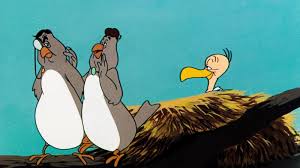
Late at night when diurnal birds slumber, a mysterious figure leaves something on the doorstep of a pair of English Sparrows. Come the morn, Monte, (the male) finds it is an egg with a note imploring him and his wife, Gwendolyn, raise the baby known as Beaky. (Whoever that shadow was, they’re not coming back, and their name was apparently “Big Beaky.”) Monte has no interest in adoption, but the Mrs. is taken with the egg, and so they will keep it.

When the hatching occurs, Monte is none too pleased. Only a mouse would grow to love the adopted son he never wanted. But Gwendolyn won’t let him dispose of it, for you see, if “The Ugly Duckling” has taught her anything, this chick will grow up to be beautiful. Isn’t that swee-did she just admit that she thinks the kid is ugly? Et tu, mama? I think I’ll have to beg to differ. Can we get a picture please?

Baby’s first meal

Yeah, no. I’m right, BEAKY must be adorable.

And yet, the narration doesn’t seem to agree with me, stating that he grows up to still be ugly. What’s worse is that BEAKY is now at that age where he really needs to be eating meat. Monte still hates the kid, but loves his mate and promises to help catch the lad a chicken. BEAKY however, isn’t too keen on flying, so Monte has to saw off the limb he’s sitting on to get him to the ground. Now, on to the chicken farm.

Monte’s plan is to go inside and throw the hens out to BEAKY. But wouldn’t you know it, chickens are much larger than sparrows, and he doesn’t succeed. So, he has a new plan: he’ll willingly get a chicken to chase him, and BEAKY can smash it with a mallet. As you’d expect, Monte ends up smashed. But a gentleman never raises his voice in anger, and he keeps the calm demeanor he has throughout the picture. (It’s actually quite funny how calm he talks. Speaking of voices, his wife barely emotes, and BEAKY sounds more like Goofy than Mortimer Snerd, here.)

Monte (who’s wing/hand actually disappears at the 5:38 mark. See if you can catch it.) resorts to using a grenade. BEAKY has never seen one of those before, and tries to give his father what he believes is an egg. Monte makes it quite clear that he doesn’t want it, and unlike I’m pretty sure every cartoon that’s done something like this before ever, BEAKY actually gets the hint. Still thinks it’s an egg though, and decides he’ll hand it over to his mom.

She does know what a grenade is though, and throws it out of the house and right into the returning Monte. Thus, endeth BEAKY’S movie career. Sad really, I like the little fella. Though I will admit this is my least favorite of the shorts he starred in. In fact, the later the date, the less I think its great. There you go, ranked all his cartoons.

Favorite Part: Monte asking how BEAKY could be so stupid, and the buzzard replying that “I get around.” I like this line not for what is said, but what it entails. BEAKY knows he isn’t the sharpest thing around, but he knows enough to get by, and he’s content with that. It really makes me want to dive into this psyche more.

Personal Rating: 3

Beanstalk Bunny

“I smeww the bwood of an Engwish wabbit!”

https://www.dailymotion.com/video/x5kb5qv

Directed by Charles M. Jones; Story by Michael Maltese; Animation by Ken Harris, Richard Thompson, Abe Levitow, and Keith Darling. Layouts by Robert Givens; Backgrounds by Richard H. Thomas; Voice Characterization by Mel Blanc; Musical Direction by Carl Stalling. A Merrie Melody released on February 12, 1955.

This is the story of “Jack and the Beanstalk.” Only Jack isn’t a human, or mouse, or sailor, or dragon, or squirrel, or puddy-tat. He’s a duck. And unlike most every Jack ever in this story, he admits to himself that trading a full-grown cow for three beans was a pretty lousy idea. He throws them away, and they land in a rabbit hole. Which is underground, and when you place beans underground, they grow into a beanstalk. But in a story like this, it’s a beanstalk that is capable of climbing.

Jack is also privy enough to know that if he climbs the plant, he’ll find himself with a good amount of golden goods to gather. Climb he does, but the lad bumps his head on a bed that grew with the stalk. Bugs’s bed, actually. Jack wants all gold for himself, and throws Bugs off the other side. Angry, Bugs decides to join the story as well.

Because of the head start, Jack naturally gets up first. Which means he also has the privilege of seeing who would reside at such heights. Someone quite accustomed to them. A giant named Elmer Foot. Jack runs back with the giant close behind and Bugs coming towards them both. Bugs also keeps Jack from fleeing, with the promise of settling things. By which I mean he points out that the giant hunts Jack in this story, not a rabbit. And by the way, the duck is Jack. (Revenge is awesome.)

Elmer decides to just take the both of them for his flour needs. (I’ve wondered, would that work? More importantly, how would it taste?) He puts the two under glass while he looks for some tools that will grind. They easily get out via glass cutter, but the lead-up is so great that I’ll save the description for my “Favorite Part.” Elmer sees they’ve escaped, and gives chase. You’d think being so small in comparison, they’d have no problem hiding, but Bugs gives his location away when he sneezes in a snuff box. (Jack gives his away, when saying “Gesundheit.”)

The two dash into Elmer’s ears for safety. (And the animator’s remembered that there wouldn’t be much light in a body. Well done!) Elmer decides to smoke the two out, by corking up his ears, and lighting a cigarette. (Probably the first time in history a cigarette has been the correct answer.) Knowing that it would work, the two poke out of the cigarette to blow out the matches. This leads to them getting found once more. (Jack: “He’s Jack.”)

They dive into the giant’s clothes and give him a bit of a tickle, using the time to escape once more. With the giant in pursuit, Bugs proves that the simplest solution is always the best one, and sticks his foot out. Elmer trips and lands hard. He won’t be coming to for some time and Bugs suggests they flee while they can. Jack won’t have any of it. He’s going to stay and get some gold like he originally intended. Bugs leaves on his own, but stops short when he realizes that the carrots up here are also giant.

Six and a half of those carrots later, (however long that takes exactly, I’m not sure.) Bugs wonders what happened to Jack. In the castle, we see exactly what. The giant stuck him in a pocket watch, to use him as the hands. Harsh, but considering the other option, fair.

Favorite Part: When they’re under the glass. Jack is frantic, and begs for Bugs to get them out. Bugs doesn’t react, which leads to Jack turning angry. Still no response. Giving up, he adopts Bugs’s pose, at which point Bugs finally coughs up the goods. And all done with no dialogue!

Personal Rating: 4. Plenty of good gags, and Jack is lovably despicable. Is it as flawless as the hunting trilogy? If you had to ask that, you’re no longer welcome on this post. But it’s enjoyable all the same. Shame it’s not as well remembered.

The Cat’s Bah

“We can spend the rest of our lives makking lo-ove!”

Directed by Charles M. Jones; Story by Michael Maltese; Animation by Ken Harris, Ben Washam, Abe Levitow, Richard Thompson, and Lloyd Vaughan; Layouts by Maurice Noble; Backgrounds by Philip DeGuard; Voice Characterization Mel Blanc; Musical Direction by Carl W. Stalling. A Looney Tune released on March 20, 1954.

Pepe is in a good mood today, for we are here to interview him about the love of his life. (Well, I am anyway. You’re kinda useless. Feel free to watch.) Pepe is also quite the gracious host. Offering me a glass of champagne, and calling me “Golden Girl.” (Would that I could be that attractive.) Now that we are all quite comfortable, he begins his tale.

It began a while ago. Pepe was living in what I assume to be Algeria. Even better, living right next to his namesake, Pepe Le Moko. His main goal is to find his soulmate, but he’ll settle for any attractive female. And wouldn’t you know it? An American tourist has just arrived, and like most tourists, brought her pet cat along for the trip. Said cat is Penelope, yes, but it’s not just me calling her that today! It really is her name! She doesn’t have to join the club of Jones’ characters who were given names years later!

What did you say, earthling?
*snarls*
No one will talk about you when you’re gone.

I hate it when my idols want to kill me.

Today is also paint the ship day, (which is every September 19.) and Penelope gets a good coating of white down her back. Her owner takes no notice of the new look, but Pepe does. (Love his face.) He decides to liberate the lady and that’s a good marriage proposal around here. She’d be crazy not to love him now. Even better? Pepe doesn’t appear to have any stench in this picture. No odor lines appear, no humans freak out at the sight of him. Heck, he managed to get an in-person interview!

Which, if this is indeed the story of how Pepe met his love, its odd to see the first female he’s encountered run away from him. I thought love always happens at first sight to both parties. Oh well, Pepe can chase. He finds it a turn on. Penelope chooses a rather ingenious hiding place: one empty jar among many. I mean, okay, its rather obvious to hide in one, but the odds of being found on the fist try?

Pepe finds her on the first try, and the chase continues all around the casbah. (Bah!) He finds her on the second hump of a camel who is really enjoying his cud today. Hey! Did you know that camels with two humps, known as Bactrian camels, aren’t native to this part of the world? Because I don’t think Chuck and his team did. Actually, no, I think they did. I think they just figured audiences back then would be too thick to know it. At least the camel doesn’t mind. (“If you’re a camel, you soon learn to put up with anything.”)

Pepe is everywhere, pretending to be anything and anyone. From a snake, to Rick Blaine. (Gets a quick case of Yellow Ear, though.) But even though she was shy, it seems that she eventually overcame that trait, as now she and Pepe are truly inseparable. Ball n’ chains will have that effect on people. She furiously files away, and I feel like I should leave the two alone. I don’t like to get involved in marital disputes. Interview over!

Favorite Part: Before the interview, Pepe asks us to let him slip into something more comfortable. There’s nothing to stop us from viewing him anyway, but he takes it well. “Intimate, no?”

Personal Rating: I’d love to give this a 4, but that ending combined with the fact that you can’t argue that Pepe’s actions are only not wanted because of his smell? I’ve a feeling that it will wad up the panties of sensitive types. I have to give it a 3.

Mouse-placed Kitten

“Happy birthday, Junior.”

Directed by Robert McKimson. Story by Tedd Pierce; Animation by Ted Bonnicksen, Warren Batchelder, Tom Ray, and George Granpre; Layouts by Robert Gribbroek; Backgrounds by William Butler; Film Editor: Treg Brown; Voice Characterization by Mel Blanc; Musical Direction by Milt Franklyn. A Looney Tune released on January 24, 1959.

As a man drives his car, he throws out something in a sack. Judging by the sounds coming from within, I’d wager that it’s a kitten. And it’s a wonder that it survives to the bottom of the hill, as it looks like that trip hurts. The small creature comes to a halt at the home of two mice, Clyde and Matilda. Matilda is instantly smitten. A child is something she’s always wanted. So what if he’s on the big side? Just more of him to love, right?

Clyde isn’t taken right away. As he points out, this baby is a cat. One of him and his wife’s natural predators. In other words, the kitten is absolutely, positively, not going to be their child. Which is story-talk for “the very next scene contradicts that statement.” Looks like the kitten is a member of the family after all. But he can only stay so long before contrasting diets make things difficult. The kitten just doesn’t like cheese.

Matilda concedes that her husband is right. (Something most husbands can only dream about.) Junior would be better off being raised by humans. I mean, he’s well past weaned. Clyde takes him to be left on a different doorstop, telling him about how much better his life is going to be. None of that “We never really loved you.” B.S. Quite the contrary, as it seems Clyde has grown to love the kid, and tearfully bids him farewell. Since they didn’t leave Junior at MY house, the kitten is subsequently adopted by the lady therein. (So what if his nose disappears for a second.)

A year goes by. The mice are still alive, and figure that the day the kid is left on your doorstop is as good as any other day to call their birthday. Time for visit. Junior has grown up by this point. And it looks like he’s matured into quite the mouser, as when Julie (the name I’ve decided to give his owner) catches sight of the rodents, he jumps right into action. He grabs the mice, gives them a good sniff… and instantly recognizes them as his parents. It’s really a sweet scene. (Yes, I’m being sincere.)

Julie isn’t happy to find the cat not evicting them. And oddly enough, once Junior puts them in his mouth, she tells him to take them outside. (Your pet too good to eat mice? Or is there a strict “No blood on the linoleum” rule in effect?) Matilda figures that with the reception they’ve gotten from 50% of the household, it’s best that they leave already. Junior won’t hear of it. And I like that. One shouldn’t have to be ashamed of their folks. (Although, I think the other way around is totally fair.)

He invites the two to partake in some snacks. He grabs the most exotic cheeses from the fridge, when Julie catches him in the act. Birthday or not, she’s not going to allow him to touch the food she buys. Clyde is not one to be deterred. He wants that cheese. (I like this guy.) He uses a jug of cider as a boost, but accidentally falls inside it. It’s the hard stuff, and Clyde is thoroughly plastered.

Junior now has to keep his dad safe from the various dangers of the house. (Namely Julie.) The more his mistress catches him messing with various things, the more cross she gets. Culminating with her deciding to kick him out should he bother her one more time. Lucky thing, Clyde’s back to normal by now, and the two decide it’s time for them to go. Junior still feels no ill will towards them, and earnestly hopes for them to visit again.

Back at their place, Matilda is overjoyed to find another kit has been abandoned at their door. (That sounded a lot more sweet in my head.) But it’s not a feline this time. It’s a skunk. Interesting that NOW is when Clyde decides to clothespin up his nasal passage. I mean, skunks only spray when scared, whereas a cat has an unpleasant stench that will follow him beyond death. (THAT sounded a lot more cruel in my head.)

Favorite Part: When Junior sees his parents again in months. Mainly because, when I first saw this short back in the day, I really thought he was going to have forgotten them, and the rest of the picture was going to either be the two trying to escape, or trying to remind him of who they were. It was a heartfelt swerve.

Personal Rating: 4. It’s a sweet story. And I love how Junior knows he’s adopted, and it doesn’t diminish his love at all. Sometimes, your real parents are the ones who don’t throw you out of a moving vehicle.

Tugboat Granny

“ANCHORS AWEIGH!”

Directed by Friz Freleng; Story by Warren Foster; Animation by Virgil Ross, Art Davis, and Gerry Chiniquy; Layouts by Hawley Pratt; Backgrounds by Irv Wyner; Film Editor: Treg Brown; Voice Characterization by Mel Blanc; Musical Direction by Milt Franklyn. A Merrie Melody released on June 23, 1956.

Would you look at that! Granny actually got her name in the title! But… it’s only so they could make a “Tuboat Annie” pun, so she won’t be featuring much in the following short. All we get out of her is a duet with Tweety about tugboats. Granny has a tugboat, you see. I don’t think I’ve made that quite clear. As for Sylvester, he’s been trying to snag a meal by hanging around the fishermen. Since that’s not working out, he decides to try and board the boat and bag the bird.

He first tries a rowboat. Tweety drops an anchor, causing the cat to have to row back to shore, sans boat. Next, he tries a rubber raft. They’re impervious to anchors, but not darts, and it just so happens that Tweety has one of those on him. (Weird. The shot of his dart hitting the raft contains no water. It makes the raft appear to levitate.) Well, the tug is making its way under a bridge now, so Sylvester tries to simply drop down. He lands in the smokestack. (Which would be impressive if this was a video game. It’d probably earn you a piece of heart.)

Right. Going on the water didn’t work. Going over the water didn’t work. Since there aren’t any sharks in this cartoon, it looks like it’s time to try going under and through the water. Sylvester makes a pipe into a handy metal snorkel, but that is exactly the kind of perch that attracts penguin-gulls. And it is insistent on staying put. Since Sylvester has no gills, he has to return to shore. Only then does he find that the bird laid an egg, which is now in his mouth. He throws it at the pest, but gravity returns it to him.

That’s enough tugging for today. Granny (Still not on screen, mind you.) starts docking. Sylvester readies a lasso, but it flies too far, and grabs a hold of a passing speedboat, pulling Sylvester in tow. He starts to get into the spirit of things, and starts pulling faces and stunts. When one doesn’t look where one is going, one is liable to crash into a post. Quoth the fish: “I tawt I taw a puddy-tat.”

Favorite Part: Sylvester’s disastrous fishing trip. Hearing somebody got a bite, he hides in their tackle box. The catch that is put in with him, is a very angry crab. The natural enemy of the common house cat.

Personal Rating: 3

Cats Aweigh

“There goes a brave pussycat!”

Nice claude hoppers.

Directed by Robert McKimson; Story by Tedd Pierce; Animation by Phil DeLara, Charles McKimson, Herman Cohen, and Rod Scribner; Layouts by Robert Givens; Backgrounds by Richard H. Thomas; Voice Characterization by Mel Blanc; Musical Direction by Carl W. Stalling. A Merrie Melody released on November 28, 1953.

Sylvester doesn’t mind being an alley cat. He can go where he likes, do as he pleases, and it really makes one appreciate your meals. His son, on the other paw, is not pleased. He wants a home! Where humans will feed him, pet him, and possibly find him cute. The main reason Sylvester is against all that, is the work that it will entail. “Meowing” for food? How civilized.

While at a wharf and searching for breakfast, Junior sees a wanted sign for cats to catch mice on a ship. It’s close enough to his wish for him! And if his dad needs help, he’ll help him! Sylvester thinks that maybe, this could work out after all. He agrees and they get the jobs. Or job, rather. Sylvester sees this as a an opportunity to take a cruise.

When Junior calls him out on his slothful behavior, Sylvester makes a deal: since his son is small, he can catch small mice. Since Sylvester is large, he’ll catch any big mice. You know, should any happen to be around. Poor little guy. He can’t bear to refuse his old man, so he resumes his chase into the cargo hold. The mouse he was chasing has hidden in a baby kangaroo’s crate.

Junior has a neat “Jurassic Park” moment with the marsupial, a good 47 years earlier than the novel. He runs to his dad, telling of the giant mouse, and per their arrangement, his job of capturing it. Sylvester humors the little guy, but finds he is telling the truth. Still, he tries to honor the deal, and sets about trying to fight the beast. It goes about as well as the previous 5 cartoons they’ve been in.

Sylvester makes a new deal with his kid: see, it’s unfair for a child to do more work than the parent, so, since there is only one big mouse, and plenty of small ones, Sylvester suggests they trade. (Geeze, Sylvester is a horrible parent.) But since Junior is such a good son, he agrees to his father’s demands once more and prepares to fight. Junior is quite quick to realize that this is all a game to Hippety, and what’s more, he’s copying all of the cat’s actions. With this knowledge, Junior is able to get him back into his crate quite easily.

Sylvester went back to his reading, because I guess he figured this would keep Junior out of his fur. But once Junior reminds him of their deal, he actually honors the deal! (He is a good father after all!) He follows a mouse back into the hold, and tells his son to not open the door. No matter what he says. The mouse (Who has a shock of red hair on his head. Huh.) hides in a crate of vitamins. And they work wonders! (Must be from ACME.)

With the upper paw, the mouse begins to pummel Sylvester, all while the cat calls desperately for Junior to let him out. Unlike how this gag usually goes, I think Junior is quite aware that his dad is in real peril. But he’s earned the right to benefit from this, and honors his father’s last request.

Favorite Part: The fact that Sylvester didn’t try weaseling out of the deal again. He’s not happy, but it takes very little provoking to get him to do his job this time.

Personal Rating: 3

Dr. Jerkyl’s Hide

“LET ME OUT OF ‘ERE!”

https://www.dailymotion.com/video/x399c06

Directed by I. Freleng; Story by Warren Foster; Animation by Arthur Davis, Manuel Perez, Ken Champin, and Virgil Ross; Layouts by Hawley Pratt; Backgrounds by Irv Wyner; Voice Characterization by Mel Blanc; Musical Direction by Carl W. Stalling. A Looney Tune released on May 8, 1954.

Hey, it’s Spike and Chester! Haven’t spoke about either of them since 2014. Oh, wait. I won’t be mentioning Spike after all. His name is Alf now. Because it’s a more appropriate name for a cockney dog, don’t you know? Oh, yes. The two have some nice thick accents this time around. Makes sense; this short’s source material does take place in London.

“Alf” and Chester, (making their final appearances) are out having a jolly stroll. At least, that’s what “Alf” wants and Chester believes. See, Chester looks up to “Alf” as some sort of hero. He’s bigger, meaner, and has people clothes. The kind of dog we’d all like to be. But “Alf” is also a bit of a bully. Smacking the little guy around, demanding he leave, and turning down his suggestions of fun. Chester then plays his trump card. Maybe “Alf” would like to beat up a cat?

That’s the ticket. “Alf” is always up for a good feline thrashing, and the two give chase to Sylvester. Poor cat takes refuge in a building that belongs to a Mr. Hyde and a Dr. Jerkyl. (And I’m sure at least one of you was planning to tell me I made a typo in the title.) Breathless due to all the exercise, Sylvester is more than happy to take a swig of what he believes to be soda. (Honestly, can YOU name another liquid with carbonation? Because I can’t. Please help.) But that wasn’t pop.

This stuff, whatever this stuff is, is designed to turn the drinker into a much meaner, much tougher, much scarier version of thyself. So Sylvester grows a couple feet, his eyeteeth grow out, and he gets a murderous look in his eyes. It is then that “Alf” comes in for a pummel. He leaves, white as a ghost. (I like how his shirt changed color, but his hat didn’t.) That stuff only lasts so long though, and Sylvester is back to his normal self when Chester takes a peek at this “scary monster.”

Well, that don’t make any sense to the spaniel. I mean, the cat is actually quite small. Chester could pound him, himself. And logic dictates that if a small dog could do it, a big dog could do it, but easier. Chester drags “Alf” back in, just as they witness their prey escape into another room. Yeah, he looks timid, terrified, and totally weak. “Alf” regains his confidence, and follows after him. (Chester doesn’t follow, for the sake of the joke.)

“Alf” corners the cat in a box, where we see the formula kicks in sporadically. Now powered up again, Sylvester gleefully plots out how we will carve the dog. “Alf” returns to Chester, but falls to pieces. (Probably a good contender for the most violent massacre in all Looney Tunes, and there’s not one drop of blood.) The power wears off again before Sylvester can take on Chester, and the dog proves good of his claim to beat the cat. Now more convinced than ever, he traps “Alf” in the building for his own good.

Sylvester takes this time to flee. (I really can’t tell if he is aware of his transformation or not. Maybe if I read the original “Jeckyll” story, I’d know.) “Alf” sees this and also sees an opportunity to seize. He uses the beakers around him to simulate a fight that he is winning. But one of the beakers he throws was full of more formula, and the stuff lands on a housefly. (And I guess it drinks it. Unless the stuff can be taken topically.) It does its thing, and the fly’s size increases, as does its temper.

Now, the insect is only roughly the size of a hummingbird, but insects ARE immensely strong for their size, and it has no trouble roughing “Alf” up and throwing him out. “Alf” begs for Chester’s protection before the two witness the fly slamming the door in their faces. A big fly, yes, but a fly nonetheless. And thus, the last amount of respect Chester might have had for the big dog is dead. As such, the roles reverse: Chester wears the hat in this relationship now, and he slaps the now hero-worshippy “Alf” around.

Kind of a shame these two had such short careers, but seeing as how this is very similar to their earlier work, there probably just wasn’t enough material to make multiple cartoons.

Favorite Part: How Chester gets “Alf” back into the building: marching him in at gunpoint.

Personal Rating:3