Corn Plastered

“Nice instrument, Junior.”
Crow(ing) Pain(s).

Directed by Robert McKimson; Story by Warren Foster; Animation by Charles McKimson, Rod Scribner, Phil DeLara, J.C. Melendez, and John Carey; Layouts by Cornett Wood; Backgrounds by Richard H. Thomas; Voice Characterization by Mel Blanc; Musical Direction by Carl W. Stalling. A Merrie Melody released on March 3, 1951.

You watch this, and you can’t help but wonder: did McKimson want to create a new series of cartoons here? One starring an oreny old farmer Al Falfa wannabe and the illegitimate cousin of Heckle and Jeckle? Calling it the Crow and the Coot? Can’t really tell anymore, but we’re here and we can see this short, so let’s watch shall we? Maybe there IS potential here.

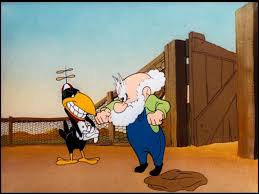
A crow (that I’m calling Cornfed) has a habit of eating the cornfields dry. He clearly has the brains crows possess, as he isn’t fooled at all by a scarecrow. He has a propeller beanie and a dickie as a wardrobe. The hat makes sense. As he has arms instead of wings, he needs something to fly with. The dickie… *shrug* a pun on dickey bird? What’s really interesting is his voice. He’s not voice by Mel! If IMDB is to be believed, the crow is voiced by a one Pat Patrick. To me, he sounds like Francis X. Bushlad. Could there be a connection?

As is typical of these kind of cartoons, the farmer (Who I’m calling Pop and thinking might be a relation to the Martin brothers,) has no chance in killing the corvid. Even when he has the bird cornered in a tree stump, he still manages to miss. I do love Cornfed’s reply: “You missed me. You didn’t exactly miss me either, but I wasn’t exactly standing where you shot.” (I’ll have to remember that one for if I ever play “Godeneye” again.) Since he missed, Pop chases him with an axe and begins chopping the tree Cornfed is hiding in. In a nice subversion of expectations, the tree doesn’t immediately fall on Pop, but threatens to crush his car. And succeeds despite his best efforts.

Pop comes home. There, he and Cornfed have a very intellectual and philosophical discussion about the refrigerator: whether or not the light stays on. Cornfed is a believer, Pop is not. The crow tells him there IS a way that they can find out, and Pop is willing to do that. He shuts himself in the fridge, and is soon begging to be let out. Cornfed does no such thing, but don’t worry, Pop gets himself out. (And is pleased that he proved his theory correct. This is how scientists are born.)

Maybe booby trapping some corn will wor- it won’t work. Pop tucks some TNT into a cob, but Cornfed sticks it back in his pocket. And making a pre-PVZ cob cannon fares even worse. (And keeps Pop’s mouth from moving.)The crow pulls on the cob, yes, but he pulls hard enough that the cannon is redirected at Pop when it is fired. And I do love his face. Looking at it, you can immediately read his thoughts: “Where did I go wrong? Why can’t I win? Is it even worth living anymore?” That last question gets answered after he lands in a boat, and angrily throws the cannonball down, making a hole.

He could swim, but he stubbornly chooses to drown. Stating that wherever he is going, there won’t be crows there. (Please don’t be heaven! I couldn’t face paradise without one of my favorite birds!) Dark enough, but the envelope gets pushed further. I guess Cornfed loves pestering him THAT much, for he quips that there soon will be, and plunges himself into the water too. HOLY-!

Maybe it’s good that any potential series stopped here.

Favorite Part: The bold and bass way Cornfed enters the house. Doesn’t knock or nuthin’, just struts in like he owns the place. Crows are so awesome.

Personal Rating: 3. Good effort. Some new twists on old gags, willing to let another person voice your characters, (I think I like Pat’s performance) and great facial expressions. (Still confused about that dickie, though.)

A Star is Hatched

“Goodnight my little pine knot.”

Supervision by Isadore Freleng; Story by Tedd Pierce; Animation by Bob McKimson; Musical Direction by Carl W. Stalling. A Merrie Melody released on April 2, 1938.

In the little town of Hickville, Emily the hen idolizes the stars and starlets of Hollywood and fantasizes about the time when she too will be on the silver screen. (Ironically enough, this short actually being her second time. She wouldn’t get a third.) So enamored is she that she even talks like Katharine Hepburn. (Unless that is her normal speaking voice. It’s possible. I sound like J.K. Simmons, myself.) She can’t be bothered with the local rooster who comes a courtin’ for her wing in marriage. The high life is always the best life!

What luck! There’s someone at the gas station she lives at who could be a huge help with getting into pictures. A one J. Megga Phone by name, on his way back to Hollywood. (I love how he wears three pairs on sunglasses. I should do the same.) Emily lets him know that she has every intention of being big one day, and he likes what he sees. (She is pretty cute.) He hands her his card telling her to look him up, as home he goes.

Emily rushes to get her bags. (Past Alfred Hick-cock who never moved an inch.) She’s Hollywood bound! And she’s so committed to her dream that she walks the entire 2,000 miles which means Hickville is located in Maryland or West Virginia. (Or maybe her hitchhiking had more success than the montage suggested. Less impressive.) She makes it though, and she gets to see what some of the stars are doing when not on screen. Clark Gable drives a trolley, and W.C. Fields directs traffic, for example. And we see the cement footsteps left behind by Robinson and Garbo. (The former having a gun print; the latter being humongous.)

The picture business, that’s what Emily is here for. And Mr. Colossal wasn’t bluffing, he really is a director. One with at least 15 assistant directors who agree to whatever he says. (Except the 15th one who still has a shred of individuality and personality. Give us one week more, we’ll fix him.) His latest picture is a musical medley to America’s 48 states and if the clapboard is accurate, his name is actually Buzzard Berkelee. (I knew his cool name was too cool to be true.) Odder still, his movie is comprised of humans. Yeah, we already saw plenty, but it was only now that I realized how weird this world is. What does everyone eat?

Emily finds a casting office, but it turns out she’s not the only pullet here. Seems Mr. C gives out business cards to any girl he comes across and the room is already packed. And when the man himself enters, Emily can’t catch his attention; not that he even looks at or acknowledges she exists. Emily is already broken. Embarrassed and upset to find she was just one of many, she decides to forgo any hard work that would get her a position, and heads back home.

She married Alfred and we see how happy their little family looks. But one daughter can’t help but idolize the silver screen, and fantasize about when she too will be a star. Emily ain’t having it and gives her kid such a smack. If she’s not going to be an instant success, then nobody is.

Favorite Part: When Colossal says, “If you ever want to get in pictures, look me up.” and hands Emily his card. Flipping it reveals just that is written on the back. Not only gives a clue that he has so many of those cards, he’s memorized the script, but can be interpreted as him just being too dumb to remember what to say.

Personal Rating: If you’re not familiar with some of the biggest stars of the day, you might find the majority of jokes confusing. It’s a 2 for people like you, and a 3 for the rest of us.

Cats and Bruises

“Here comes Mr. Butt-inski.”

Directed by Friz Freleng; Co-Director: Hawley Pratt; Story by John Dunn; Animation by Bob Matz, Norm McCabe, Don Williams, Manny Perez, Warren Batchelder, and Lee Halpern; Layouts by Dick Ung: Backgrounds by Tom O’Loughlin; Film Editor: Lee Gunther; Voice Characterization by Mel Blanc; Musical Direction by Bill Lava. A Merrie Melody released on January 30, 1965.

On every Cinco de Mayo you can find all the mice in Mexico celebrating. That’s all well and good, but it also means they’re all in one location and Sylvester knows that spot. He tries to infiltrate the party with his own mouse ears (It’s worked before.) but Speedy can see through the disguise and tells everyone to run while he takes care of the party crasher. Speedy even uses an old sign to taunt him. (They still have that? Move on, guys.)

Speedy gets Sylvester into the nearby dog pound a couple of times. (Must be why they chose this venue.) But the budget doesn’t allow any scratches on the cat. He does manage to get Speedy in a net, and dragged around. He’s smart enough to grab a hammer, but slams into a pole. Later, Speedy takes a romantic boat ride with a mouse doe, whilst Sylvester tries to sneak up via rubber raft. Speedy pops that with a dart.

Like the new saying I just made up goes: if you can’t bead’em, outspeed’em. Sylvester is putting his engineering degree to good use as he designs a car that will actually outpace Speedy. We said it was crazy and couldn’t be done, but only the first part of that statement came true. As amazingly enough, the car is doing a dang fine job of catching up to the guy. (If we could see the speedometer, we could use basic math to figure out Speedy’s top speed. I’ve never wanted to do basic math more in my life!)

As it turns out, Speedy is the fastest mouse in all Mexico, and that includes his stopping speed. Meanwhile, it seems Sylvester never foresaw the mouse calling it quits, and didn’t bother to install brakes. He drives off a cliff and into a lake. (Although the camera pans upward. So we should all be forgiven for thinking it launched him into the thermosphere.) Speedy lets everyone know that it is safe to continue partying, and they dance again in the same shot we saw them in originally. (Wait… Speedy really kept them waiting while he went on a date? What a cheesehole!)

But Sylvester isn’t dead if that’s what Speedy was implying; he’s just in a wheelchair. So he can still chase the mouse in a way. Speedy humors him by running a fraction of a fraction of his normal pace. What a cheesehole.

Favorite Part: After Slyvester gets out of the dog pound. Speedy asks if he’s nervous. I like Speedy’s smug face, and the quick “yup” Sylvester responds with.

Personal Rating: 2. And that’s me being nice. This whole picture was a mishmash of reused gags we’ve seen before! (Probably why the animation looks a bit more polished than what was coming out at this time.) However, casual fans and newbies could probably find enjoyment here. (Still, I wouldn’t use this to introduce the characters to them.)

Stooge for a Mouse

“…You like cats, how come?”

Directed by I. Freleng; Animation by Arthur Davis, Gerry Chiniquy, Emery Hawkins, Ken Chapin, and Virgil Ross; Layouts by Hawley Pratt; Backgrounds by Paul Julian; Voice Characterization by Mel Blanc; Musical Direction by Carl W. Stalling. A Merrie Melody released on October 21, 1950.

It’s so nice to see Sylvester happy. Even better? He’s happy with a dog! A dog! His natural enemy! It doesn’t matter what he does, any dog sees him and he gets mauled. Mike is much more understanding than those neander-canines. He’s even happy to let his pal use him as a pillow. But there are still responsibilities to uphold, and Sylvester’s main one at the moment is keeping his eye on a mouse.

Whoever owns this house loves leaving unwrapped cheese on the table. Naturally, the visible scent is going to attract a mouse. But Sylvester is on the job, and while not fully catching him, does send him running back to his hole. Seems like this isn’t the first failure for the rodent, so he’s going to have to resort to chicanery if he wants that rotting milk-wad.

He cuts a hole in the ceiling and lowers a phone receiver. Taking the other end, he starts putting doubts in Mike’s head about enjoying the company of cats. They only like other life-forms for their warmth, and will kill you once you outlive usefulness. (I mean, I don’t think he’s wrong…)  To make things worse, he plants a knife in Sylvester’s paws and has the dog look. He’s not pleased and banishes his chum to the other side of the room. Let’s call the mouse D.J.! (Short for dick jerk)

Mike sleeps once more, and Sylvester decides it’d be okay to at least share the rug. Mike can have some personal space, sure. But once the two are asleep once again, the mouse ups the ante. Wielding a mallet, he gives Mike a whallop and plants the weapon on Sylvester’s person once more, fleeing before his trick is discovered. Again, Mike is pissed to think what he once considered a good friend is now causing him bodily harm.

D.J.’s tricks get worse, and Mike decides the only option is to put the cat in shackles and throw him out of the room. Even though this should help prove Sylvester’s innocence, Mike still blames him when the mouse saws a hole around him, and gives Sylvester the saw. (Really, Mike? You don’t see ANYTHING suspicious about this? You KNOW there’s a mouse in the house.) He gives Sylvester a pounding leaving the cat dazed. But the mouse has one more scheme to try: it involves a boxing glove and horseshoes.

Figure it out yet? D.J. is going to use a magnet to drag a horseshoe-filled-gloved-Sylvester into Mike’s mug. That’s it. Mike retaliates and punches the (still oblivious) cat right back again. And the mouse pulls him right back once more. This goes on for a while, and when it’s all said and done, the house is a wreck and the two pets have been knocked senseless. D.J. goes to get his cheese, but thank goodness for small mercies. You see, you can’t turn a magnet off and it pulls on something else metal. The lighting fixture which comes undone and knocks D.J. unconscious. Hopefully when everyone comes to, they’ll know who’s really to blame: the moron who lets good food sit and spoil.

Favorite Part: Mike being a very supportive friend when Sylvester admits the mouse got away. He still thinks his pal did a good job scaring the pest, and that’s what really matters. What a good dog!

Personal Rating: Before we get to that, here’s a bonus Toon for you to watch:

Now, even thought this cartoon doesn’t look or sound as good as what we’ve already discussed today, I find it the better picture. First off, the dog and cat’s friendship is so cloyingly, saccharine-sweet, that you kinda want to see them change tune. (Doesn’t help that the cat sounds like Meowth with his balls caught in a vice.) Second, Herman actually makes BOTH of them think the other is turning traitor, so you don’t pity them too much. And most importantly, they catch wise to his scheme so things will most probably work out.

TL;DR: I’d give this today’s short a 2, but if you’re not as sentimental as me, you’d probably say it deserves a 3. ( Herman’s short DEFINITELY earns a 2.)

Ready Woolen and Able

“See you tomorrow, Sam.”

https://www.dailymotion.com/video/x7zfn66

Directed by Chuck Jones; Story by Michael Maltese; Animation by Ken Harris, Richard Thompson, and Ben Washam; Layouts by Maurice Noble; Backgrounds by Philip DeGuard; Film Editor: Treg Brown; Voice Characterization by Mel Blanc; Musical Direction by Milt Franklyn. A Merrie Melody released on July 30, 1960.

Sam Sheepdog drives to work in his humble, rattly car. Ralph Wolf is doing the same, but because he makes more, he has a much faster, spiffier ride. (That still has nuts, bolts and bits of wire streaming out of it.) The two park in their very own parking spaces, (one of the perks of working in their field) and share pleasantries as they clock-in. Ralph, as previously established, is all about speed and runs right to his first sheep of choice. Partaking in humbler, but still successful means, is Sam who drops a rake for Ralph to step on.

You know how to tell if your friend is a true friend? True friends are allowed to try and blow each other up. Ralph is going to try with his own invention: the TNT-totter. With this device, he plans to fling an explosive stick at the dog. But it just rolls towards him when he jumps on his end. Continuing from there, the wolf tries to roll a lit barrel of gunpowder at his best pal. It bounces over the dog, (leaving Ralph with a wonderful “Oh my aching head” expression) and detonates under a boulder that flies back to Ralph.

Okay, so maybe the simpler approach has some merits after all. Ralph attempts to swing via trapeze over to a plump morsel. But wouldn’t you know it, Sam is at the other end. Ralph puts him back where he belongs confused at the switch. But wait! At the apex of the upswing, there is Ralph again! Ralph climbs up the trapeze only to find Sam was the one holding it up, all along! And when he slides back down, Sam is sitting on the other end. Seeing as how he can’t escape that dog, Ralph opts to jump.

Would you believe it? He passes five Sams on the way down! (One of which is riding in the most static hot-air balloon I’ve ever seen.) A sixth is fishing, the seventh is sleeping with the fishes, (literally, thanks.) and an eighth is inside the whale that Ralph swims into. (A freshwater sperm whale with inaccurate dental structure? Now I’m starting to freak out!) And yes, there’s a ninth one that Ralph encounters when he is spouted out. Terrified, the Wolf swims for shore only to find himself on a nude Sam beach of 33! (Always room for one more, though.) I don’t think Ralph can take much more of this…

Theory, correct. At the end of the day, Sam drives home in his crummy looking, but functional car, and Ralph goes home in an ambulance. Complete with strait jacket. And to think it’s only Monday…

Favorite Part: Ralph tying out some bed springs on his feet. They flip him on his face. And really, what else should he have expected to happen?

Personal Rating: 3

Hiawatha’s Rabbit Hunt

“Imagine a joik like that tryin’ to catch a smart guy like me.”

https://www.dailymotion.com/video/x6gu9tk

Supervision by I. Freleng; Story by Michael Maltese; Animation by Gil Turner; Musical Direction by Carl W. Stalling. A Merrie Melody released on June 7, 1941.

Warner Bros. certainly hit gold with their wascawy wabbit! Only four shorts in, and he’s already gotten his second Oscar nomination! (Out of three total, but still…) I can’t say this was better than the year’s winner (Disney’s “Lend a Paw”), but I’d have given the award to “Rhapsody in Rivets.”

Bugs is reading the classic and harmonious “The Song of Hiawatha,” and while he does find it enjoyable, he’s a little bit terrified that the piece tells of the mighty warrior hunting a rabbit. I mean, Bugs is a rabbit, and Hiawatha is right there! Or a facsimile of one who looks like he might have some Elmer Fudd in his ancestry. Still, a bow and arrow can hurt something fierce, and with an intention to make rabbit stew, it’s probably in Bugs’s best interest to hide.

But that cooking pot makes a pretty good tub, and living in wilderness can get a guy rather filthy, so you can’t fault Bugs too much for treating himself to a bath. Just what Hiawatha was planning, so why question the good fortune. He prepares the fire with Bugs’s help and the rabbit eases himself into the just right (for now) temperatures. Awwww! And the hunter is feeding him too! Why would anyone need to fear him- oh, yeah. Those carrots are ingredients. Just like Bugs. He bolts.

Bugs tries to make an escape via one of his holes, but this being early in his career, he actually fails to complete the whole stunt. (I love how ashamed and embarrassed he looks. We’ve all looked like that.) Hiawatha plans to tie Bugs up with a rope. (And his hand? Either he slipped on a glove at falcon speed, or he accidentally cut off all circulation to it for a second. Both are feasible.) Bugs ties him up and does the worst kind of mocking: dance mocking. (Though I love his dance. The butt bouncing is the cherry on the icing on the cake on the plate.)

When the little guy actually manages to point an arrow at Bugs’s cranium, the rabbit finds that hopping away won’t work, as the man follows his jumps precisely. Bugs challenges him to take on his finisher, a series of rapid hops and landing on a branch growing out of a cliff. It’s that last part that is the trickiest, and so it’s the part that slips up Hiawatha. (Oh, and thanks for calling him a sucker, Bugs. I wouldn’t have understood the classic transformation gag if you weren’t commenting. Do it verbal or visual, not voth. Er, both.)

You gotta know when to accept defeat, and Hiawatha does. Time to canoe home and get some takeout from Bison King, or Buckdonalds, or maybe even Kentucky Fried Trout. (Much simpler.) Bugs recites the end of the poem, as he watches him leave. But Hiawatha is determined to have the final say, and he paddles back to give Bugs one of those smooches he’s always giving out. Seems like we’ll have to declare a truce.

Favorite Part: When told he is going to be tied up, Bugs bursts into laughter. The best way to take all pluck out of one’s plan. (Plus, it sounds funny.)

Personal Rating: 3

The Country Mouse

“It looks bad for the challenger!”

Supervision by Isadore Freleng; Animation by Don Williams and Jack Carr; Musical Score by Bernard Brown. A Merrie Melody released on July 13, 1935.

Somewhere in the country, is a mouse named Elmer. He’s the local hero amongst his circle of friends, including Beans and Mickey Pig. He may be a mouse, but he’s quite muscular. (And his muzzle sometimes changes from beige to brown.) And he’s got a goal of someday going to the city and becoming a very successful fighter. But right now, his grandma has other plans: chores.

Muscular is probably the mice’s actual last name. Elmer doesn’t chop down trees, he uproots them. Then he slices them into boards as easily as a razor blade through crisco. Granny is not impressed. She’s the type of hard-working, hard-smoking, hard-chewing grandmother, and she doesn’t uproot trees, she punches them down. And when she hears what her grandson is planning to do with this life, she drags him home by the ear. If he can’t stand up against his kin, what chance would he have in the city?

But his mind is made up, and he leaves in the dead of night. He must have pretty good connections, because it looks like he’s been booked into the ring the very next day. (I suppose time could have passed, but I figure Grandma would have tracked him down by then.) This is a pretty important fight too. It’s the “championship of the world!”. And the announcer is a… desman, I think? (Look them up. You might agree with me.) Elmer is going by “The Hickville Threat.” (Which is either the wimpiest name I’ve ever heard, or just the worst.) His opponent is a bulldog that is known as “The Run-some Bulldog.”

The fight begins and Elmer isn’t as outclassed as some other guys I’ve seen. He manages to get in a few good punches. But you can’t beat the champ because he’s the champ, and Elmer gets himself a good beating. Back at home, Granny worriedly listens to his exploits on the radio. Deciding that she can’t stands no more, she makes like a biker mouse from Mars and bikes all the way to the city.

The crowd is loving the violence. (It’s the spastic monkey in the back and the drunk bonobo in the front that make it for me.) Just as it looks like Elmer has lost, Granny enters the ring. She takes the champ out with one punch, and is declared the winner. Nice crown. Elmer got something out of it too: a couple of black eyes. And I don’t mean what you’re thinking, his sclera is ebony! For running away from home, Granny punishes him in the most humiliating way she can: a spanking in front of a crowd of thousands. At least he’ll be famous now.

Favorite Part: Elmer is recovering in his corner, aided by a pig trying to bring him to. It works, but the pig wasn’t done playing the hero, and punches him back out.

Personal  Rating: 3

Fair and Worm-er

“I’m a beast.”

https://www.dailymotion.com/video/x7xjovo

Directed by Charles M. Jones; Story by Tedd Pierce, Michael Maltese; Animation by Ben Washam, Ken Harris, Basil Davidovich and Lloyd Vaughn; Layouts and Backgrounds by Richard Morley and Peter Brown; Musical Direction by Carl W. Stalling. A Merrie Melody released on September 28, 1946.

You know about chase cartoons, right? It typically has a chaser and a chasee. Two adversaries. It’s a formula that works. Sure, sometimes you can up the number to three, but it tends to stop there. Not here. Here we have Jones’s unit attempting to cement itself as the ultimate chase cartoon. I must admit, I’ve yet to see anything top it in its amount of characters.

Let’s start with what gets everything rolling: an apple. Sweet, crispy, and worth getting out of paradise for. It’s not really a character though, just an object of desire. Desired by a worm, that is. (I’ve just realized that I haven’t seen apple-loving worms in media for decades now. Pesticides have ruined what was once as believed as cheese-loving mice and peanut-loving elephants.)

Worms are chock full of protein, and lack a skeleton that’s either exo or endo. This makes it a great morsel for something that has no teeth: a crow. We could stop there, but the food chain won’t. A cat wants that crow, and a dog wants that cat. This isn’t enough. How about a dogcatcher trying to do what his title promises? But even he’s got a fear: his wife. She claims to be afraid of nothing, but a little mouse calls her bluff. (Don’t worry. Those last two barely function into our story. They’re relegated to literal running gag.)

The crow tries to disguise his fist, (Yup. Crows have those.) as that apple. The worm may be blind (Those aren’t real eyes because I say so.) but he isn’t that stupid, and he mallets the faux fruit. The dog, meanwhile, is chasing the cat up the tree with the aid of some tree climbing spurs. The resourceful cat eats bananas and sends the peels to the dog, to send him to the gleeful catcher at the bottom. This catches the attention of the crow who does some thinking. If cats chase birds, and dogs chase cats, then its his duty as a bird to give the dog a hand. Brilliant deduction! Just snip a little here and…

The dog falls through the net, but the cat won’t let this setback go unchallenged, and throws him back to the catcher. In turn, the crow gets a boot and kicks the catcher in the shins. This makes the bird the new subject of desire for the man, meaning the dog is free to chase once more. I love how the cat flees piece by piece. Even better is the dog’s pupil turning white with rage. (I’m really not sure if that is a coloring error or not.)

When the worm tries creeping up on the unguarded apple, he isn’t aware that the rest of the chain is on his heels. (The dog just appearing out of nowhere instead of from behind the tree like the others. Definitely an error. Also, the distance to the apple has increased dramatically.) They give themselves away by saying “gesundheit” to the sneezing worm. Everybody chases, but runs from the newest entrant in our cartoon: a skunk. Which is never stated to be Pepe, but it does his signature hop complete with musical score. I’m going to say it’s Pepe. (If Chuck wasn’t the director, I might consider otherwise.) Be glad I’m not claiming the human is Snafu. I totally would!

Whilst everyone follows the worm underground to avoid what’s most definitely Pepe, the worm utilizes a pin to get them out. Each fleeing from the skunk. (And taking away the imprint they made as well. That’s courteous.) Leaving with a gas-mask, (Because worms are known for their keen noses.) The little guy finally gets himself the apple that started all this. A narrator who we haven’t heard from since the beginning asks the worm if this sorta thing happens whenever he wants food. The worm reveals that he wasn’t looking for food, he intends to live in the fruit. (With housing prices what they are, I don’t doubt the whole thing was worth it.)

Favorite Part: The worms launches a torpedo at the crow, but misses and it goes toward the cat. The worm is quick to make sure the bird gets the blast. I choose it not because I secretly love cats and have been hiding my true intentions for my whole life because I’m that insecure. I just like how the worm is willing to protect those who can protect him. It’s how friendships are born.

Personal Rating: 3. Not a whole lot of jokes, and I feel the story could have been more creative. Like, having the odds and evens teaming up? Or maybe the apple was that variety that causes discord and we just kept getting bigger and powerful creatures fighting for its possession? (With the victor being Pepe of course.)

You’re too Careless with your Kisses

“Ain’t that just like a woman?”

Animation by Rollin Hamilton and Larry Martin. A Merrie Melody released on September 10, 1932.

Late at night, a tipsy bee heads back home. Since he’s been drinking, he can’t let the wife know that he’s there, and tiptoes into their room. They cut the sneaking crap fast, and his clumsy klutziness wakes the girl up. She is none to pleased to find Rupert (her husband) has been at the spiked honey again. (I’m a calling her Hunny. Objections? I’ve got none.) There’s no time for reprimanding him though. (Her antennae turn black.) As the female, it’s her responsibility to go out and make honey to make dough.

Outside (where her antennae have decided to stay black) she sets to work. She’s definitely got an interesting method of gathering nectar. She separates the lower half of her abdomen, and uses it like a bucket to scoop out the sugary sweetness. Kind of like an enema as thought up by David Lynch. I’m torn (get it?) between laughing my butt off and puking my guts out. And then comes the rain…

Bee’s can’t fly in this kind of weather. In fact, if Mario has taught me anything, the water there should turn her into a human, and those make milk, not honey! (Kind of hard to when you’re limited to one stomach.) So after robbing a store for a skirt and top, (Okay then. Perhaps you’d like to explain her change of wardrobe?) She comes to the first place one could conceivably call shelter. If I knew anything about predators, then I’d wager a spider lives here. A spider lives here and…Hey! I know this guy!

Score that later short another point! (You know, now I’m starting to think that that Terrible Tom character was the cat from “It’s got me again!“)

Spike (who still looks nothing like any spider I’ve ever seen) brings her in. She immediately recognizes the danger she’s in, but tries to escape up his winding stair! You fool! (Oh, and her stripes are back. K.) Her cries and screams reach her husband who seems to be snapping out of his stupor. He’s got no stinger, but he can blow a mean horn to alert the proper authorities. (I like how the cartoon trusts our intelligence enough to not spell out that the bees are riding horseflies.)

Rupert gets there first, and Spike plans to eat him as well. So Rupert just drags a thorny vine through the guy’s crotch! That looks to completely redefine ‘painful’. Imagine how much worse it would be without an exoskeleton. This isn’t going to be a winning fight, so Spike heads for his washtub boat. (Wait, if that’s human sized… I knew it! He’s not a spider! He probably just got spit on by Peter Parker!) The bee’s fight back like planes on a airliner, (One of whom teleports back to her original spot. Coward) but Spike knows how to defend himself, and puts up a good fight.

Time for the best weapon they have! What I presume to be a wasp (and the only insect in this short that has the correct number of limbs) drops a firecracker on the “arachnid”. The explosion not only destroys his tub, but it makes it look a lot like some stocks, and Spike is trapped in them as well. A happy ending for the pollinators. I guess willing to stand up to a predator is enough of a reason for Hunny to forgive her honey. (Come on. You knew I was going to say that.)

Favorite Part: Okay, that way of getting honey was pretty cool and unbelievably creative. I wish I had thought that up.

Personal Rating:2. Doesn’t do anything too creative that you haven’t seen in any other rescue picture. And the soundtrack is rather depressing.

Billboard Frolics

“SEE THEM AND HEAR THEM”

Supervision by Isadore Freleng; Animation by Cal Dalton and Sandy Walker; Music by Bernard Brown. A Merrie Melody released on November 9, 1935.

We must begin today’s post with what happened at to me at Comic Con: I had a great time. Twice as many people asked me for photographs than last time, two people asked me to dance and sing, (one of whom filmed me) and I lost count of how many compliments I got on my costume. (My favorite was the guy who said and I quote: “Hell yeah! Michigan J. Frog!) Apart from that, it’s a real pleasure in life to see the current voice of Bugs Bunny in person. I can die a happy man, death! Any day now!

Now for today’s post: A very popular story to tell in animated features anymore is “What does ‘X’ do when I’m not around.” It’s been going on much longer than just lately. Exhibit A is our short today. Today, it’s what the characters on billboards do at night. (Which is coincidentally the premise for one of Illumination’s upcoming films. They’re calling it: “Billboard Games.” It will be mediocre but have an impressive box-office return.)

We begin with an advertisement for the musical duo of “Eddie Camphor” and “Rub-em-off”. They sing a merry melody that I feel should be the theme song to a series of theatrical short films someday. Plenty of ads join in the fun. A cute Cuban dances on her travel ad, Mexican tamales sing along, and Russian rye bread do their expected squat dance. The one I don’t get is the smoking toy penguins. Is that a reference? I’ll be very grateful if you educate me.

Since these are living ads, they can do things that our boring reality ones can’t. Namely, they can hop off of their billboard and traipse around the “real” world. That’s what the chick on the “My am I?” billboard does. (Is that one a reference? Is it just a play on Miami?) He has seen a worm and he is eager to be a part of the food chain. But this is one wily worm who doesn’t want to give up eating crops for being eaten and placed in a crop. (Bird humor.)

Now the funny thing about food chains is that they are almost never are two links long. The local alley cat is happy to take his part in nature’s grand design. Even if his prey of choice tastes like acryllic paint and advertising. My-am-I decides to make a retreat. (I love his face. Why hasn’t that been memed? You fools always seem to neglect my best ideas!) Good thing the board members have such a strong union, and begin fighting off the predator. Including sending out the next link in the food chain: a dog.

The cat manages to trap Fido in a pipe, and he continues chasing the chick. The bird finds himself trapped against a dead end. (Which will be literal if a last minute save doesn’t happen.) The little guy is saved by the baking soda ad on the nearby wall. (Ham and Armour brand, of course.) That chick certainly has something to crow about now.

Favorite Part: When chasing the worm, the chick has an adorable angry face. Coupled that with his non-threatening “cheeps” makes me just want to fawn over him, cuddle him, and give him that worm. (Cute things always get precedent.)

Personal Rating: 3