You were never Duckier

“Brother, could I use 5,000 sthmackereenies!”
 Directed by Charles M. Jones; Story by Tedd Pierce; Animation by Ken Harris, Phil Monroe, Ben Washam, and Lloyd Vaughan; Layourts by Robert Gribborek; Backgrounds by Peter Alvarado; Boice Characterization by Mel Blanc; Musical Direction by Carl W. Stalling. Released in 1948
He craves something, but doesn’t know what this is.

Directed by Charles M. Jones; Story by Tedd Pierce; Animation by Ken Harris, Phil Monroe, Ben Washam, and Lloyd Vaughan; Layourts by Robert Gribborek; Backgrounds by Peter Alvarado; Voice Characterization by Mel Blanc; Musical Direction by Carl W. Stalling. Released in 1948

Daffy is at a Poultry judging. The best rooster wins $5,000, and the best duck wins $5.00. (Sorry duck farmers, but best ducks are still just food.) Daffy is angry but figures that all he has to do is disguise himself as a chicken and he’s on the road to cash. He slips on a red rubber glove as a comb (If it’s good enough for penguins…) and then grabs some cock tail. (And by that, I mean he takes the tail feathers off of one of the cockerels there, thank you very much.) His disguise complete, Daffy goes to snooze while he waits for the judging.

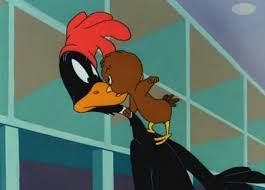
Up in a tree meanwhile, a little chicken hawk  is going to bed himself. His dad is reading him his favorite bedtime story, “The book with pictures of various different breeds of chickens and no words.” (I hear it’s getting a movie soon.) It’s Henery and his dad, George. For once in my blogging career I have to come up with a middle name for a character rather than a first one. His middle initial is K, so the only logical name is ‘Ketuckyfried’. Henery is just amazed at how much his dad knows about chickens. He’d love to get him one. So he heads off to the show.

Finding a sleeping Daffy, he tries to take him home for dinner. When Daffy demands an explanation, Henery tells him that he’s being taken to his dad: the greatest judge of chicken flesh. Well, Daffy wants to be judged right? He happily comes with. Once at home, he finds out the name of his would be judge: George K. (entuckyfried) Chickenhawk. (Red-tailed, that is.) In a refreshing twist, Daffy doesn’t do the ‘ole “repeat the name and then realize what’s been said. He immdiately realizes that he’s pretty much a goner. While George prepares the pot, Daffy tries to prove that he is really a duck. I don’t care which answer is right. Both are tasty.

But giving a swimming demonstration doesn’t cut it, and he can’t get his disguise off. When he tries to just flee, George grabs hold of his “comb” and when it snaps back, George now has it on. So you can’t really blame Henery for accidentally hitting his old man with a hammer in the ensuing chase. Daffy leaves and remembers that he still has a contest to win. Donning a new glove he gets to the podium with dollar signs in his eyes. But he loses to George of all birds. (Still wearing the comb.) Well, 5.00 is five bucks and Daffy strips down to try and win something. (With cent signs in his eyes.) He loses once more, this time to Henery in duck disguise.

Personal Rating: 3

Hollywood Daffy

“The sthity of the sthinema at lastht!”

A cop isn’t just beer and skittles, you know.

Directed by I. Freleng; Story by Michael Maltese; Animation by Ken Champin, Virgil Ross, Gerry Chiniquy, and Manuel Perez; Layouts and Backgrounds by Hawley Pratt and Paul Julian; Voice Characterization by Mel Blanc; Musical Direction by Carl W. Stalling. Released in 1945

Well folks, a new job is going to make it difficult for me to post on Wednesdays anymore. So the only logical thing to do is move to Mondays. (Which my previous job prevented me from doing.)

Our story today takes place in Hollywood. (Naturally) There are plenty of wolves here as it’s a perfect environment for them. Plenty of hot babes, nice climate, and delicious toons to eat. Daffy has just arrived and much like his Disney counterpart did in “The Autograph Hound”, wants to see some celebrities. Despite the fact there are plenty of signs saying he can’t, he waltzes into the studio anyway. He is thrown out by a studio guard dressed like a klassic keystone kop (Or a kkk member for short.) Considering Daffy is a black duck, that could be part of the reason why Rolly, there (that’s what I’m calling him) refuses to let him in.

The chubby cop (portrayed hysterically by Mel) may be fat enough to snack on two popsicles at once, but he isn’t an idiot. He does his job well. (You know Daffy’s apprentice, Plucky, would also have a hard time getting past Ralph the guard in Tiny Toons to get in the studio years later.)Daffy tries various disguises. Charlie Chaplin, Jimmy Durante, and Bing Crosby don’t get him in. But he is able to slip by as an Oscar. Even though Rolly can’t tell what he’s supposed to be, he does have a button that is to be pressed when gatecrashers disguised as Oscars come in. His disguise revealed, Daffy flees into the lot.

He pretends to be a tour guide and shows Rolly some of the stars dressing rooms. Abbot and Costello’s are fat and skinny, and Durante’s has extra space for his nose. He even shows off the studio guard and shows that his head is so thick, you can repeatedly hit it with a stick and he won’t feel anything. (Physically; mentally he will feel angry.) He chases once more as they run past Jack Benny trying and failing to get an Oscar out of a claw machine. “I’ll never get one of those.” And he didn’t. (A regular Nostradamus.)

Daffy pretends to be a director and flatters Rolly into being in his film. He gets him to jump off a cliff. The chase continues (and Daffy is saying his trademark laugh, strangely quietly) and the cop tries to stop him with a painted backdrop of a path. (Daffy runs into it, and Rolly runs through it.) The duck thinks he’s finally rid of him, but Rolly grabs him anyway. Daffy says that he is not leaving because he wants to see stars. Rolly asks why he didn’t say so. He can show him stars. He beats him on the head and tosses him out. But Daffy is happy. He’s seeing more stars than Carl Sagan ever did.

Personal Rating: 3

Oily Hare

“No doggone, long-eared rabbits’ a’gonna stop me from dynamiting no oil drillin’ hole!”

Directed by Robert McKimson; Story by Tedd Pierce; Animation by Rod Scribner, Phil DeLara, Charles McKimson, and Herman Cohen; Layouts by Peter Alvarado; Backgrounds by Richard H. Thomas; Voice Characterization by Mel Blanc; Musical Direction by Carl W. Stalling. Released in 1952

This short takes place in Texas. In the future I’m guessing. (Dallas had been renamed to Dalla$) Bugs is residing in Deepinahola, Texas. (Just a little bit past Deepinaharta) He enjoys his life. Outside a very long car drives by. “How long is it?” It’s so long, that not only does the passenger need a phone to call the driver, but it’s a long distance call! This guy is pretty much McKimson’s Yosemite Sam. Since he’s not given a name, I’ll give him an extremely clever and original one. Nah, I’ll just call him Tex.

His driver does have a name, Maverick. And I may sound weird but Maverick is kinda adorable. With his hat that covers his face, a shirt that covers his entire body and the fact he doesn’t talk… I dunno. I just want a plush toy of him. Back to our story: Tex is angered to see that one of the holes on his property is not gushing oil. He and Maverick start setting up an oil derrick, when Bugs pops up to see what’s going on. Despite his claims that the hole is his home and lacks fossil fuels, Tex still continues his work. He sets some dynamite into the hole as well, to keep Bugs away.

Happy to find “party decorations”, Bugs makes a cake and decorates it with the “candles.” Sending it back up. Tex is surprised that someone remembered his birthday was today. Especially because it’s not. (Speaking of birthdays, I have one.) Bugs urges him to make a wish. My wish is that we got to hear what he was going to wish for. All we know is that it’s not money. (He’s got plenty of that.) After the explosion, he tries to just shoot Bugs. The rabbit puts up a funnel and some pipe that lead the bullets back to Tex’s rear. Time for some grunt work.

He orders Maverick to go get Bugs, but the silent cutie comes back empty handed. Tex goes in himself and asks for plenty of TNT. Guess what? Bugs stole Maverick’s clothes and hands him sticks upon sticks of explosives. (Tex doesn’t seem to realize that there is a Maverick in the hole and out of the hole) Soon, there’s so much dynamite that the earth is near bursting at the seams! Bugs is pretty cool with the destruction of his home and all worldly possessions, since he tells Tex where his lighter is.

After another explosion, we see that Bug’s hole was not on top of an oil gusher; but instead a carrot one. Catching our disbelieving looks, he reminds us that anything is possible in Texas. (There you go. Toontown and Texas. The only two places on the planet where anything can and will happen.)

Personal Rating: 3

Transylvania 6-5000

“Rest is good for the blood.”

Directed by Chuck Jones; Co-Director: Maurice Noble; Story by John Dunn; Animation by Bob Bransford, Tom Ray, Ken Harris, and Richard Thompson; Layouts by Bob Givens; Backgrounds by Philip DeGuard; Film Editor: Treg Brown; Voice Characterization by Mel Blanc, Ben Frommer, and Julie Bennet; Musical Direction by Bill Lava. Released in 1963.

A pretty late entry for Bugs, and the last time he’d be directed by Chuck Jones. (In the golden age at least.) Said bunny is burrowing through what he thinks is Pennsylvania. Obviously enough; by the title we can tell he’s on the other side of the world. (Tough luck on his part. Vampire pencils aren’t nearly as dangerous as humanoid ones.) He pops up and asks directions from someone who I think is the most unusual specimen (and that’s saying a lot) of all Looney Tunes. This is Agatha and Emily. (Voiced by Julie Bennet. Who was well known for voicing Cindy Bear.) They are a two-headed vulture. Okay.

They don’t really have much of a point in this short. They don’t even help Bugs, they just go on talking about eating him I think. (They talk like he’s not even in front of them.) Bugs opts to go ask for help at a building he mistakes for an motel. They don’t even follow him. But they’ll be back. (Seriously, why two headed?) It’s really a castle he’s found and the sole occupant is one by the name of Count Bloodcount. (Nice name, but a little redundant don’t you think, nice name?) I like how his pupils can travel in between his eyes. I bet that’s useful. He welcomes Bugs in. (He’s voiced by Ben Frommer, who you might remember as the Hitchcockian narrator in “The Last Hungry Cat.”) It’s a nice place. Complete with piano from “Super Mario 64”, pictures of his relatives, (bats) and even a photo of that time when he was a leader of some Ghoul Scouts. (I hear they sell great cookies.)

Despite Bug’s clearly stating that he just wants a telephone, the Count shepherds him into a room saying he can do that tomorrow. Bugs eventually agrees and tries to get some sleep. But it’s no use, he just can’t fall asleep in an unfamiliar bed. (I’ve been there.) He decides to try some reading; selecting a book that contains magic spells. He doesn’t notice the vampire just behind him. (Who doesn’t really have teeth, just teeth shaped lips. Just like Hassan. Mr. Jones, what is going on?) Apparently “Abracadabra” is indeed a magic phrase. (Even though Bugs says it as “Abacadabra” Close enough I suppose.)

The word changes the vampire into his bat form, which Bugs mistakes for a mosquito and swats. The dazed bat flies out of the window to escape, but Bugs tries another phrase: “Hocus Pocus.” This turns him back to normal and he plummets into the moat. Bugs goes for a walk and the Count reveals his true self. Using his new tricks, Bugs turns himself into an umpire. Not wanting to be one-upped (I think that’s the reason) Bloodcount turns into a bat. Bugs does too. A baseball bat. And he has no qualms about hitting a bat wearing glasses. The count slips under a stone and changes back to human shape. Now he has a weapon to crush Bugs with- Bugs turns him back into a bat and he is crushed. This goes on for a few more times. (At one point, the Count looks angry until he reverts to full height, at which point he just looks dizzy. Repeated crushings can’t be healthy for someone who can’t even be killed that way.)

Bugs then switches things up and trys out “Abakapocus.” This turns the count into a vampire with a bat’s head. Turning it around and saying “Hocuskadabra” makes him a head with Bat wings. And Newport News, (wait, that’s magical too?) Turns him into Witch Hazel. (Nice cameo. And that counts as an appearance. So she makes my five appearances rule.) And it turns out Walla walla is also magical. (That must be a fun place to live.) This turns the count into… a two headed vulture. (What is wrong with one head?) Remember the female one/s? Bugs calls them over and it’s love at first sight. For the girls. The count/s is terrified (and I guess speechless now) and takes off with the lovebird/s in tow. (Ugh. It’s confusing.)

Bugs meanwhile, has finally found a phone. He calls for his travel agent and hums the song “It’s magic” to himself. Only he puts one of those magic phrases into it. And since there’s no one there but him, the magic turns his ears into wings. Seeing as he’s a mammal, he gets mammal wings. And seeing as how the mammal that can fly is a bat, he gets that model. He’s not bothered though. He tells the operator to cancel his call and flies home instead. (He’s also deaf now.)

Personal Rating: 3

A Pest in the House

“Poor fella. Sthure is sthleepy.”

Directed by Charles M. Jones; Story by Tedd Pierce and Michael Maltese; Layouts and Backgrounds by Richard Morley; Voice Characterization by Mel Blanc; Musical Direction by by Carl Stalling. Released in 1947.

There is a labor shortage, and this means anyone will be hired. And that includes Daffy. At Elmer’s hotel, a guest is checking into Suite 666. There’s just one thing to keep in mind: This man (voiced by Arthur Q. Bryan, Fudd’s voice actor, speaking in his regular voice) has quite the temper. He’s tired and demands peace and quiet. If he’s disturbed, he’ll pound Elmer. (A-hole. You paid to stay here. If it’s not comfortable enough, leave.) Bellhop Daffy loads the guest up with his own luggage, and leads him to his room. All the way, yelling about how much peace they have. He then picks through the keys one by one as the man (who I’m naming Duffy) strains. Daffy finds the right key and if you pay attention, you’ll see the door was already unlocked. Inside, he tells Duffy to just drop the bags and gives him a tip.

Only outside does the man remember HE’S the guest. He angrily storms in to find Daffy trying on his clothes. (Daffy’s not disturbing him while he’s sleeping, so Elmer wouldn’t be hurt in this case.) But he calms down as he see’s the bed inviting him to rest awhile. He leaps in and Daffy takes his leave. But he is considerate enough to nail a “Do not disturb sign” on the door as loudly as possible. Elmer is punched. Later, Daffy feels the room could use some fresh air and opens a window. The sound of traffic has Duffy leaping out of bed. (And getting a mild case of white ear.) To add to his problems, some drunk has starting loudly singing in the next door room. Daffy assures him, he’ll take care of it. Daffy gets drunk and joins in. Elmer is punched.

Later, Daffy is cleaning a window. There’s a speck on it though. (I hate when these kind of things happen.) He tries scratching it off which continues to disturb his exhausted guest. He punches Elmer through the phone this time. Some time later, (again) Daffy hears a great joke and just has to tell it to somebody. He chooses Duffy. (I love his face as he sits up in bed. That’s the same face I wore many times in High School.) While Daffy continues to try and spit out the humor while still laughing, Duffy goes to hit Fudd again. Even Elmer’s knight helmet doesn’t protect him and Duffy goes back to his room to find Daffy finishing the joke. Too bad he forgot the punchline. (At least Duffy can supply plenty.)

Daffy then feels the room is too cold and tries to turn the heat up. Fudd, not wanting to be hit again, muffles the radiator with pillows. It still whistles though and it looks like he’ll be punched again. But he removes the whistling part and hides it under the pillows. Safe right? Not quite. Daffy heard the whistle and busts in yelling and berating his boss for disturbing their guest.  Duffy wakes and Elmer flees for his life. He’s got a plan though. He makes it to the front desk and rings for Daffy. (Who is obviously practicing his ventriloquism. I didn’t see his beak move.) Elmer is promoting him to manager and takes his place as the bellhop. Duffy arrives and makes straight for the manager. He still ends up punching Elmer in the face. (A-hole.)

Personal Rating: 4

Bugs Bonnets

“How come every other private in this mans army has a rifle, and you’ve got a gun?”

Hardy har harberdashery.

Directed by Chuck Jones; Story by Tedd Pierce; Animation by Ben Washam, Abe Levitow, Richard Thompson and Ken Harris. Layouts by Robert Gribbroek; Backgrounds by Richard H. Thomas; Voice Characterization by Mel Blanc; Music by Milt Franklyn. Released in 1956.

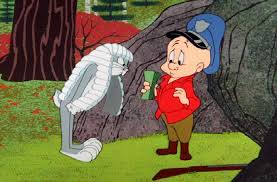
As this short begins, we are told that people’s behavior may be changed by their attire. (This is scientifically known as cosplaying.) But a full outfit is not exactly necessary. All one needs is a hat. Our example being Elmer. When he puts on a hunting cap, he goes psychotic. Seriously. He wants to see Bugs’ blood paint the scenery. He’s never been that crazy before. So, it’s no surprise that Bugs is pretty scared. As their chase begins, a truck full of hats’s doors open and spill the contents all over the woods.

An army hat falls on Bugs and he has Elmer march into a lake. Elmer sinks but his hat doesn’t and when he comes back up, he has a general’s hat. (Making him act like Douglas MacArthur.) Bugs runs from his now commanding officer, but Elmer gets his original hat back and fires. Bugs has dove into a hole and ends up burrowing up under a game warden’s hat. Finding Elmer shooting the army hat, he asks what he’s doing, as sergeants aren’t in season at the moment. A gust of wind blows Elmer’s hat off and replaces it with a pilgrim hat. He just trying to get Thanksgiving dinner.

The wind next gives Bugs a Native American wig and he takes Elmer’s gun and gives chase. They both lose the hats and the tables turn. But as Bugs crosses a busy street, a bonnet falls on Elmer and makes him as feeble and timid as a stereotypical old lady. Good thing a boy scout hat fell on Bugs and he wastes no time in helping Fudd cross. (Reciting the Scout law as well. I hated that. It’s too long and makes one sound like there perfect.) A car drives by and they lose the hats again. As Bugs flees once more, he ends up with a mobster’s hat and tells Elmer to get out of his territory. But a policeman cap falls on Elmer and he tries arresting Bugs. (Even thinking he’s Rocky. The mobster, not the boxer.) Bugs hands him some money as a bribe and even though Elmer doesn’t accept it, the wind replaces Bug’s hat with a Judges… hat? wig? The thing they always wear in cartoons.

He is angered to see Elmer holding bribe money, (where did Bugs get that in the first place?) and sentences him to only 45 years and hard labor in prison since he knows Fudd’s a family man. (They might still be alive when he’s free.) As Bug’s leaves Elmer asks him to marry him, as he now wears a bridal veil. A top hat landing on Bugs has him agreeing and he carries his “bride” home.

Personal Rating: 3

Ali Baba Bunny

“It’s mine, ya understhand? Mine! All mine!”

Directed by Chuck Jones; Story by Michael Maltese; Animation by Richard Thompson, Ken Harris, Abe Levitow, and Ben Washam; Effects Animation by Harry Love; Layouts by Maurice Noble; Backgrounds by Philip DeGuard; Film Editor: Treg Brown; Voice Characterization by Mel Blanc; Musical Direction by Carl Stalling and Milt Franklyn. Released in 1957.

This one is a classic. I think it’s Bugs and Daffy’s best known team up, outside of the hunting trilogy. Naturally, it’s one of the 100 greatest Looney Tunes and ranks number 35 on the 50 greatest cartoons.

In (somewhere in the Middle East, I’m sure) a midget seals a cave that is brimming with treasure. He tells the guard there, (Hassan) to guard it with his life, because the price is life. Poor Hassan. I bet he’s really a nice guy who wants no part in this. But seeing as he’s got no alternative, he dutifully stands watch. The midget rides away on his adorably ugly, midget camel. We then see a very familiar burrow coming along. It heads right into the cave. Having noticed this, Hassan tries to enter but can’t seem to remember the magic words. (“Open sarsaparilla? Open Saskatchewan?”)

Inside, Bugs announces that they have finally made it to Pismo Beach. Or have they? As he puzzles over things, his travel buddy, Daffy notices the treasure in a way I think we all would act. (Wide eyes, licking lips/beak, and plotting to get rid of the other guy.) He claims it as his own and shoves Bugs back into the hole, before unleashing his inner Scrooge. (I remember in middle school seminary class, I got to teach about the seven deadly sins. I used Looney Tunes as examples and this was greed.)

Hassan meanwhile has finally gotten the phrase correct. (“Open septuagenarian?” No. “Open saddle soap?” Wrong. “Open sesame?” DING!) On his way out, Daffy mistakes him for a red cap and asks for a cab. Hassan slices his cute diamond studded hat in half. (Shame. That was my favorite treasure.) Daffy flees back to Bugs asking for his help in exchange for a diamond. Bugs is too cool to care. Daffy then tells the angry guard, that Bugs is the one who brought them there and he should get all the blame. Bugs has disguised himself as a genie and offers Hassan a reward if he frees him. He does so, and Bugs grants him the treasure all to himself. (Doing an amusing chant as well)

With that taken care of, Bugs heads out and thinks that maybe they’re not at the beach. But his pondering must be put on hold as Daffy has gotten himself in trouble again. Seems he took one of the diamonds that now belong to Hassan. Bugs agrees to help and gets rid of Hassan by having him climb a rope into the clouds. (Here Daffy admits that he can’t help being greedy, it’s his hobby. At least he’s honest) With the guard gone, the treasure is all Daffy’s. He loads up a mine car with all the loot, (Good thing he always has that on him.) and takes one more quick look to make sure he’s got everything. He finds a lamp and rubbing it produces a real genie. Even though, it sounds like he’s going to grant Daffy a wish, the duck’s paranoia has him assuming the genie is after his treasure and tries to shove him back in the lamp.

The genie is furious, and Bugs (wisely) decides to leave. Daffy is unafraid of the genie’s wrath, and says one of the best lines in all of ever. (“Consequences, schmonsequences. As long as I’m rich.”) Brilliant. I have the feeling every celebrity ever has said that at least once. (And once Kanye is out of debt, he’ll say it again.) At the beach, Bugs muses about what happened to Daffy as he eats clams. (They must taste like carrots.) He finds a pearl in one. (Or they’re oysters.) Just then, an ant-sized Daffy runs out of the hole and claims the pearl as his own. Annoyed, Bugs shuts the bivalve on him. (It’s probably dead now, so at least he won’t be digested.) Daffy doesn’t seem to mind. And why should he? The oyster is his world!

Personal Rating: 5. If for no other reason than Daffy is probably at his best here.

Kiddin’ the Kitten

“Here comes trouble for Dodsworth.”

Directed by Robert McKimson. Released in 1952.

This short begins with a lady freaking out over some mice. (Come on, really? I still refuse that any woman in the history of ever has freaked out like this over a mouse.) The mice mock her, and rightfully so. If she’s going to act like this, she deserves to be ridiculed. Of course, maybe if her cat actually caught mice, she might be a little more sane. The cat, Dodsworth, (Interesting name.) would rather just lie about eating sardines. The mice don’t fear him in the slightest and take one of his snacks for their own. The woman tells the cat to cat-ch them, (heh-heh) or he’s out of the family.

Work is not something he’s too keen on. Apparently no one in his family had to stoop to such lows. What he really needs is someone to do it for him. With that idea in mind, he puts a sign outside claiming it’s a school of mousing. (M.U. we’ll call it.) Almost right away, he’s got someone interested. A little kitten that actually is pretty cute. (Maybe in part, because I think it looks more like a dog than anything.) Despite the bow, Dodsworth refers to it as a male, so I guess I have no choice but to do likewise. (But I’m still going to give it the genderly ambiguous name of Riley.)

His teaching method states that experience is all you need. He hooks Riley to a fishing hook and tells him to tug when he’s caught a rodent. The kitten is cast into the kitchen. The mice are not scared. (Why should they be? In a house where potential dangers either laze about or act hysterical…) but Riley gives chase regardless, cornering one into a hole. He puts some cheese on his middle finger and the now dazed mouse takes it. Riley then flicks his finger, (or toe I suppose) on to the mouse’s head knocking him out. Now back with the teacher, he learns that getting one mouse at a time is not good enough, and he’s cast out again. So he gets a big wheel of cheese and fills it with ball bearings. (Why were they in the fridge?) The mice either don’t chew their food, or they just possess the strongest teeth of all rodents and gobble it down.

Riley tugs back on the line and when he’s pulled back, uses a magnet to attract them all to him. Hearing his lady approaching, Dodsworth quickly gives him a diploma and shoos him out. Walking to the cage of mice, he takes credit for the work. I guess Riley figured it was weird to be rushed out so fast, as he came back to witness the whole thing. In retaliation, he lets all the mice go. The woman acts pathetic again, and Dodsworth is bound and gagged. Riley then chases them all out saving the day. Later, Dodsworth has apparently been kicked to the curb as Riley now occupies his bed and had his name crossed out. But I think he should have kept the name. It suits him now that he has adopted Dodsworth’s habits. Seeing this, the mice come back and pick up where they left off. Riley-sworth quotes the original, “One of these day’s I’m going to have to buy myself a mousetrap.”

Personal Rating: 3

The Unexpected Pest

“Okay sthlave, I’ve got a job for ya.”

Directed by Robert McKimson. Released in 1956.

Before we begin, a brief mention of the symphony I attended last week: IT WAS GREAT! I got to talk to a lot of Looney Tunes fans. I complimented a man’s tie, a woman complimented my shirt, and I got a picture of me posing next to Bugs in a scene from “Rabbit of Seville.” They played the corresponding music to several shorts. (Including a few Tom and Jerry ones.) The short’s you’d expect were there: “Baton Bunny,” “Long-haired Hare,” and obviously: “What’s Opera, Doc?” All in all, it was spectacular. Here’s hoping everyone had a merry Christmas. (I did.)

A man comes home but is disgusted by the cat who lives there. (Sylvester) The feeling’s mutual however, as Sylvester hides behind a pillow when he looks at the man’s face. (Best joke of the short right there.) The man complains to his wife,(June Foray in one of her first roles at Warners.) but she reminds him that they got the cat to catch mice. Which he apparently did. (It’s nice to not have him fail for once.) Since there are no more mice, she agrees to get rid of the cat tomorrow.

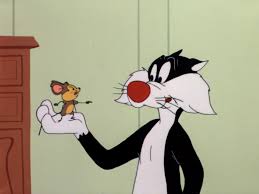
Sylvester has heard the whole thing and is not willing to part with his home. Luckily for him, there is a mouse right outside, who faints at the sight of the cat. (And this mouse shall be named: Dennis.) Sylvester brings him to with some cheese, and the mouse thinks he died and went to heaven. When he sees the cat still behind him, he figures it’s the other place. Sylvester lays down the rules: the mouse does what he commands, or it’s down the hatch. He has the mouse go in and scare the woman of the house. (Did any woman really ever jump on a stool at the sight of a mouse? I figure they’d beat it to death with a broom first.) Sylvester comes to the rescue and pounds the rodent. The wife tells her husband the cat is staying. If there is one mouse, there must be more about. (Poor Dennis probably IS a father.)

The charade goes on for a few weeks, until one day when Sylvester gets his pet, Dennis talks back. He’s been thinking, and realizes that Sylvester is not going to eat him; he’s far too valuable. In fact, he can do as crazy stuff as can be as he wants. Jumping off of high places, grabbing mousetraps, and standing under anvils, knowing the cat will save him each time. His antics go too far when he sits on a lit firecracker. Sylvester throws it out of the room, where it explodes on the man. Cut to Sylvester battered and bruised. (Holy crap! That guy actually beat a cat up? I hate the things, but that’s flucking evil! I hope for his sake that Dennis’s family isn’t there, or your wife will have his head.)

Speaking of that mouse, he waves to Sylvester from a bridge and jumps. He pretends to drown much to the puttytat’s delight. As he goes on his merry way, Dennis tells us he figures after all that hell, he deserved a happy ending.

Personal Rating: 3

See you next year!

Cat Feud

‘Electro-Magnetic Crane’

Directed by Chuck Jones. Released in 1958.

Well, forget that Marc Anthony and Pussyfoot ever met. According to this short, this is how it all really began. Of course, Marc is gray here, so it might just be an alternate universe. The short itself starts in a construction site. Marc Anthony is a guard dog who marches in time to the short’s soundtrack. He takes great pride in his work and ferociously barks at a moving bag that contains a kitten. Um… Why was it in a trash can? (Humanity, what’s wrong with you!) Despite the large canine barking in it’s face, the kitten is not afraid and instead makes itself comfortable on the dog’s back. He falls for the cutie and adopts him.

He sets him down with a sausage to eat, while he continues his rounds. Hungry eyes are watching, however. It’s a creature that looks like a mix between Claude Cat and the Grinch. So we’ll call him Grinch cat. He heads for the meaty treat, but as soon as he lays one paw on it, Marc Antony is there to pound him. But the sour puss is not going to give up that easily, as he begins to raise the I-beam the kitten is on. In turn, Pussyfoot wakes up and takes note of the meal in its possession. With the dog’s help the kitten, manages to not walk off into the abyss, but he is left hanging by another beam. Grinch cat, shakes it a bit, (sure showed him.) and goes back to the hunt. (I really like how he’s animated.)

When he does get the sausage from the kitten, the kitten shows it is not pleased. Grinch cat does the ole “Go on, hit me!” routine, not seeing the I-beam Marc Antony has sent heading for his skull. Thinking the pain was delivered by the kitten, he doesn’t notice that a return trip means he’s about to be I-beamed again. (And I beamed.) Fearing the obviously herculean super kitty, Grinch cat grabs a hammer. Marc in turn makes use of today’s quote and pulls him and the hammer up. Grinch falls down, and Marc releases the hammer head on cat head. The cat grabs a hardhat and keeps his cranium intact. But the clever dog, turns the magnet back on, and the cat flies back up. Then Marc just trolls him by quickly turning the thing off and on. But he has to stop, when he sees his precious Pussyfoot about to fall again.

He saves him (her/it) and Grinch tries to make a break for it. He gets his foot caught in a bucket though, and the magnet grabs him again, wedging him between the pail and the hat. Later that night, he’s still up there as the dog and kitten happily bunk down for the night.

Personal Rating: 3

Guess who is going to a symphony tonight? Not just any one though, this one is going to be playing a tribute to Looney Tunes. A dream come true! Here’s wishing you all a Merry Christmas!