The Bear’s Tale

“Isn’t this where the three bears live?”

Supervision by Fred Avery; Story by J.B. Hardaway; Animation by Rod Scribner; Musical Direction by Carl W. Stalling. Released in 1940.

This short begins by showing us the cast. Papa is played by Papa Bear, Mama is played by Mama Bear, etc. The only exception being that Goldilocks is playing herself. In the beautiful, green, forest, there is a cottage where three bears live. They sit down to their porridge but find it too hot. Papa tries to cool his mouth down with a gulp of water, but drinks from the hot tap. I just want to point out that I love this guy. He won’t stop cracking jokes and laughing heartily at them. It’s Tex Avery voicing the bear, and he’s loving every moment of it.

Deciding to let it cool, the family goes for a ride on a tandem bike for three. (The little bear being forced to do all the pedaling.) While they’re gone, someone else is waltzing through the beautiful, green, forest. It’s little Goldilocks. (Is that her real name?) She comes to a cottage and enters. Whoops! There’s somebody else’s story going on here. A wolf in a bed lets her know that she’s at the wrong place. He sends her on her way, but figures that she is no different from Little Red Riding Hood, and so he takes a taxi to the Bears place to surprise her. (The bears in question, are still biking. Papa is having a grand time pretending to be a siren. Have I mentioned I love this guy?)

Goldilocks gets to the cottage and begins eating. At the same time, Red gets to her location and finds a note from the wolf saying he got tired of waiting for her and went to find food elsewhere. Red phones Goldie, (on her way to the bedroom) and lets her know of the plan. Goldie leaves just as the family returns. They are sad to find their food gone. The wolf sneezes and the trio panics, thinking there is a robber in the premises. Papa tells the two to stay put and he’ll go get the crook. As he climbs the stairs, he laughs once more and tells us he knows full well that there is no robber. He read this story in Reader’s Digest and is prepared to find Goldie. (Okay, it’s official. If I was a gay cartoon bear, I would marry this magnificent creature.)

Imagine his surprise when he finds an angry wolf in the bed instead. Scared, he takes his family and they run off into the sunset. Papa, Mama, and the little bear’s bare behind, behind. (Yes, they end on a butt joke. But I’ll forgive it for the spectacular wonder that is Papa. It’s a shame he never got his own series.)

Personal Rating: 4

Don’t expect a post next week. I will be on a trip. I’ll resume the week after next.

Swallow the Leader

“I came here for a swallow, and I’m not leaving until I get a swallow.”

Does anyone want to play Jacks after dinner?

Directed by Robert McKimson. Released in 1949.

I never mentioned, but last week’s post is one of my favorite Porky shorts. He was offended when he heard that, seeing as how he’s absent for about 80% of the film. To appease him, I’m sharing another one of my favorite of his films that has only him. Enjoy!

Personal Rating: 4 (unless you’re too immature to handle it. Parental discretion is advised.)

We’re not going to be on speaking terms for awhile. So why don’t I just move on to today’s short?

It’s that time of year again. The time when the swallows come back to Capistrano. (I don’t get why the narrator is so amazed that they find their way back every year. Don’t mention pigeons or salmon to him. He might crack.) Naturally, such a phenomenon attracts many bird lovers who come to see the event. And a bird lover is indeed there. A cat with no name is waiting. (I don’t know why he has that collar on. I guess to have some identity? I’ll solve that by calling him Miles. He looks like a miles.)

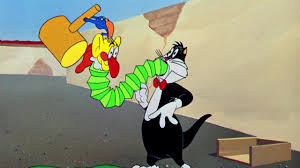
The scout swallow comes about making sure everything is ready for his flock to nest in. Miles quickly puts a nest together for him. The bird likes the new nest, but why are there teeth in it? He let’s his friend in first. A Mr. In the box, by name. Miles’ neck becomes elongated. He chases the little bird with a net, but has to stop at the edge of the building. The bird drops a brick in his net for him. How thoughtful. The bird finds a metal swallow and paints it to resemble him. Miles takes the bait and swallows it whole. Now he is at the mercy of the bird’s magnet. (One of those horseshoe kind. Has anyone actually seen one of those? Outside of cartoons I haven’t.) He ends up stuck around a pole thanks to the bird, and the bird puts a lever under him. He ends up turning into a test your strength game. Or rather, test the cat’s skull’s strength game. (Ouch.)

Wings, a superman costume, and a gun don’t work, and trying to bait an electric plate with corn, might’ve worked if the bird hadn’t turned it on first. The swallow finds a tooth free nest and jumps in. Jokes on him; the bottom was fly paper. (Or in his case, anti-fly paper.) Miles prepares to enjoy his snack, but it appears he took too long. The rest of the swallow flock appears and chase him out. Determined to get a swallow, Miles sees a sign advertising them. He rushes over and finally gets something in his belly: alcohol. At least he seems happy.

Personal Rating: 3

Pizzacato Pussycat

“Whoever heard of a mouse pianist?”

Directed by I. Freleng. Released in 1955. (A nice touch: the quotation marks in the title are music notes.)

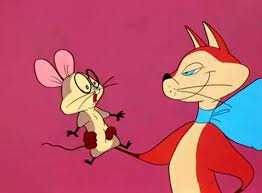
This short, which looks a lot like the shorts U.P.A. was producing, stars two animals. They live in the house of John and Vi Jones. Vi claims that not only has a toy piano gone missing, but she keeps hearing it play. If I know anything about mysteries, (And I definitely do.) then the culprit was the lobster! No wait, he’s a percussionist. It was probably that Schroeder kid. But seriously, the thief is a mouse. He sneaks out to get some more sheet music, but the cat of the house takes notice. (Name time! Let’s call the cat, Chauncey and the mouse, Michael.)

The mouse loses his glasses in the chase and the cat kicks them under the couch before grabbing the rodent. Then he picks up another pair off the ground. (What?) Now seeing his possible doom in front of him, Michael asks to be spared. After all, he can play piano. (Although, I’m more interested in where he got glasses.) Laughing at the absurdity, Chauncey gets the piano and demands a demonstration. Michael provides, but now that he is out of his hole, both of the Jones’s can hear him. In a panic, the cat puts the pianist mouse in the larger piano and mimes playing it himself. The owners are shocked and call the papers. The cat decides to spare the mouse as long as he plays (get it?) along.

Soon they are all set to play for a large audience, including several critics. Things start smoothly, but all too quickly, one of the piano keys breaks Michael’s glasses. The resulting music is quite abominable, and the cat is exposed as a fraud much to his and his owner’s shame. Back at their place, the cat chases the mouse again. The resulting chase leads them to a drum set, (Who plays those? The piano can at least be seen as decoration, but who just keeps drums around the house?) While swatting at the rodent, Chauncey discovers that he is quite skilled at the drums. Michael grabs the piano and they form a pretty sweet duet. Vi goes to call again, but John declines against it and the two keep their musical pets a secret to the world. It’s probably for the best. Michael isn’t going to live longer than 3 years.

Personal Rating: 3

Dough Ray Me-ow

“Louie is my friend. Yes sir, my best little pal.”

Directed by Arthur Davis. Released in 1948

One of Warner Bros. best one shots! This short stars two pets. The parrot, Louie and the cat, Heathcliff. (Who predates the comic strip Heathcliff by about 25 years. Speaking of, have you ever read it? It’s the most surreal bizarre comic I’ve ever seen. I can’t even tell half the time if there is a joke being told.) Back to the REAL star…

Heathcliff is dumb. He’s so dumb that he actually forgets to breathe! That… is flucking hilarious. No, that’s not a typo. I’m not swearing. Louie helps him out though, despite the fact he is clearly annoyed. (That’s so sweet.) Heathcliff (who actually got make a cameo in “Looney Tunes back in Action“) finds a piece of paper that he wants Louie to read. Turns out, it’s their owner’s will, and when they go, Heathcliff will inherit everything. Once he’s gone, Louie gets the dough. (Makes sense. Parrots tend to live longer than cats.) Louie tells him that instead of reading, he should go on a vacation. The cat returns half a second later due to being homesick. Looks like he’ll have to be permanently removed.

Louie bribes a bulldog to come kill the cat when Louie calls for help. Heathcliff is as strong as he is stupid and saves his chum while holding the dog in one paw. While the cat cracks nuts, (with the nut in his mouth and his head in a giant nutcracker) Louie tries playing a game of “William Tell.” (Which he unhappily seems to be a master at.) He rips a wire out of the wall and invites the cat to play “Radio.” You’ve never played? It’s a wonderful game! All you do is stick two live wires in your ears. Music will then play. (Warning! This only applies to mammals. If you are a bird, then the basic rules of electricity WILL apply to you.) Even putting a can on the cat’s head and having walk into an upcoming train doesn’t kill him. He should have just let Heathcliff do himself in. Besides his breathing problem, he seemed pretty close to crushing his head when he was playing with his nuts. (Don’t try to find an innuendo there by the way; there is none.)

Louie then surprises Heathcliff with a birthday cake. With 3 real candles, and a stick of dynamite. (It’s the thought that counts.) Heathcliff is apparently smart enough to know about numbers as he claims that he is only 3 and hands the explosive back saying it’s unneeded. (So depending on how old Louie is, he probably couldn’t wait another 10-11 years.) Despite Louie claiming he IS four, Heathcliff refuses to accept it and takes the cake and runs. (Why didn’t Louie make all the candles explosive? Your face, that’s why.) After a chase scene, Heathcliff finds his birth certificate that literally says he’s four. He takes the candle back, and wouldn’t you know it, Louie’s scheme works. Heathcliff bids him farewell, as his nine lives fly up to cat heaven.

But Louie just can’t keep his big beak shut, and tells him about the money he can’t take with him. Life number 9 calls the other back, and they all fly back into the body. If Heathcliff can’t take the money with him, then he’s not going. (I didn’t know death was that easy to get out of. I guess every time we sleep, we technically die. We just choose not to permanently die yet. Death is considerate like that.)

Personal Rating: 4

The Night Watchman

“I guess you’ll have to watch the kitchen tonight, son.”

Directed by Charles Jones. Released in 1938.

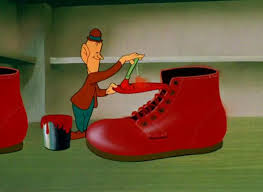
In Chuck’s directorial debut, our story takes place in a house. There is a cat there, but he is sick tonight. Therefore, his “The Night Watchman” duties will have to be handled by his son. His son looks like some kind of a rodent to me, with his big buck teeth. And he’s kinda clumsy too. Even smacks himself when trying to salute. He heads out to perform his old man’s job. Geez, he’s tiny! I know he’s a rodent, but he didn’t look much smaller than his father. Maybe the kitchen is giant?

Either way, he’s immediately in the company of a mouse. The mouse does the ole “what’s that and flicks his nose” gag and steals one of his buttons. Learning that the regular watchman is sick, he calls his posse and they begin to feast. They eat their way through the food and make some humorous sight gags. Like, starting at one end of a pretzel and eating one’s self into a knot, and getting into a jar of olives and eating them all. (Thus creating your own prison with only an olive jar.) The kid tries to get them to stop, but he’s not very assertive and actually ends up helping prepare a steak for the leader.

The mice perform a floor show and this forces the child to yell to get his “quiet” heard. The leader hits him and he walks off in tears. His conscience berates him for letting his father down and reminds him he’s a cat. (Really? All this time I though he was a gopher. That still doesn’t explain why he’s so small.) With newfound courage, he heads back into the fray and pounds every mouse that tries to stand in his way. Before he’s through with them, he is sure to steal a button from the leader. Turnabout is fair play.

Personal Rating: 3

Booby Hatched

“Who turned off the heat?”

Directed by Frank Tashlin.  Released in 1944

You know what this Sunday is? If you don’t then go look at a calendar.

Sorry. That was rude. (You may not even have a calendar.) It is Mother’s day. And one of the sweetest things to me, is the relationship between mother and child. How they are willing to die for them, and how the child sees the mother as essentially an almighty superhero, who can protect them from anything. I’m rambling. Let’s talk about a short dealing with such love.

It’s winter, and a duck (with teeth) is desperately trying to hatch some eggs. (She also has no name. I shall call her Ethel.) It is really cold, and the eggs have begun to turn blue. (The father was a smurf.) She holds them up to a light to see inside, and finds the soon to be ducklings sneezing, warming themselves by a stove, skating and skiing. (At least they’re not dead.) She does her best to keep them warm, but the poor things are below subzero! Time for drastic measures.

As much as it pains her, Ethel sticks her rump right up to a lantern. She’s in agony, but a true mother won’t let her children die, if she can help it. When she’s done, she goes over. The eggs hatch before she sits down. (“Don’t do it! We’ll come out.”) I guess it’s warmer outside than in an egg, so the new family heads down to the pond for a swim. Uh Oh! One egg didn’t hatch all the way. Craving warmth, the egg with legs goes off to find his mother. Ethel meanwhile, is doing a head count and finds that her little Robespierre (such a great name for any generation) is missing.

Finding his footprints, she follows them into the woods. Robespierre is nearly dead, but finds his mom wearing a fur coat. (A bear.) And he slips under “her.” The bear takes it rather well. (“So I laid an egg.”) But this was all seen by a hungry wolf. Wait, is that William? No, his mailbox says he is known as B. B. (So he’s a transvestite. Because Bebe? Forget it) He uses some TNT to blow the bear off, and happily takes his prize home. The bear takes it rather well. (“Dreams like this, worry me, ya know.”) B.B. runs into Ethel on his way back, and the two keep swiping Robespierre from the other. Eventually, Ethel gets home with a doorknob.

B.B. is preparing some egg drop soup, when Ethel returns and pokes his eyes through the key hole. She then rescues her son. Is he grateful? Heck no, he was finally getting warm. He dives back in.

Personal Rating: 3

Puss N’ Booty

“Have you any more canaries?”

Directed by Frank Tashlin.  Released in 1943

When Merrie Melodies first came out, the main difference between them and their Looney counterparts was that they did not have a main character. As time went by, Merrie Melodies became the shorts that were colored, and Looney Tunes were still black and white. This here is the last black and white one. After this, I have no idea what the difference was between the two, if there was any.

A lady (Bea Benedarret) comes home and finds her canary, Dickie, gone. Rudolph the cat hasn’t seen him, but seems genuinely worried, and helps search. (After he hiccups some feathers.) As soon as his owner leaves the room, he whistles like a bird and opens a window. She comes back to find the cat sobbing and waving goodbye. That makes 5 canaries gone in one month. Most people would give up and consider it a waste of money. But not (let’s call her) Megan. She calls the pet shop  up to see if they have any more of those birds. (Rudolph prays for a yes.)

Happy days! They will send another one right over. Rudolph obviously has a severe case of gluttony as he paces back and forth many times and gets excited at every passing truck. (Canaries must be really tasty. Anyone have a recipe?) Finally, the truck shows up with the newest addition to the family, Petey. Megan loves him very much and gives him plenty of seed, telling him to eat it all and grow up big and strong. (Rudolph agrees with that statement.) She also gives the cat a saucer of either milk or cream, (whatever one gives them) and leaves the room. Rudolph spits out the dairy and immediately enters vicious mode. He pounces, but Petey is quite the resourceful bird and flies up, lifting his cage to safety, and making Rudolph crash. (Forget the seed. I think he’s plenty strong already.)

Rudolph ties the cage down, (and I can’t help but think if he was able to do that, he could have already snatched Petey.) and pounces again. This time the bird opens both of the doors and Rudolph crashes again. That night, Rudolph gets into Petey’s cage and a huge fight ensues. Megan comes downstairs and finds Rudolph missing. She asks a sleeping Petey if he’s seen her, but he hasn’t. However, before the short ends, he does hiccup Rudolph’s ribbon. Don’t mess with a bird that makes the food chain his hen.

Personal Rating: 4

You’re an Education

“Calling all countries! Calling all countries!”

Directed by Frank Tashlin. Released in 1938

This short takes place in a travel agency, where the brochures come to life. We see many different countries mixed with appropriate music gags. Hawaii plays “Aloha-oe”, Oxford plays “We’re working our way through college”, Scotland plays “The cambells are coming”, Africa plays “Conga”, and Mexico plays “La Cucaracha.” All the racial stereotypes cheer. “Cuba” plays a tuba and “India” plays that pipe, that snake charmers play. “Little America” and “Asia Minor” shake their rattles to the music, and a fish from the “Indian Ocean” does a war chant.

While the title song plays, two “Hungary” fellows visit the “Cook Islands” to fill their rumbling bellies. But why stop there? They get “Twin Forks, Minnesota” and load up their plates with “Turkey”, “Sandwhich (Islands), some “Thousand Island” dressing, “Hamberg(er)”, “Oyster” (Bay), and some “Java” to drink. While they tuck in, the thief of “Bagdad” sets about robbing the “Kimberly Diamond Mine.” He unlocks the door with the “Florida Keys” and tries to make off with his prize. However, he accidentally steps on a toy duck, waking a baby. It’s “Wales” alert everyone and many troops like the “England” guards and “Canada” Mounties rush after him.

He is found trying to sell the diamond to the “Pawnee” Indians and he tries to run for it. The “Pisa” tower blocks his path, he is poked by “West Pointers”, and must take cover from an erupting “Mt. Vesuvius.” His hiding place in the “London” fog, is revealed by the “Holland” windmill. A man from a “Dude Ranch” lassos him and drags him through the “Red, Black, and Yellow” seas. (Turning him many different colors) “Italy” uses its shape to kick him and he lands on the horse of the Lone Stranger. They gallop off together. (Huh. The villain won.) Interestingly enough, the Lone Stranger would reappear a few months later with Porky.

Personal Rating: 3

Now that Summer is Gone

“Poppa needs a new pair o’ shoes.”

Directed by Frank Tashlin. Released in 1938.

Another year has gone by, and in the tradition of updating each year, I will now list the year in which the day’s featured short was released. So, let’s begin.

It’s Fall, and that means the squirrels are busily storing acorns for the winter to come. All except one little squirrel. Work is for those who don’t like to have fun. He’d much rather gamble for them. He wins and the other all storm off. (What poor losers.) Unfortunately, the squirrel’s father shows up and scolds him for his deeds. (The other squirrels laugh and tell him that gathering acorns is the right way to do it. Hypocrites.) Despite his dad’s warnings, Jr. keeps it up and wins all the time. Soon enough, it’s time to go get their acorn supply from the “nutional bank.” His dad reminds him to not gamble while doing so, but he immediately runs into another squirrel who offers to play with him.

Admist a montage of dice, cards and roulette wheels, the little squirrel steadily loses everything. (Obviously that older guy is cheating.) With nothing left to win, the gentleman leaves and Jr. sadly heads home. Once there, he begins telling a tale of how bandits beat him up and stole the acorns. (They must’ve been nice enough to clean him up afterwards.) Too engrossed in his fib, he doesn’t notice his dad putting on the disguise he was wearing. (Are you shocked?) But he does soon enough. Having caught his delinquent son in the act, his father plans to give him ten lashes. Has Jr. learned his lesson? Will he take the punishment like a man? Heck No! He offers double or nothing but gets paddled anyway. We hear his cries of pain all through the ending.

Personal Rating: 3

Little Pancho Vanilla

“You will never be bullfighter. You will always be, Mamacita’s good little machachito.”

Directed by Frank Tashlin

Our main character, Pancho, is reading a book on bullfighting. His mother however, is very discouraging and pretty much tells him he sucks. As Pancho (whose age is also never mentioned) sulks, three senoritas (of unidentifiable age) walk by. They cheerfully say hi, but Pancho is too busy brooding to be polite. The girls sing/mock him. (That’s the best part) Their attention is grabbed by a poster, that shows Clark Gable as a toreador. He’s apparently the greatest in the world! Or at least in Mexico. Pancho knows of one better: himself. The girls laugh. Come the big day, Pancho tries to enter the amateur entrance with everyone else. (At least he’s not insisting he’s a pro) He is turned away due to being too short. He sits on a wagon and grumbles at the fact they’re not letting him in, because he would scare the bull. (Suddenly, I have a huge craving for sour grapes) Inside, the bull is making billiard balls out of everyone. They bounce around, (dissapearing) and one flies out and lands on the wagon Pancho’s on. This launches him into the arena. He lands on the bull who is knocked down. Getting his second wind, the bull charges. Pancho may not be very big, but he is fast and gets out of the way. The bull still launches him, but Pancho launches him right back. Not fooling around, the bull revs up and gives a mighty charge that sends Pancho into the air. He falls on the bull and knocks him out for good. Back with his mom, Pancho and the girls (who I think I will name: Rose, Rosie, and Rosita) tell her what happened. She still acts kinda like a jerk. (You could’ve gotten hurt) But at least she makes use of Pancho’s first prize: a washing machine.

Personal Rating: 2