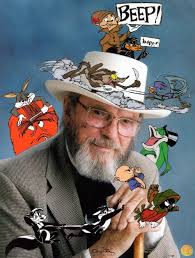
Charles Jones

Here is another example of the amazing talent Warner Bros. had. Some would say he’s the peak.

Born in 1912, he was the son of an unsuccessful business man. When this father would start up a new business, he would always get some stationary with the new company name on them. When they failed, he told his children to use them up as fast as possible. As such, young Charles got plenty of drawing practice. Good thing too, in an art class later in his life, the professor said that everyone has 100,000 bad drawings in them that they have to get out before they can draw anything worthwhile. (Harsh, but that explains why I can’t draw.) Chuck had no such worry as thanks to all that paper, he was well over the 200,000 mark.

After graduating from Chouinard Art Institute, he received a call from a friend who had been hired by the Ub Iwerks studio. Starting as a cel washer, he moved up from painter to in-betweener, (the person who draws what comes between the drawings the animators make) He also met a cel painter named Dorothy Webster, who would one day become Dorothy Jones. He joined Warner Bros. in 1933 as an assistant animator, but got promoted to actual animator two years later. He was assigned to work with another man named Tex Avery. They moved into what they called Termite Terrace with other men named Bob Clampett, Sid Suterland, and Virgil Ross.

When Frank Tashlin left the studio, Chuck took over his unit and became a director. The man created many characters for the studio. Some not quite well known even though they are more hysterical than the majority of cartoons today, (Charlie dog, the Three Bears, Hubie and Bertie) and some that are rightfully considered cartoon legends. (Marvin the Martian, Pepe Le Pew, and Wile E. Coyote and the Roadrunner.) He would also work with Dr. Seuss himself, Theodore Geisel on Private Snafu shorts, (and later would direct “How the Grinch stole Christmas”) he did some uncredited work on Disney’s “Sleeping Beauty” and wrote the screenplay for the film “Gay Purr-ee” (Animated cats in France? Why does that also sound so Disney?)

He left Warner Bros. in 1963 and worked for MGM, making some Tom and Jerry shorts until 1967. He continued work on animated TV adaptions of stories like “Rikki Tikki Tavi”, “The White Seal”, and “Horton hears a Who.” Also producing the “The Phantom Tollbooth” movie.  He even made a cameo in the movie “Gremlins.” His last Looney Tune was 1996’s “From Hare to Eternity” which was a tribute to Friz Freleng, who had died the previous year. (It’s surreal to see Sam being directed by Jones. Yosemite Sam that is, not Sam the sheepdog.)

The man died in 2002 due to heart failure, and his ashes were set out to sea. He may be gone, but his work is still highly celebrated. He won Academy awards for three of his short films, (“For Scent-imental Reasons“, “So Much for so Little“, and “The dot and the line.”) And in “The 50 greatest cartoons”, Numbers 5, 4, 2, and 1 are all shorts he directed. Mr. Jones, I salute you. You were one of the most talented Human beings on this planet. I am honored to have shared planet time with you. 

90 Day Wondering

“I’m a civilian!”

Directed by Chuck Jones. Released in 1956.

Two posts in a day? It’s an October Miracle! (Or the idiot who runs this place didn’t plan ahead in advance very well, and realized he needed to have two in one.) Well anyways… At a location named “Fort Itude” (Which let’s be honest, is one of the best names of any place in history.) A tornado seems to leave. Taz was in the army? Nah, it’s just Ralph Phillips who is beyond happy to be “normal” again. His family welcome him back, but soon the excitement wears down and they settle back to their daily routine.

Ralph decides to go out for some fun. (Of course, not until after he’s had a few beers and smokes. The kid of “From A to Z-z-z-z”, people. ) He heads to the malt shop he used to go to, but nobody he used to hang with is there. They’ve been replaced with younger teens who make Ralph feel like an old man. But he has his address book! He calls up the girls he used to know. Which leads to an expected, but still hilarious joke: “Mommy? A man wants to talk to you.” He goes through them all; none of them are interested. If you weren’t there to engage them every day, you deserve to die alone.

As Ralph mopes in the park, a tiny little character shows up. This is Pete, the civilians friend. He’s here to tell Ralph the benefits of being out of the army. Another character shows up named Re-Pete. He looks cool, so naturally he is my new friend. Both begin trying to persuade Ralph to stay on/come back to their side. The army may pay less, but it gives so much more. There are over 400 jobs available, it can finance one’s education, give you a paid vacation, and if you play your cards right, you can retire at age 38. (Dang. Is that still possible? I’d look it up, but I don’t want to.) Pete is losing the battle and none of the ideas he’s pitching are working. (Like inventing dehydrated water and inheriting Fort Knox. Both of which I’ve already done multiple times.)

Ralph re-enlists. A nice short, but it seems to be saying that you can’t be happy unless you’re in the army. Say good-bye to free will kids. Your choice has been made.

Personal rating: 2

Ralph Phillips

You know, I’ve mentioned Ralph before in previous posts, but I have yet to give him his own post. I aim to fix.

Technically speaking, Ralph only appeared in 2 classic shorts from the golden age. But, he also starred in two army recruitment films and an unaired TV pilot that was repackaged into a theatrical release. So he still makes the criteria for getting his own spot. Ralph is just like any ordinary boy. He as an active imagination and it showed in his two shorts. He was either daydreaming during school, or fantasizing at home. Both shorts are very creative and his first one is considered one of the 100 greatest Looney Tunes.

In the recruitment films, he was much older and a little bit more serious. Which just goes to show how much he grew up. And if you watch his shorts, listen carefully to his voice. Sound familiar? No, it’s not Mel. It’s Dick Beals, the same person who was Speedy Alka-Setzer. Ralph doesn’t get a lot of recognition these days. (I mean, why market a small boy, when a talking rabbit is far more profitable?) But he will always have a place in the hearts of those who are young at theirs.

A-Haunting we will Go

“I told ya, there’s no such thing as a witch.”

Directed by Robert McKimson. Released in 1966.

Did you ever want to see what would happen if you crossed “Broomstick-Bunny” with “Duck Amuck” and added Speedy in? You did not, and if you are saying you are, you’re just being a smart@ss. Stop it right now. And yet, here we are. (And what an appropriate short, given the season.)

Someone in Bug’s witch costume comes up to Witch Hazel’s door. It turns out to be a young duck who resembles Daffy. When he gets one look at the witch, he bolts. Back home, he tries to tell his Uncle Daffy that he saw a real witch. Daffy, naturally, doesn’t believe him, and drags him out to prove him wrong. Hazel (making her last appearance in the golden era, which means it’s the last short June Foray worked on.) meanwhile, is working on one of her brews. She bemoans the fact that she hasn’t taken a vacation in quite a while, but she is interrupted by Speedy. He wants to borrow some cheese. (Am I the only one who thinks that’s a weird phrase? You can’t borrow food. You eat it.)

She initially refuses, but reasons that if she tinkers with the cheese, she can turn him into her double and then she can go have some fun. She hands him some, and wouldn’t you know it, it works. (Speedy fell for it? Then again, Hazel always has been rather smart. She did catch Bugs a few times, even if he did get away in the end.) Speedy takes the whole thing rather well and the real witch leaves. Speedy messes with the brew a bit, when Daffy shows up. Speedy invites him in and pours him some brew to drink. Daffy is pretty polite here, as he drinks it despite disliking the taste. I guess he made his point. (Despite the fact his nephew isn’t with him anymore.)

As he leaves, he turns into the thing Bugs once painted him to be. Hazel returns, (Wow. Short trip. Who was keeping her from leaving anyway?) and asks Speedy how it went. Speedy shows off the transformed duck who has still yet to leave. (I guess he found out what happened and wouldn’t leave until he was fixed up.) Hazel is angry and turns Speedy back into mouse saying that’s all he’s good at. Speedy seems a lot happier, so that was a waste of an insult.

She then turns Daffy back, and declares it’s been a while since she had duck. Daffy flees, but she scoops him up with her broom. He jumps and somehow has a parachute, but the witch turns it into an anvil and he plummets. But she doesn’t look where she’s going and crashes. On the ground, Daffy’s nephew finds him and asks if the woman was a witch. Whether he just won’t admit the kid was right or he doesn’t want him to be scared, Daffy lies about her identity and they head home. As they walk, Daffy turns back into his flower-headed, four-legged form.

Personal Rating: 1 (Mostly because the shorts it copies from are infinitely better, and Speedy really doesn’t add anything.)

The Wild Chase

“Vamanos! Vamanos! Yee-haa!”

Directed by Friz Freleng. Released in 1965.

My four shadows are gone! Do you get it yet? I said in a few posts back, that I wondered who would win in a race between Speedy and the Roadrunner. Foreshadowing! Seems I’m too subtle for my own good. Well, we might as well carry on anyway.

A race is being held for the honor of Mexico and Texas. (Oh. Okay. I always pictured the Roadrunner shorts taking place in Arizona or New Mexico, myself. And I like the idea of the new trying to outdo the classic.) The fastest mouse in… well probably the whole world, Speedy, vs that literal road burning bird, the Roadrunner. Both entrants are being watched by hungry eyes. One Wile E. Coyote, (who is for a first, NOT being directed by Chuck Jones) and Sylvester. And this is his last starring role. He’d reappear as a cameo one year later, but that was it.

The race starts and the bird takes the lead. The coyote follows and the ” resulting smoke hides the fact that there’s no more road” gag from “Zoom and Bored” is reused. Sylvester chases his prey of choice but has to stop at the same cliff. (I guess Speedy jumped.) The Roadrunner for whatever reason, went backwards and surprises the cat to jump off and land on the struggling coyote. Both predators try launching boulders at the prey, but they collide in midair and land on their respective launchers. Wile E. tries the “putting iron pellets in birdseed gag” that he used in the short “Wild about Hurry”, with Sylvester laying cheese as bait. The racers stop for a snack. (Should I stop pointing out every time there’s a color goof? ‘Cause Speedy’s nose turns tan.)

Wile E. sets a grenade tied to a roller skate with a magnet on it to go toward the two. It breaks in two just as he checks to see how it’s going. They try pushing a rock on the two, but it won’t fall until both are jumping on it, and when trying to set up a TNT plunger, it blows up before they get it set up. They decide to catch their prey by riding in a rocket car. They catch up, but the racers veer away from a tunnel that the car enters. It leads to empty air, but the car is going so fast, that they don’t plummet. Instead they pass the combatants and end up winning the race themselves. Then the car blows up.

Amusing short, but I feel like this story was done better in an issue of Looney Tunes DC Comics. Where the racers tie… for second place. Cecil turtle won first. (Great joke and twist.)

Personal Rating: For the crossover alone, it earns a 3. But it’s real close to being a 2, due to the repeating gags and cheaper animation.

Pancho’s Hideaway

“Don’t worry. I’ll get back all the money’s.”

Directed by Friz Freleng.* Released in 1964.

*”But wait” you say, “didn’t you just say that in the last post that “Nuts and Volts” was the last of the golden era Warner Bros. shorts to give him director credit?” Yes I did. Don’t worry, all will be explained in about twenty-one letters later. That was fast. You see, by 1963 the cartoon studio at W.B. was shut down. Friz Freleng and executive David H. DePatie formed Depatie-Freleng Enterprises to keep making shorts. While they did continue to make Looney Tunes, many feel that these just simply weren’t as good as they were before. (I still think they’re pretty dang good.) The studio’s biggest claim was creating the Pink Panther. But let’s move on to what I’m supposed to be talking about, hm? (And why are my four shadows even bigger than before?)

A bandit is coming to town. Named Pancho Vanilla? Oh, where did he go wrong? Winning washing machines for your mother just wasn’t cutting it anymore? You had to move on to burglary? Wait a minute… That’s Sam! Except for the fact he’s dressed up like an early version of the Frito Bandito and has a Mexican accent, it’s Sam. But for your sake, (and the fact that famed cartoon historian Jerry Beck said Sam’s last appearance was in an earlier short named “Dumb Patrol”,) he shall be referred to as Pancho for today.

He robs the “Uno National Bank” and rides off. The town is all broke now. A mouse tells Speedy that this is good news. No money means they can’t afford cats, right? Maybe, but Speedy points out that with no money the people will eat all the crumbs the mice typically live off. (Actually Speedy, I think they’d eat their cats. So yes, good news!… Until they run out of “gato guacamole” and move on to “mouse with mole…”) Speedy decides to go get the money back himself. (Since you’re not stealing this time, you’re actually being a real hero for once. Good for you!)

He interrupts Panchos counting and claims that he is going to take it all back. Pancho has a good laugh at this and doesn’t notice Speedy take a coin away. He promises to come back for the rest, seeing as he can only carry one at a time. When he returns, Pancho is waiting and they march up to one another. Speedy is too fast for the draw, and Pancho only ends up shooting his feet. (At least he’s going to heaven!… ‘Cause he’s got holy soles?…Forget I tried.) When burying mines, Speedy sneaks up from behind and shouts. The bandit flies up into the air and lands on the mine. (Land, Mine, Land mine! Almost had a gag there! Joke that is…)

Pancho blocks the only way to his shack but leaves a little hole that his gun can poke through. Speedy runs through easily. (But he’s at least kind enough to give the bullet back.) A montage of Speedy succeeding constantly is played until Pancho sets up a new trap. As soon as Speedy comes in, he’ll be shot! But Speedy actually comes back to apologize. Seems like he took one coin too many and it actually does belong to Pancho who comes into the line of fire to get it. (Ouch. But… didn’t he notice he was out of coins?) Back at the bank, Speedy is counting the money to make sure it’s all accounted for. As he is in the thousands, Pancho sneaks up and shouts at him. Speedy loses his place and begrudgingly starts over.

(Don’t worry kids. The four shadow mystery will be solved next week.)

Personal Rating: 3

Nuts and Volts

“Sorry Senor pussycat, I can’t play with you no more.”

Directed by Friz Freleng. (Interesting note, this is the last of the golden era Looney Tunes to give him director credit.) Released in 1964.

During one of their many chases, (in which Speedy is laughing a little TOO hard. Is it that fun?) Sylvester gets tired. (At least all that exercise is good for him.) He decides to try using technology to catch the mouse. (Why not? It’s the 60’s. Time to upgrade.) He sets up an electric eye that will sound an alarm as soon as Speedy exits his hole. Sylvester will then be launched towards him. (He crashes into the wall.)

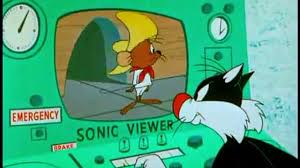
He builds a mouse disposal robot. Working the controls with a sonic viewer, he spots the mouse and sends out his droid. Speedy is still much faster, so Sylvester turns up the robot’s speed as high as it will go. It crashes into the wall like he did. Round 2. Whatever that viewer is connected to, Speedy is able to look through and see the cat. The robot is sent after him but Speedy leads him into the viewers screen which somehow ends up hitting Sylvester as well. (Toon logic may be less logical than ours, but it’s more fun.)

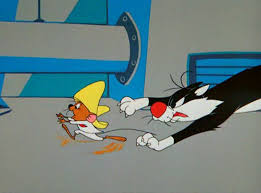
Third time’s the charm right? Sylvester warns the bot it is down to its last chance and unwinds its arm to place some dynamite in Speedy’s mouse hole. Speedy keeps moving back, and Sylvester somehow knows to keep the arm going. Speedy leads the arm back behind the cat who can’t escape even by hiding in the robot. He tosses the thing out and grabs a club. (Ah the caveman approach. Very nice.) Speedy in turn, has gotten into technology himself, and sends a robot dog after the cat.

Personal Rating: 3

A Message to Gracias

“To cousin Speedy, everyway is the shorts-cut.”

Directed by Robert Mckimson. Released in 1964

This short has a most fitting title. Unlike a majority of shorts, this one does not get it’s name from some form of wordplay or song title, but rather it flat out tells what the short will be about.

It begins at the H.Q. of a mouse named El Supremo. I don’t really know what kind of power that entails, but he’s fat so we can assume he’s a tyrant. He needs a message delivered to his friend, General Gracias. (Interesting name) He sends out a mouse named Manuel who is denied the privilege of finishing his will. The runs out into the cruel, hungry world, and while the other mice think he will make it, we know full well that he is going to be food. The mice mark another one down.

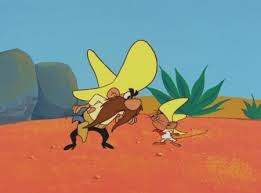
As El ponders how to get this message through, one of his mice suggests Speedy. Supremo agrees that it’s a good idea and is glad he thought of it. I’m not a fan when characters do that. Better add him to my list of annoying people I want to hurt. (…Fools who say Disney and Nintendo are only for kids, A-holes who kill animals but don’t eat them, The cast of “The tenth kingdom”…) They send a message and Speedy arrives. El gives him his orders of how he must cross a desert, climb over mountains, and cut through a jungle to get to Alcapulco. Which probably means if you’re bored enough, you can figure out where this errand is starting. Then you can challenge yourself to traverse the same route. Speedy runs over the waiting Sylvester, leaving behind some flames, and runs along the road making it bend much like the Roadrunner does. (I wonder which of those two would win a race. And on that note, why do I suddenly have four shadows?)

Sylvester is smart enough to chase him in a car, but Speedy stops for lunch break and Sylvester crashes. Next, they’re in the jungle. (Either nothing interesting happened in the mountains, or Speedy ran around them.) Sylvester takes aim from a boat in the river, but hits his head on a branch and shoots the boat instead. He ends up running from Caimans. He sets up a snare trap and catches a…I’ll be honest; I have no idea what that is. It looks kind of like Sam Sheepdog, the Tasmanian Devil, some green paint and some periods were all thrown in a blender. Maybe it’s just a radioactive jaguar?

Sylvester is eventually able to lasso Speedy, but the mouse drags him into a tree and ties him up. Speedy delivers the message which turns out to be a simple birthday poem. What’s more, it looks like Supremo only needed someone to distract the cat so he could come over with cake. Speedy is rightfully annoyed and lets Sylvester go. The cat chases the two bass turds into the distance. Speedy makes no effort to hide the fact that they will soon be eaten. (Can’t be good for the heart.)

Personal Rating: 3

Chili Weather

“All these foods and not a crumb to eat.”

Directed by Friz Freleng. Released in 1963.

There’s a food plant, and where there’s edible goods, you’re bound to attract mice. Good thing whoever owns the place has Sylvester on guard duty. Speedy almost immediately comes by and offers to help the mice get some grub. He actually manages to run in and out the first time, without Sylvester noticing. When he does become aware, he chases the mouse onto one of the conveyor belts. While Speedy compliments how much easier it is running this way, (and barely misses being chopped up) Sylvester is chopped up.

Speedy greases the floor and Sylvester slips into a vat of tobasco sauce. Sitting on ice cools him down somehow. (He’s not even licking it, not that it would help, but was the sauce being cooked? It didn’t look heated.) While Speedy looks at some soda bottles, (I don’t know what’s in there, but they say “es bueno” on the side. That’s good enough for me! *takes*) Sylvester comes back and actually grabs him. (2 posts in a row? New record!) But the bottle cap machine caps him and blinds him, simultaneously. (He must be really small.)

He manages to get it off with a bottle opener, but Speedy surprises him and he jumps back up into it. Speedy’s inner troll emerges and he takes it away. Sylvester blindly swings a bat around and doesn’t notice he’s running into the dehydrator. (It appears to belong to a someone named Gomez. Or maybe that’s the machine’s name?) He shrinks and is now able to get the cap off. Seeing Speedy, he runs off in fear. (After years of chasing Hippety Hopper, he’s finally found a real giant mouse.)

Personal Rating: 3

Mexican Boarders

“When do we eat? I’m hungry.”

Directed by Friz Freleng. Released in 1962.

In this short Sylvester chases Speedy through the house of J. C. Mendelez. (Him again?)  Naturally, Speedy is too fast to catch, and Sylvester wears himself out just by climbing the stairs. There is a knock at the door. Why, it’s none other than Slowpoke Rodriguez! Haven’t seen him since “Mexicali Shmoes.” (If you translate his song, you find out he’s singing about a cockroach who lacks marijuana. Don’t you dare say he’s an evil stereotype. From what I hear, he’s very popular in Latin America.)

Turns out he’s Speedy’s cousin and the cat gleefully lets him in. Slowpoke lives up to his name and plods in. (I like his hat. It changes color with every step he takes.) Speedy grabs him in the nick of time and brings him back to his hole. Slowpoke wants food. (Also, he’s not voiced by Mel. It’s a man named Tom Holland. Who I’m 96% sure is not the same Tom Holland who directed “Childs Play.”) Speedy offers to get it as he is the faster of the two. He brings back some sustenance. He forgot the tobasco sauce though, and races back. While he’s getting the sauce, Sylvester puts some glue on the ground. Speedy comes back, and Sylvester’s trap actually works. He grabs the mouse, but really should have removed the sauce as it gets poured down his throat.

Slowpoke has enjoyed the food, and wonders about dessert. Sylvester has set up a net which Speedy rushes through. When the cat tries it, he is cubed. That night, Slowpoke is hungry again. I don’t know if he’s trying to let Speedy rest or if Speedy is refusing to go out, but Slowpoke decides to head out himself. Speedy tells him not to, but Slowpoke is fine admitting that he is slow. (Not that way. I meant speed wise.) Still, he is not helpless. (Remember his gun?) Sylvester grabs him but Slowpoke has a different tactic this time. (Perhaps Peta told him to stop shooting cats?)

Making a face that I will undoubtedly see in my nightmares, he hypnotizes the feline. (Unlike in the Pokemon games, this Slowpoke can learn hypnosis. Come to think of it, don’t girls have this power too?) Now under mouse control, Sylvester is forced to fan the mice as they have another feast.

Personal Rating: 4