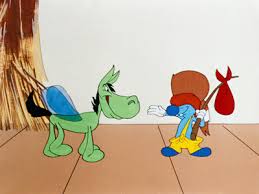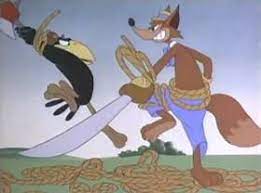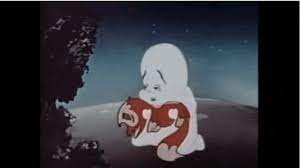
Doggone Cats*

“That’s a nice doggy.”

Directed by Arthur Davis; Story by Lloyd Turner and Bill Scott; Animation by Basil Davidovich, J.C. Melendez, Don Williams, and Emery Hawkins; Layouts by Don Smith; Backgrounds by Philip DeGuard. A Merrie Melody released on October 25, 1947. (*It was reissued as “Dog Gone Cats” I didn’t misread the title.)

Wellington Dog delights in what any dog would: cat beating. His targets of choice are an orange one I named Stan, and a black one Chuck Jones named Sylvester. And he seems a little out of character as we know him; he’s more dope than oaf. This isn’t even the only time he was portrayed this way, as Davis’s unit would do it again in “Catch as Cats Can”. (That’s now two weeks in a row I’ve mentioned that short. That means I’ll discuss it someday.) I don’t know why he is portrayed this way, but I can’t help but wonder if Freleng said something along the lines of “My cat’s a clown, not a dolt.”, and that’s how Davis made Heathcliff.

Welly’s fun is interrupted by a call from his human. (And yes, that bit of him wearing a trashcan lid on his head and turning quote unquote Chinese had to be cut on some prints.) He is to deliver a package to Uncle Louie, because mailmen got sick of being chased by dogs and decided they could do the job themselves. She also threatens bodily harm on the dog if something happens to his cargo. This is good news to his prey, as now he has a weakness they can employ. They start immediately with glove slaps and eggs to the face. And Wellington can’t do more than growl at the pests, lest he let go of the package. (Wait, was Stan able to see that ghostly image of the woman Wellington imagined? That’s scary.)

Sylvester gets the package hooked on his fishing pole and reels it in, Wellington desperately hanging on by his teeth. This leads to him getting his head stuck in a gap of a fence. Stan is utilizing a crane to lift the end of the board that isn’t nailed down and wasn’t there when Sylvester was fishing, while Sylvester cuts the rope holding it up. (Ouch. A delicious ouch.) Wellington gets the parcel back from them, but loses it again when Sylvester leads him in a dance into Stan’s pin. Sylvester takes it and runs.

Hey! Error! Wait a minute! The next shot has Stan carrying the package. When did they switch? I really hope somebody got fired for that blunder. Actually, I don’t. It’s actually quite trivial and easily ignored in the grand scheme of things. Stan hurls it onto some train tracks, (Leading to a fun little skid on Wellington’s part where his body and head spin independently from each other.) imitates a train with Sylvester to scare Wellington into ducking for safety, and leaving him to get run over by the real deal.

Then, to really mess with the dog, they wrap an iron weight up the same way, and hurl it from a bridge. Wellington and his rental boat sink trying to catch it. (And the repairs are coming out of his pocket, too.) But they lose it again, because Sylvester hits Stan with a mallet instead of Welly. (Which would have happened even if he was in his smarter form. Let’s not fool ourselves.) With the brains of the outfit out for the moment, the dog retrieves the goods once more.

Stan blows on a phony cigarette of pepper to make Wellington sneeze, sending the package right into the line of Sylvester’s steamroller. It may cost every bone in his body, but Wellington manages to keep the package safe, and finally get it delivered to Uncle Louie. He seems a bit too young to be the lady’s uncle. Is he Wellington’s uncle? I guess that means Wellington enjoys beating his cousins up because the cats not only belong to Louie, but the package contained their dinner. Does the woman just have a side business of making homemade cat food? Was it a mail mix-up? Did the cats know what it was? And what was my favorite part?

Favorite Part: The “shh” Wellington tells the cats when his lady is calling him. You may see it as a psychopath telling his victims to stay silent or die, but I see it more like a child not wanting the other kids tattling on him.

Personal Rating: 3

Curtain Razor

“I killed them in Cu-… camonga.”

Directed by I. Freleng; Story by Tedd Pierce; Animation by Manuel Perez, Ken Chapin, Virgil Ross, and Pete Burness; Layouts by Hawley Pratt; Backgrounds by Paul Julian; Voice Characterization by Mel Blanc; Musical Direction by Carl W. Stalling. A Looney Tune released on May 21, 1949.

Hope you enjoyed the green rings in the opening because they’re gonna be the iconic orange from here on out!

Today’s role Porky finds himself in is a talent scout at the Goode and Korny talent agency. It really is one of the world’s more entertaining jobs. You get to see the beginning of the greats, total failures embarrass themselves, and best of all: send the worst down a trapdoor. The operatic grasshopper that was singing over the opening titles wasn’t too shabby! Can any other acts top that?

We aren’t off to a promising start. Clara Cluck’s sister, Sara, instead of trying to develop a talent on her own, tries to copy her sibling’s opera shtick, seeing as how said sibling has been retired by now. Here’s a tip Sara: close your eyes when you do that. Makes you look more operatic and less “I’m being goosed by a poltergeist.”. She  stops her performance short upon laying an egg during the performance. Literal or figurative, that’s earned you a trap door ride. (Her egg hatches before it follows her, revealing Tweety’s stepbrother, Tweeter.)

A fox enters the room boasting about what a sensational act he’s got. Porky is willing to see it, but the fox totally cut the line. He’ll have to wait his turn. Next up for real is Cecil Turtle’s nephew, Sessile. He’s this universe’s Mel as he claims to have 1,000 different voices. (Of which, I can make out Bugs, Foghorn, Durante, and Rochester.) Despite his claim, Porky only counted 999. The poor reptile leaves, hoping he’ll remember the last one. (Isn’t it your normal speaking voice? Sessile, get back here! You need to be discovered!)

Next up, a parrot named Bingo, (who you can also see in Arthur Davis’s “Catch as Cats Can”) a chicken named Frankie, and a duck named Al, collectively known as the Three Cavalheiros! They sing just like their namesakes and I think they’re rather swell. Porky thanks them as they leave, but confines to us that that kind of stuff is only going to appeal to the bobbysoxer crowd. (Porky, pal, I can see your socks. Don’t be ashamed of what you like.)

And now a man with two heads enters. Porky is sure this act is going to be awesome, but the man angrily states that he is only the janitor. I figured two heads meant there was two of you. I guess me and Porky are both guilty of facial profiling. That poor guy! He’s just like every tall person who has to tirelessly tell everyone that no, he doesn’t play basketball. When will we learn as a society that we need to ask what other people are into. Oh, and the fox still tries to jump the queue.

After a couple more acts, including a regular old human using the same pigeon act Daffy tried in “Show Biz Bugs“, Porky finally gets tired of the pushy fox, and sends him down the trapdoor. Just in time for a dog to enter. He’s not a dog act. He’s merely the transportation. (Porky? What did we just learn from Double Header‘s son?) The dog’s got a flea circus act! And by that, I mean the fleas build a circus. (And judging by the musical accompaniment, they commissioned the  Rubber Band to join.)

Finally, finally, it’s that foxes turn to perform. This better be nothing we’ve ever seen before, considering how much hype he gave it. The act in question? Ingesting several flammable substances, before swallowing a lit match while dressed as a devil. … Well, I suppose back in 1949, people wouldn’t have yet seen this ending in a different cartoon by Freleng’s unit. I’ll give it to him.

Favorite Part: The scowl Porky gives after Sara’s performance. He’s all “B*tch, don’t you be having no babies on my floors. I just got these carpets cleaned!”

Personal Rating: 3. It’s a shame the aforementioned “S.B.B.” did this sorta idea better, mainly by having established characters with an established rivalry front and center. If you were watching this short before 1957, then it was a 4.

A Horsefly Fleas

“As long as they’re gonna chase me anyway, I might as well get paid for it.”

But can he cantor?

Directed by Robert McKimson; Story by Warren Foster; Animation by Charles McKimson, Phil DeLara, Manny Gould, and John Carey; Layouts by Cornett wood; Backgrounds by Richard H. Thomas; Effects Animation by A.C. Gamer; Voice Characterization by Mel Blanc; Musical Direction by Carl W. Stalling. A Looney Tune released on December 13, 1948.

All work done between November 5th and December 10th continues to be lost. And I’m still in the dark about it. And I’m still UPSET about it. Any info on WHY this happened would be lovely. And you know what else? I don’t think I ever want to retype them until I get an actual explanation as to what happened.

It’s the return of A.! You remember A., don’t you? He’s that flea with the catchy song about dinner being around the corner. Yeah, that guy! Seems eating Elmer and Willoughy wasn’t a bright idea after all, as A.’s singing about finding himself a new home. (Now being voice by Mel as opposed to Sara Berner.) But he’s not alone for long. Another animal that normally feasts on mammalian blood is outside, and that’s a horsefly. (An animated horsefly. Which means he’s 80% horse.) Cars have made his “mane” food supply dry up.

Since they’re both in need of living quarters, A. invites his fellow pest to join him in the homestead hunt. The best looking land can be found in the mountains. (A dog.) They fly over and start settling. Chopping “trees” makes a mighty fine cabin, but a shelter won’t be of much use without a food source, so A. begins digging a “well”. (Never called an incision that before.) Of course, the “land” is aware of these activities, and scratches at the discomfort causing “earthquakes.” But that’s only the biggest concern in literal terms.

This “land” is “Indian” flea territory. (Really? The “land” doesn’t look like a jonangi to me.) These fleas look like Miniature Injun Joes, so you know they mean business. A. wasn’t foolish enough to try taking land without guns, and he’s a pretty good marksflea. At least five chibi Joes change up their usual diet and bite the dust. But A.’s shots are a finite amount, and he and his horsefly soon have to do what the title suggests. The chase begins and neither snow nor sleet (flea powder and… more flea powder) slows down either chaser or chasee.

You know, I think these native fleas really do have Joe’s blood in them. They have the stamina to wear down a horse fly just chasing on their feet and skis. A. and D. (Horsefly) are tied to a “tree” and a fire is lit beneath them. The “land” draws the line at this, and heads to the outdoor fountain to extinguish itself. In the panic and confusion, A. and D. escape via stolen canoe. The Joes still pursue them, but the “land” doesn’t care too much. It’s just glad to be his own “land” for once.

But not for long. The circus has just arrived! See, this “land” is actually their winter quarters. So, those little Joe’s aren’t really natives then? Well, they are now as their continued chase of A. leads all of them into the center ring. Just in time for wild west show! The “land” by this point decides to just take things in stride and enjoy the show.

Favorite Part: A. looking over the sign that warns he’s entering “Indian” territory. After doing so he comments that he probably misses out on important details being illiterate and all.

Personal Rating: 2. Light on new gags, D. doesn’t really contribute enough to warrant being part of the title, and it could be viewed as offensive today. But at least I’ve finally discussed A.’s entire filmography.

A Tale of Two Mice

“You’re scared of the cat.”

Directed by Frank Tashlin; Story by Warren Foster; Animation by Art Davis; Musical Direction by Carl W. Stalling. A Looney Tune released on June 30, 1945.

It’s the first of the two times Babbit and Catstello were mice, and it turns out that hunting cheese is nearly as dangerous as hunting Tweety. There’s a cat that looks a lot like Babbit used to guarding the stuff, but the current Babbit is certain that his rotund chum can get past him to the dairy. He lays out the plan while his ears change color. Catstello is against it until he hears that the cat will be asleep. That’ll be a cinch! He’s ready now! He’ll show the old model of Babbit!

Change of plans! He wants back in the hole, pronto! But Babbit can’t let that happen, and flings Catsy back out via rubber band. Cats crashes into the cat and barely makes it back to the safety of the hole. Plan two is much more sensible: Catstello will fly over in a wind-up plane. Babbit is so sure that this will work, that he’ll be a jackass if it won’t. (His fur will change color regardless.) You know this is going to end swell when the wings get torn off on the small hole. No flying allowed, but the plane does beat the cat up a little before returning back home. Catstello is happy to remind him of his promise. (Number of times ‘jackass’ is said in “A Tale of Two Mice”: 3.)

The next plan must’ve worked great at first as we see the two in the middle of it. From what I can gather, Babbit hoisted a platform over the cat to the fridge for Catstello to load with cheese. But it was a hefty hunk of the stuff, and Babbit struggles to hold both it and Castello’s portly girth. He can’t hold on much longer and the load plunges down towards the cat, stopping at the last possible moment. I get a kick out of Catstello’s raspy, squeaky, whispery yells for help. And I can believe Babbit could hear them, as he’s been dragged right up to the cat’s maw. Soon as he realizes he’s in the danger zone, he’s out, leaving Catstello to face whatever fate the cat chooses, alone.

Catstello has a half good idea: using the cheese as cover. The cat following and appearing to just be gliding along the ground. (I’ve seen cats do that, sure.) Babbit tries to warn his companion, but is just reminded that this is a stealth operation. When the danger is revealed, Babbit does what I’d expect any best friend to do: start advertising for a new roommate. The cat tries to toss his prize into his mouth, but doing that in front of a fold-out ironing board was second only to doing so in the midst of a firing squad in terms of worst places to toss a prize into his mouth.

Catstello opens it, crushing the cat’s skull, somehow warping inside the iron that was also inside, and crushes the cat’s skull again. With imminent death right behind him, he grabs the cheese and makes it back to safety, with doom on his heels. Once safe, Babbit has the audacity to berate his partner for grabbing Swiss, knowing full well that Babbit hates the stuff. (I can’t blame him for not being able to tell at a glance. All cartoon cheese has holes. Without them, they’d look like tofu.) Having had a very tiring day, Catstello stuffs the stuff down Babbit’s throat.

Favorite Part: Babbit trying to go over his plan, with Catstello loudly saying that he’s not doing it. The face Babbit makes upon realized he’s being ignored, coupled with the threatening smile he flashes are two of the greatest gifts to animated facial features.

Personal Rating: 3. The animation on Catstello alone makes this at least worth one watch by every person on Earth.

The Gay Anties

“OW!”

Directed by I. Freleng; Story by Tedd Pierce and Michael Maltese; Animation by Ken Chapin, Virgil Ross, Gerry Chiniquy, and Manuel Perez; Musical Direction by Carl W. Stalling. A Merrie Melody released on February 15, 1947.

The late 1800’s do look like an idyllic time to live. Media has told me so! It’s a shame that any cartoons at the time were on zoetrope, otherwise I’d definitely give these years a visit. Just long enough for a picnic, anyway. I’ve always wanted to go on one of those. They must’ve been the high point  of fun once. Just look at everyone high-stepping to the park to partake of food amidst the wonder of nature that mankind put a fence around and claimed as city property.

One couple has set up shop on the riverbank. Even though they look like a very healthy happy relationship, she won’t stop being so coy. She gives him the side peek of genuine interest, he responds with a mustache wave to show the feeling is mutual, (wish I wanted a mustache so I could do that) but when he tries to hold her hand, he gets a mousetrap for his trouble. I mean really, you’ll let a guy eat your food but physical contact is too much? These mixed signals are why I prefer animals to most people.

Oh goody! The local ants have heard the picnic’s call and will now take the remainder of the picture’s focus. Who likes food stealing gags? That’s mostly all you’re getting. They take the cake, the hot dogs, even the soda, too. But they’re pretty smart, so they use the goods as simple machines. Donuts make delectable wheels, and make transporting bananas much easier on the thorax. And like the old saying goes: teamwork makes the sandwich. A perfect opportunity to use the ‘hold the onions’ sign gag again. (I kinda wish they would shake things up with a ‘hold everything BUT the onions’ sign gag.)

But for their skills, you have to remember they are ants and as such, tend to be seen as nothing more than insects by humans if they’re even seen at all. The man takes the sandwich without even a thank you, angering the chef ant. But picnics aren’t just all sitting and eating I’m told. There is usually some sort of physical activity to take part in. Humans have choices like croquet, or horseshoes, or maybe even touch football. Ants are smaller than sports equipment, but they have solutions. Flowers make good dresses, corn silk can be used as hair, and olives can augment your nonexistent tats and iss. Put it all together and the you have the human equivalent of a fur suit. It’s not a fetish, it’s their lifestyle.

Some ants don’t dance, but they can sing. Being so small, their voice kind of sounds like the Chipettes with chipmunk voices. Now me, I never found sped up voices annoying like a majority of people. It seems like a majority of ants don’t share my views. They’d rather isolate themselves in areas that have little to no air, and thus, no sound. At least the one in the juice uses a straw to breathe. I hope the one in the jar is pleased with the prison she just made for herself. The singer is shut up the way most are: fruit. (Fruit that shrinks as it travels towards her. A whole banana was launched, but a chunk small enough to just cover her face hits her. What, did a fruit bat eat most of it in the air?)

Meanwhile, the chef ant has just had her third sandwich stolen by the man. (What kind of metabolism allows him to still be hungry after just sitting and ogling?) The chef sets up some karma by placing the woman’s hand in between bread and mustard. And hunger mcgee takes the bait. She slaps him into the water. Now, she could tell he was holding her hand. (Which she had no problems by now as their relationship was several minutes longer by this point.) Logically, she should have felt the handwich being constructed.  Was she expecting a very specific kind of foreplay I never needed to know about? Did she just think he was going to nibble around her fingers, and maybe lick the condiment off? (Hmm… that actually does sound pretty hot, to be honest.)

Oh yeah, the ants take what they couldn’t finish back to the nest. Humans may act high and mighty, but our insect overlords are the true rulers of the planet. How many mass extinctions have they survived?

Favorite Part: The ant dancers were actually kinda attractive, but I’m more impressed with their clever get-ups. I never would have though of using corn silk for hair.

Personal Rating: 2. It’s not terribly funny, but it’s cute enough. Too bad it can’t stand on ever footing with ant pictures Freleng’s unit had already made and would make later.

Notes to You

“Poor dear.”

Supervision by I. Freleng; Story by Michael Maltese; Animation by Manuel Perez; Musical Direction by Carl W. Stalling. A Looney Tune released on September 20, 1941.

And we bring the month of horror to a close with one more tie-in to the month’s post. What could be more thematically appropriate than a cat at night?

Ah yes, Night. Black as tar dipped in shadows. A time where the absence of light helps you realize how insignificant you really are. How vulnerable. You wouldn’t last three minutes against those who thrive in dark. Might as well sleep so you can manage to avoid the feelings of dread that will consume all empty space available in your mind. Helps that you’re probably exhausted to boot. It is at such a moment we find Porky. The best friend I’ve never personally met due to him being animated and I, not so much.

Murphy’s Law. Always lying in wait. Ready to pounce on the best laid plans of mice, men, salmon, and sea turtles. If you’ve got the gift of life, you’ve got an appointment with this phenomenon. All you have to do is anticipate. It will catch you when you stop. These two forces of nature intersect when an alley cat picks the fence bordering Porky’s domicile as the perfect location to partake in the only kind of wauling he partakes of: caterwauling.

Understandably, Porky is not pleased with the feline crooner. It’s around this time that you will take note (s to you) of that peculiar feeling we call deja vu. We’ve discussed a very similar plot over a decade prior.  So, even though this short was the original, you’re liable to see the more polished, colored reimagining first. It hurts me on a spiritual level to have to put Porky down, but the latter cartoon really does everything here, but better.

There’s a few differences. One that I like is when Porky sets out a dish of milk for the cat while he waits with his gun. It remembers that Porky’s patience isn’t the only thing getting exhausted. The cat (That I am now calling ‘Notes’ for obvious reasons.) is able to down the dairy delight without getting a bullet through the cranium. Of course, since cat’s are the natural world’s a-holes, he wakes Porky for no other reason than that it amuses him.

After lulling Porky back to sleep with a lullaby, and placing him back in his bed, he wastes as little as time as possible in turning on the radio, full blast. He leaves to keep in his spirit contained within his body, but doesn’t let up with the songs. Even entering the domicile again to make sure Porky’s ears catch the noise his larynx pitches. It’s hard to sympathize with Notes once he passes such a threshold. At least Sylvester would spend most of his picture’s running time out of Elmer’s place. Makes it easy to wonder why Elmer couldn’t just try ignoring the sound better, and since both are being jerks in their own unique ways, you don’t feel too bad when both end up dead in the end.

Oh! Don’t worry! Freleng and the Frelettes don’t go so far as to let Porky die. But rather than using a more cartoony version of killing, say, blowing a cat up with dynamite, Porky opts to just shoot the kitty. And don’t let Notes’s singing and hamming up his wound make you think he’s faking. Porky just shot a cat through the chest. Your sympathies probably won’t stay with him after such a stunt, regardless of how much you don’t care for cats. It’s pretty out of character for the guy, too. He doesn’t jump to murder as a solution for those who annoy him unless he was already hunting them.  At least Porky feels guilt for having to resort to such extreme measures, and from what I was taught before leaving religion behind, that should be enough of a punishment.

Murphy’s law, my friends. It returns with seven of Notes’s nine lives to continue the serenade with total immunity to guns now. (4 and 8 have gone to heaven and hell, respectively.) It’s an ending to be proud of as it stays on the singin’ sextuplets for over thirty seconds. (Gotta let them finish the song. Not like they’ve been singing throughout the rest of the picture.) And with that said, I’ve brought things full circle back to Porky-centric ghost stories. Will the cycle repeat the next time we meet? It wouldn’t be fun if I told you. Wait like the mortal you are. You’ll have a happy Halloween to keep you company.

Favorite Part: Porky is so sleepy that his head hits the pillow before he can lie down properly. It’s up to the rest of his body to get itself into slumber position. Cute; like a child insisting they are not tired and being betrayed by the eyes they thought were on their side.

Personal Rating: 2. The remake really was better in all ways. It kept the best jokes, gave the cat role to someone who had been building a screen presence, fixed the ending to be less horrific and more, you know, funny. It’s the superior product. If there wasn’t slight differences, you’d actually do fine to pretend this didn’t exist.

Shop Look & Listen

I’d like to hold a hand like that myself.”

Supervision by I. Freleng; Story by Dave Monahan. Animation: Cal Dalton; Musical Direction by Carl W. Stalling. A Merrie Melody released on December 21, 1940.

There was a video game released in 2007 titled “Super Mario Galaxy.” It was a major hit with both critics and consumers and everyone agreed; they wouldn’t mind a sequel. The creators would deliver with “Super Mario Galaxy 2”, but not because of fan outcry. Rather, it was because they themselves had so many ideas for that one project that one game wasn’t enough to hold them all. I tell you this, because I think something similar happened about 70 years earlier.

Earlier in the year 1940, Freleng’s unit released a cartoon titled “Little Blabbermouse.” It wasn’t anywhere near close to being the studio’s best work. It was just one of their gag oriented cartoons using a mischief of mice taking a tour of a department store as an overlay. The title was referring to one particular mouse who’s one defining character trait was not shutting up.  (A good three years before Sniffles took up that role.) They couldn’t have thought this idea was 14K of comedy gold. But hey, all these gags means one less cartoon idea to come up with while they were brainstorming about this rabbit of theirs that seemed to be taking off.

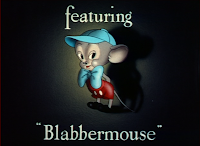
Thus, we have this sequel short. And Blabbermouse even gets his own title card!

*Is my internal fear showing?*

Eww. I don’t like that face. It’s making him look like a child comma molester. And you know, they didn’t need to use that at all. Blabby hardly features in this feature. Gets about four and a half lines total. Hardly befitting the blabber name.

Well, our gags take place in J. T. Gimlet’s department store. A few decent gags are available on the banners outside the building. But the one about the hours confuses me a little. Oh, I get the joke “Sunday 9-6 If we were open Sundays” But why do they bother listing weekdays and Saturdays separately if they’re going to say the same hours? Either switch the times up, or list them as one. It shouldn’t be that hard.

Our host is the same as it was in the previous short. (Which I’ve yet to discuss, because it’s more fun for me to not know what surprises I will discuss each week. I hope this isn’t your first time here. What a horrible post to sell someone on.) If I can steal a name from another short, then I can call him W. C. Fieldmouse. Showing some mercy to those of us who might have seen the other cartoon, they skip the preparation of their trip and take off. (Reusing the same animation they did last time.) Essentially, they travel by a gondola that is big enough to hold a crowd thrice their size.

Fieldmouse shows them the shoe section where we get a joke that I don’t get. (Are there shoes called mules?) Then, an art gallery where we see “Whistler’s Mother” and “The Thinker” doing what their names suggest. Then we see some of the robotic devices for sale, and they demonstrate what they can do. There’s a device that snuffs out cigars for you, and another one that seems like it was built to play poker all by itself. (It couldn’t be comfortable to sit with those robotic arm attachments pressing into your chest.) It can shuffle, cut, deal, cheat and kill cheaters all by itself. Which means you’re obsolete and not needed anymore, so you might as well go home.

B.M. has been annoying W.C. sporadically during this tour, and the larger mouse threatens him with bodily harm, should he speak once more. (I do love the animation of Fieldmouse stress sweating as he struggles to contain his rage. It was worth using in both shorts.)The tour then comes to a machine that can cut lengths of ribbon for your purchasing pleasure, and wrap it up for you as well. Blabber then opens his mouth again, and Fieldmouse prepares to make good on his promise. But instead of getting his hands dirty, he just has the machine wrap the little pest up instead. I hope it was worth it, as Blabbermouse’s father is a policeman. And policemen aren’t scared of anything. They’re brave and strong. We’reluckythey’resobraveandstrongandwillingtoprotectus.Geewhiz,IwishIcouldbeasbraveasstrongasapolicemansomeday.ToobadIhavenointentionofbeingapolicemansomeday.Itdoesn’tlineupwithmypersonalinterests,butIguessI’mgladthattheoptionisalwaysavailable.That’sthegreatthingaboutbeingapoliceman,anyonecandoit.Well,Iguessnoteveryone.Womenbecomepolicewomen,don’tthey?Oraretheystillcaleedpolicemanaswell?Orwhataboutcops?Isthereadifferencebetweenpolicemenandcops?Andwhy….

Favorite Part: The first time Blabbermouse speaks up, Fieldmouse gives him a good smack on the back of the head, while reprimanding him in rhyme no less. History’s first rap battle victory!

Personal Rating: 2. It only escapes one because it had different gags than its predecessor, and therefore, you can justify showing it to your friends if you feel you need to.

Fox Pop

“I’m practically sold already!”

Supervision by Charles M. Jones. A Merrie Melody released on September 5, 1942.

A man sits alone in his cabin. Vulnerable and alone. And some sort of wild animal is heading in his direction. A wolf? Nope, too small for a wolf. It’s a fox! And that thing could cause rabies or chicken famines! But the man is lucky this time, for the fox just takes his radio back to the forest and proceeds to hack it to bits. Two crows are stumped to this very un-foxlike behavior. He tells them his tale.

You see, whilst he was scrounging through the trash cans for food, he overheard the radio saying that foxes are what is “in” at the moment. They’re going to be everywhere and every lady will want one around their neck. This pleases the fox very much, as he imagines what a wonderful world it would be if there were foxes walking freely amongst the humans. (I want to live in such a world.) The radio doesn’t go into details about how these foxes will be in such locations, but it probably expected only humans to be listening, and they’d know.

The fox heads to location the radio said the foxes were coming from: Sterling Silver Fox Fur Farm. He gets himself trapped fairly quickly, but the owner turns him away. It’s fairly racist, but they’re only accepting silver foxes like their name says. Red ones are o-w-t, out. The fox that we will call ‘Fawkes’ is thrown into the garbage. (Which ironically, is where the racist man also belongs.)  Amongst the scrap metal, he finds just the answer to his problem. Not a gun, but silver paint. He gives his coat a good coat and badda-bing, badda-boom, Fawkes is welcomed into the farm.

He’s brought to his “room.” (It is darkly hilarious to see Mr. Sterling escorting him by the paw, rather than just carrying him by the scruff. These foxes lives in luxury for their remainder of life.) Just as he gets settled, the next door fox informs him of the jailbreak that is planned for tonight. And Fawkes is either participating with them, or dying early. His choice. He plays along, but being smaller than the others works to his favor, as he is able to lose himself in the rush and backtrack to the “comfort” of his “suite”. Look, he’s even got a tag attached to his “door”. I mean, door.

It’s here that he learns the awful truth: this place wants the skins of foxes! And I do love his childish naivete. “How will they… get it off of me?” The grindstone knows! Fawkes decides that maybe this place isn’t so great after all, and flees. The hounds are sent after him, chasing him through log and pond alike. But what’s this? The miracle of water has reverted his fur back to its original red! He happily shows the dogs that he is not silver and they have no need to chase him. They’re not racist though, they’re speciesist and pound him for daring to be born vulpine.

And that’s Fawkes’s story. Upon hearing all this, the crows join in and help the little guy smash that problem box that started it all. A kind of relationship I’m not used to seeing between these two animals.

“I’ll give you something to crow about!” “Don’t fox with me!”

Favorite Part: The next door cellmate is pretty bass. He makes a key by biting one out of his nail file. In one chomp!

Personal Rating: 3. A hilariously dark premise that thankfully doesn’t end like this:

I never know whether to laugh or grimace.

Mexican Joyride

“Let’sth consider the ‘Good Neighbor’ policy.”

Directed by Arthur Davis; Story by Dave Monahan; Animation by Don Williams, Basil Davidovich, J.C. Melendez, and Herman Cohen; Layouts by Thomas McKimson; Backgrounds by Philip DeGuard; Voice Characterization by Mel Blanc; Musical Direction by Carl W. Stalling. A Looney Tune released on November 29, 1947.

Vacation is all Daffy’s ever wanted. He has to get away! I hear Mexico is lovely every time of year. So down he drives. It’s weird to not see him flying or hitchhiking. (You know, like how most birds do.) Upon arrival, it’s time to do what’s first on anyone’s mind after a traveling trip.

The first thing we want to know about! Eating! Mexico is well known for having delicious food. Enchiladas, tamales, tacos, burritos, serapes, huevos, and those little jumpy beans you probably wouldn’t try if you knew what they actually were. I’m getting hungry already! Daffy digs in, wondering why he’s heard people say that this food is spicy. He’s not having any problems. Unless you call a fireplace in the mouth a problem. (You do? I didn’t know that about you.)

Daffy begs for some liquid to soothe his scorched mouth, not yet aware that water will do do absolutely nothing. (Or was it known back then and just not acknowledged?) The bartender is happy to oblige, but grabs the tequila. Judging by the pile of stiffs, he still thinks this will be hilarious the tenth time. (It is. Don’t worry.)

Time for tourist activities. Bullfights sound exciting if you’re a psycho. So Daffy…

He’ll have a great time.

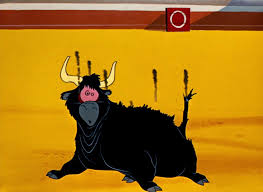
Or I’ve spoken too soon. Much like me, Daffy is constantly disappointed that the bull is failing to hit the evil human that is trying to kill an innocent and cute creature. But unlike me, Daffy’s complains that it’s the bull’s problem. And that’s more than a proud bovine can take. So he stomps into the stands to give the duck what for. Daffy fails to notice that the stands are clearing out until its too late. The bull will show Daffy by… making the duck fight… him. Well, things will probably turn out better for him than these guys:

Daffy tries to nail the pen shut with the bull outside, but the bull is helping. One of these two is going to leave the arena in pieces, and his horns and bulk say it won’t be him. But first, he must take a phone call. It’s Daffy giving a farewell message, and the game is on! When the bull charges Daffy’s cape, we fade-out for no real reason that I can see. Why not just do a quick cut? Then Daffy tries a trick that he knows works on birds: covering the bull’s eyes, so he thinks it’s night. (Another fade. Tricked me into thinking we had cut to a whole new joke.) Works until the bull hits a wall.

Time for a cartoon staple: hiding in one of three hiding places, with your pursuer checking all three. Things are made more fun this time, with Daffy popping up to claim to the bull that he isn’t under the last one to check. The bull thinks otherwise, but thanks to another staple: the vocal switch-around, Daffy has him claiming that his prey ISN’T under the last hat. And he’s willing to bet money on that. Daffy makes a tidy profit with the bull’s life savings. (Living through bull fights pays great.)

Since he can no longer face his friends and is now homeless, destitute and useless, (Daffy’s words not mine!) the duck tells him suicide is really the only viable option left. (No it isn’t. I used to look up to you, duck!) But when the bull misses, Daffy makes the mistake of giving him a tommy-gun. Oh, it’s not a mistake because convincing anyone to off themselves is the worst thing you can do don’t try and debate me, it’s a mistake because the bull comes to his senses and is now extra angry and wielding a tommy-gun.

Time to cut the trip short! Daffy runs back to his hotel for his stuff, loses the bull in the elevator, and drives for home, happy to be safe. We all know who’s riding in the backseat, but he’s staying silent for now. Just giving us a wink, and quietly plotting Daffy’s murder. (Which will get a whole lot worse if the bull finds those seats are made of leather.)

Favorite Part: After Daffy advises suicide. He’s already got a butcher shop set up. When life gives you hamburger, right?

Personal Rating: 3

Malibu Beach Party

“I don’t want’a be covered in sand.”

Supervision by I. Freleng; Story by Jack Miller; Animation by Gil Turner; Musical Direction by Carl W. Stalling. A Merrie Melody released on September 14, 1940.

Like many kids, I had the standard ‘dream of being a celebrity’ dream. I was going to be a star of my own direct-to-video movies (I’m that old, yes) I was going to do all my own stunts, and people were going to love me and I’d be on talk shows. Oh, and parents and kids would both adore me because I’d be entertaining AND educational. What changed my mind about such solid and realistic career plans? Well, I don’t fancy the idea of having to socialize with other people in Hollywood. (Why must I entertain the amateurs?)

But thanks to cartoons like this, I can get a glimpse of what kinds of things happen when all the biggest stars of the day get together. Jack Bunny is playing host, and is still stuck with that name despite being all human in this short. He’s in character, seeing as the invitations he sends come with a coupon that will give you a free 25 cent meal in exchange for fifty cents. He’s accompanied with his lady friend Mary, who gets greeted by Spencer Tracy. She’s Miss Livingstone, he presumes, and Kay Kaiser confirms. (Both glad to have escaped from that squeaking Africa.)

Always on the lookout for a way to make money, Jack is selling boats and yachts. While a certain George hangs out with the rest of the rafts. The typical “Gable has big ears joke’ this time is him using them to paddle through the sea, and ‘Garbo has big feet’ one has her using them as water skis. Back on the beach, John Barrymore announces that he is here to bury Caesar. Bad luck for Mr. Romero. (At least now there will be no future arguments about his mustache.)

Bunny has musical accompaniment by “Pill” Harris and his orchestra, and the tunes are enough to get people dancing on the furniture. And we’ve got “Winchester” tending bar. Bunny wouldn’t spring for more than a half-pint of liquor, but it’s a party so he IS willing to splurge on his water bill to fill those glasses. Now for our singing act: Deanna Durbin. Her voice is so lovely that she could even get Ned Sparks to smile. (And he does with great effort!) Mickey Rooney is smitten with her but his difficulties with height means he can’t catch the flower she tosses. Carey Grant has just made a mortal enemy.

Bunny now hypes up the featured attraction: himself! And that means violin playing that many of us are too uncultured to appreciate as the highest art. But with the kind of celebrities we have walking out, I don’t fell like I’m in such bad company. (Even if they have comedically oversized heads.) Winchester too, tries to take his leave, but his boss ain’t having it. At least one person is going to listen to him play, and if he has to sit on Winchester to make it happen, so be it. (I wish I could say this was the first time in history the white man stood over the black.)

Favorite Part: Ned Sparks attitude is so bad that even a literal crab tells him to cork his windpipe. I like the crab’s line delivery.

Personal Rating: 2, if you know your old celebs. Probably a 1 for everyone else. At least “Hollywood Steps Out” had some decent gags that didn’t completely rely on knowledge of the stars.