Hare Trigger

“I ain’t a-givin’ up without a struggle!”

Directed by I. Freleng; Story by Michael Maltese; Animation by Manuel Perez, Ken Champin, Virgil Ross, and Gerry Chiniquy;  Layouts and Backgrounds by Paul Julian and Hawley Pratt; Musical Direction by Carl Stalling. A Merrie Melody released in 1945.

Happy 4th! There’s nothing more American than a cowboy. So, why not talk about Sam’s first short? (Heck, it was said to be Freleng’s favorite short that had him in it!) This short is full of firsts! It’s Hawley’s first time being credited, and what’s more it’s the first short that gives everyone their due. Leon Scheslinger wasn’t one to let valuable screen time be taken up by a still shot with a bunch of names. But when the studio was sold to the W.B. they were finally given that right.

Bugs is riding a train through the west of America as a piece of mail. (And hiding from his numerous relatives who are trying to piggyback on his film super-stardom.) Sam makes his first appearance trying to hold the train up. (He looks a wee bit different here than in his later appearances. He has a wart or something on his nose, and his mask has less hair surround it, so it is easier to tell it is a mask) The train doesn’t slow down at all. It passes right over him! Sam has to catch up to it on horse. (Which he needs stairs to mount.)

Once on board, he frightens the post man away and begins to load up. (Mail was pretty valuable in the forties.) One piece of mail talks back, so Sam introduces himself as “the meanest, roughest, rip-roaring’est, Edward Everett Horton-est, hombre that ever packed a six-shooter.” (Which is how I would introduce myself if Edward Everett Horton was still well known.) Bugs tells him of a guy in the next car who not only is all that, but packs a seven shooter to boot. Sam goes over to challenge him. (It’s Bugs.)

Sam dares him to draw a gun. Bugs is a pretty talented artist, so it’s no trouble for him. (I love this joke. I’ve pulled it before with cards. Then managed to draw the same card I drew.) Sam is impressed and tries his hand at it. It takes a while, (his efforts brilliantly portrayed with piano notes being off tune) but he manages to draw one which Bugs seems to be genuinely interested in.

“It stinks.”

(Guess not.)

Bugs is chased and he considers heading into a club car, but it’s full of live action people. While toons are definitely allowed in, the prejudice is still strong, so he heads back to the car Sam is in. They trade shots with Bugs ultimately removing Sam’s hat. What he thinks is said hat getting put back on his head, is really Bugs who calls to Sam as a sheriff. He pours some red ink on Sam’s head and Sam believes himself done for. He might have actually convinced himself to death had Bugs not left the bottle dripping onto his face.

Bugs next leads him into the club car, which now has a fight going on in it. Sam gets roughed up pretty badly, and while dazed, Bugs tricks him into stepping off the train. Sam returns though, and pulls Bugs on top for a brawl. Ultimately, Bugs is left tied up and dangling off the side with an anvil attached to his feet, Sam gleefully starts cutting the rope as the train passes over a gorge. Then a narrator acts like we’re in a serial and asks us if this is the end of our beloved Bugs Bunny. Bugs comes out onto the screen with Sam tied up mocking the idiot trying to pull this crap. He doesn’t know Bugs like we do.

Personal Rating: 3

I’ve Got to Sing a Torch Song

“One, two, one two. Breathe Deeply!”

Supervision by Tom Palmer; Animation by Jack King; Music by Bernard Brown and Norman Spencer. A Merrie Melody released in 1933.

Once upon a time, there was an invention called the radio. It was THE form of entertainment back in the day. In fact, entire families would do their aerobics in front of it. While others got their exercise in more creative ways like tightening their wife’s girdles or rocking their children to sleep. But there was more than just exercise programs on the radio. Here, many singers who are legends today, got their starts on the radio. Like Cros Bingsby who would sing in the tub to the delight of women everywhere. (This was how many people “viewed” porn before the internet.)

And the radio wasn’t only popular in America. Wherever there were people, there were radios. In Shanghai, the police listened to it to be aware of any crimes being committed. (And tying it into a knot if it disturbed their naps.) Cannibals would tune in to listen to recipes about how to prepare celebrity soup. And even up in the frozen north, the Inuits listen to it while they fished. If they caught a whale by accident, their radio could become lodged in the creature’s blowhole. (They didn’t seem to mind though.) The radio was so popular that people would rather listen to it, than watch scantily clad women dance in front of them!

The title of this post was the name of a song that was sung by many female celebrities at the time, like Greta Garbo and Mae West. Even Lady Liberty couldn’t help but join in. Finally, the time was even told by a man who looked an awful lot like Ed Wynn. But I guess this was when he was much younger as he doesn’t even SOUND like Ed Wynn. Or maybe it could be his father? The entire family looks exactly the same.

Personal Rating: 2

A Tale of Two Kitties

“HEY, BABBIT!”

Supervision by Robert Clampett; Story by Warren Foster; Animation by Rod Scribner; Musical Direction by Carl W. stalling. Released in 1942.

This short was supposed to introduce the world to new characters who would be stars for Warner Bros. But someone else stole the spotlight. The two supposed stars are two kitties. (This is their tale.)

The taller one is named Babbit (Tedd Pierce) and the stout one is Catstello. (Mel) His name is never mentioned in the short, but come on. He’s a cat and if you have any idea who Abbot and Costello are, then you know who these two are based on and you’ve made the pun yourself. (That and the studio model sheets labeled him as such.) It’s time to eat and Babbit tells his comrade to go get a bird out of a nest so they can eat. Catstello is reluctant even after he’s told of how small it is. (I guess they’d each get a mouthful, but I have a feeling Babbit would hog it all.) Turns out hes got “Heightrophobia” and it takes a pin to his backside to finally get him up the ladder.

Scared sightless as his partner is, Babbit has to angrily demand that he gives him the bird. (Catstello laments that the Hayes office is what is keeping him from fulfilling that desire. I just didn’t know the term existed in the forties.) He makes a swipe at a sleeping bird but misses. This is the birthplace of Tweety. (Inspired by nude baby photos that Clampett’s mother had and he resented.) The ladder breaks and Catstello begs to be rescued from atop the remainging pole. So scared is he that he doesn’t notice Babbit saving him until he is in his arms.

For the next attempt, Babbit shoves his pal into a box against said pals protests. He’s also afraid of the dark. Babbit lets him out and the springs on his feet bounce him up to the nest. Here, our little baby Tweety (model sheets had him labeled as Orson) utters his first words: “I tawt I taw a putty tat.” Seeing as he did taw a putty tat, Tweety has no choice but to defend himself. And does he ever! Using an arsenal of guns, clubs and even TNT sticks, he continues to beat the crap out of the poor putty tat. Catstello cries over his failure while unbeknownst to him, he sits on an explosive. When Babbit detonates it he flies up towards the nest again. But he flies past it. (Tweety helps himself to Catstello’s apple. Or rather, the worm that was inside.)

When gravity kicks in, the cat falls and is able to cling onto a telephone wire. Tweety comes over to play “This ittle piddy.” A sequence that would be reused, essentially verbatim, in “Roger Rabbit“. Even down to Tweety resembling his old design.  The bird isn’t totally heartless, as he throws the cat a rope. It’s attached to an anvil, though. Said anvil crushes the cat into the ground and drags all the surroundings towards it. This includes Babbit and his victory garden. (I really like how concerned he sounds for his friend. Turns out he really does care.) The final attempt is launching Castello with wooden wings strapped on. Wouldn’t you know it, it works. (Human beings have been trying to fly for years, and it took a simpler mind to figure it out.)

Tweety calls the “fourt interceptor tommand” to report the disturbance and the cat is blasted out of the sky. He manages to avoid landing on a pitchfork in favor of his partner. (While they didn’t become the stars, they did appear in a couple more shorts after this. But they were mice. How humiliating.) Tweety is now on the ground and initiates a blackout. Seeing their chance, the two cats stalk their prey with faces that haunted my childhood.  Tweety doesn’t freak out, though. He yells at the two to turn out the lights like he told them too. Their glowing eyes instantly dim. (As does the moon.)

Personal Rating: 4

Wagon Heels

“Him, screwball.”

Directed by Robert Clampett; Animation by Rod Scribner, Manny Gould, I. Ellis, and C. Melendez; Layouts and Backgrounds by Thomas McKimson and Michael Sasanoff; Voice Characterization by Mel Blanc; Musical Direction by Carl Stalling. Released in 1945.

What’s going on? Why is this place updating a day early? Well, I’m working tomorrow so you’ll have to put up with me during your holiday. Happy Martin Luther King Jr. day! If you’re racist, the Martin Luther King snake will bite you!

This is a color remake of an earlier short by Clampett called “Injun Trouble.” This new title is much more friendly. If I was smart, I would have reviewed all the shorts in chronological order. (However, I amn’t smart.)

In 1849, the U.S. was a much smaller country. It was all relegated to the east coast and the rest of the land belonged to the red man, Injun Joe. (If he was born today, he’d be called Native American Joe.) But if you read your history books, (And I know you did. Kids love history!) you’ll know that the white men decided that the land was theirs and they would soon have it. A wagon train is headed to what is today known as California. (Back then, it was Joelifornia.) There are some familiar looking faces in those wagons. They look an awful lot like the gremlins from “Russian Rhapsody.”

Seeing as they’re entering enemy territory, (Containing such lovely locales as Joeklahoma, New Mexijoe, Minnejoeta, and Injunsaas.) they send out a scout to watch for trouble. Who better than my pal, Porky? Not too long after crossing the border, he finds the remnants of Joe’s last massacre. There’s only one survivor: Sloppy Moe. A blue-skinned runaway from Wackyland who may or may have clearly been driven insane by Joe’s wrath. He does admit to knowing something he won’t tell. Shouting that it’s a secret when Porky inquires. Porky shrugs him off as a lost cause.

Now why don’t we check in on this Joe character? How strong is he? And what of his age? Is the mighty Joe, young? Well, he’s certainly earned his title. He’s the original Joe Cool. He doesn’t walk around mountains, he walks through. Trees with what look like Tweety clones in his way? Them too, without pity. He reduces the most ferocious of bears into whimpering cubs, and bites bear traps into letting him go. Naturally, if you’re going to fight him, you’re going to have to send someone beyond cool, manly, and cunning. And I don’t see how you could disagree with me, but Porky fits that description. Unfortunately, Joe has found Porky’s wagon train and diverts them off course leaving them out in the open. You might think Joe loses coolness points for riding a stick horse, but that’s actually quite clever. What horse could hold his weight?

The train tries to fight back, but they don’t stand a chance. Joe uses whole trees as arrows and can make uses of bullets too. He crams them in his mouth and fires back cannon shells at them. Porky catches up and wrestles Joe’s tomahawk away from him and gives him a smack on the foot. At least he hurt Joe. That’s more than any of us could have done. The angry Injun causes Porky to jump out of his skin-colored pants, and chases him to a cliff. It looks bad. How could things get worse? Well, Moe comes back. He’s still singing about his secret, but Joe won’t put up with such tomfoolery and demands to know it. Turns out, he already did.

Moe’s secret is about Joe’s weakness: he’s ticklish. Using his beard Moe tickles the burly brave into submission and he falls off the cliff. The force of his impact causes all of his territory to be dragged down with him, stretching our country to it’s current size. Goodbye, U.S.J. and hello U.S.A. (Bet you didn’t know that the country was fully formed at that time. We just didn’t announce it until 1912.) It’s all thanks to our heroes: Porky the fearless and Sloppy Moe the brave. (Moe would appear years later on “Tiny Toons” when they did a parody of “The Great Piggy Bank Robbery.” There, he was called Ticklepuss.

Personal Rating: 4 Better than the original. (If I was smart, it’d be discussed by now.)

The Wacky Wabbit

“You chubby little rascal!”

Supervision by Robert Clampett; Story by Warren Foster; Animation by Sid Sutherland; Musical Direction by Carl W. Stalling. Released in 1942.

For the past two weeks, I’ve been able to connect the featured short with something appropriate for the time of year. Can I do it again? You bet! Elmer is in his fat phase again, just like how most of us are after the holidays. (But not me because I was dieting all of last year.)

Elmer is out in the desert. (My guess is it’s in California. Do you really care though?) He’s off prospecting for gold whilst singing “Oh, Susannah!” (No one sings that anymore though. Shame.) Bugs is there too, hiding under a bovine skull. He says hi to the the passing prospector, who politely says hi back. Not getting the reaction he wanted, Bugs tags along joining in the song. Eventually, Elmer catches on and freaks out. (I know I would be if I saw a singing skull with eyes still in the sockets.) He quickly figures out it was just that “scwewey wabbit” and starts digging. (I love how he makes an “X” before digging in a completely different spot.)

He drops an explosive down the hole, but it keeps popping back up. In desperation, he zips the hole up an hides. Being the nice guy he is, (*snicker*) Bugs returns him his T.N.T. Elmer cowers, but the stick was a dud. That doesn’t stop Bugs from shouting “BAM” anyway. Elmer grabs his gun but Bugs has exciting news: Gold has been found! Where is it? It’s his gold tooth. Elmer shows off his own before realizing the trick. He tries to dig Bugs out of his hole, but his pick axe has gotten stuck in the cliff wall behind him. Bugs uses this opportunity to cut Fudd’s clothes off, revealing his girdle. Seeing us laughing, Elmer scolds us, saying that he’s sure plenty of the audience’s men wear one too. (Not me personally, but I love how comfortable he is with himself.)

Redressing, he leaps into the hole himself. Bugs buries him and walks off. (Notice that the shot has changed. They were in a canyon before, but now they appear to be out in the open.) Elmer escapes somehow and tells the wabbit his plans: he came for gold, and he’s going to get it. And Bugs definitely has some. Bugs is not willing to part with a piece of his body, so Elmer tackles him and wrestles it away. The short ends with him smiling at his success, unaware that the tooth he is holding is his.

Personal Rating: 3

The Old Grey Hare

“What’s up, Pruneface?”

A bad case of rabbitightens.

Direction by Robert Clampett; Animation by Robert McKimson; Story by Michael Sasanoff; Voice Characterization by Mel Blanc; Musical Direction by Carl W. Stalling. Released in 1944.

Here’s your final entry of 2016. Everyone has already said that this year sucked. They’re right. I’d go more into it, but this blog is for Looney Tunes and Looney Tunes related things. So, let’s just agree that the year was crap, we’ll hope the next will be better and around this time next year, we’ll be saying the exact same things. Now then, with time constantly moving on, why not talk about a short that shows just that?

Elmer is crying. It’s only been four years since he started, but he’s already given up hope on ever succeeding in getting Bugs. A voice tells him to keep trying. It’s never explicitly stated, but it’s kinda obvious that it’s God. (And he’s voiced by Mel. Don’t you think it would have been a bit more clever if he was voiced by Arthur Q. Bryan?) Elmer agrees that he should keep trying, but how long will it take? So God allows Elmer to look into the future to see how things will turn out. This means one of two things: either he’ll succeed, or die trying.

It seems that things will come to an end in 2000 A.D. Which is odd; I was alive by that point and I don’t recall any of this. (But then, I had just discovered Cable T.V. and it was hard to pry me away.) A lot has changed. (And I don’t just mean appearance wise.) The horse Bing Crosby bet on still hasn’t come in, and Smellivision replaced Television. (The paper that Fudd is reading says that Carl Stalling doesn’t think it will catch on. Guess he was right.) And Elmer is now toting a “Buck Wogers Wightning Qwick Wabbit Kiwwer.” There’s no way he can lose! All we need now is Bugs.

Luckily, he pops up not too long afterwards. He’s looking pretty good for being 54 years older. (All that time has passed and I only can see one grey hare.) Sure he’s aged somewhat, (less teeth, glasses, and a beard) but he still has enough strength to strangle Elmer before hobbling away. (Seems like he’s got lumbago too.) Elmer fires his new weapon, and wouldn’t you know it: he shoots Bugs. The bunny can’t believe it either. He begins reminiscing and gives Fudd a present: A photo album! It shows all their good times together, including the first time they ever met. That happened when they were babies. Even though Fudd’s picture is labeled with him being “only 3 and a 1/2 years old.” (They just couldn’t resist making that joke again. It really should say “seconds” instead of years. Wouldn’t it be funnier to think that the very first thing Elmer did after being born was go hunting?)

A flashback ensues. Elmer is crawling along with a pop gun and looks into a small rabbit hole. Bug’s pops up and babbles some baby talk while drinking carrot juice. (Luckily there is a subtitle for those of us older than the age of 1. But then they both start talking in English. I guess we’re just seeing things from their point of view?) They begin their first chase of many. Only to stop briefly to take a nap. When they resume, Bugs is able to get away. (This proves that no matter how many times Bugs is called a “rabbit” he is really more of a hare, as young rabbits are born naked and helpless, whereas hares are not.) Needing to match his prey’s speed, Elmer gets a stroller and drives after the leveret. (That’s the term for a baby hare, folks.)

Miming a cop, (that includes miming a motorcycle too. Something proto-Bugs did once. Leading me to believe he is Bug’s father.) he pulls Fudd over and berates him for speeding. After he leaves Fudd crying in his carriage, (I think that’s a real baby cry too. Way to be authentic, Bob.) the flashback ends and we go back to the two seniors. (This is the only Bugs Bunny short where Bugs doesn’t appear once as his modern self.) Elmer is devastated that he has killed his oldest and dearest friend, while Bugs starts digging his own grave. He tells Elmer to smile while he does it. (Doesn’t every dying person say that?) Elmer is so distraught that he doesn’t notice Bugs switching places with him, until the rabbit (I mean hare) buries him alive.

So there’s God’s answer: Elmer is never going to win. Elmer is unhappy, but he takes some solace in the fact that he is rid of Bugs forever. Bugs comes back to give him some parting gifts: a goodbye kiss, and a lit firecracker. Don’t worry. Bob may use actual crying of children for sound effects, but he draws the line at blowing up the elderly. But that doesn’t stop it from rattling the “That’s All Folks!” end card once it does blow.

Personal Rating: 4

Hare Ribbin’

“Mama, Baby, Dad!”

You naughty bow-wow!

Directed by Robert Clampett; Story by Lou Lilly; Animation by Robert McKimson; Voice Characterization by Mel Blanc; Musical Direction by Carl W. Stalling. Released in 1944.

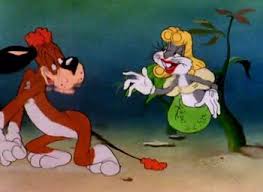
Besides the titular hare, this short stars a dog who looks like Willoughby with a haircut. He’s Russian because it’s a reference to a character on the “Eddie Cantor” radio program. While sniffing around for a rabbit, he rather abruptly runs into Bugs. Bugs claims to have not seen any rabbits, but this dog isn’t as dumb as Red Hot Ryder and gives chase shortly thereafter. He chases Bugs into a lake. And I’m not kidding, the rest of the short takes place underwater. I guess a friend of Clampett’s really had a fetish for characters being underwater and Clampett was too good of a friend to suggest he go get help.

Of course, being underwater makes for a perfect excuse to have Bugs dress up as a mermaid. So maybe that’s the whole reason it’s underwater. I don’t really care though. This is Clampett! I’ve accepted stranger things than this from him. The dog, who shall be called Vladimir,  (It’s my blog and I’ll be as uncreative as I want!) falls for the get up and hits on “her.” Agreeing to play games, they start up a round of tag. Bugs uses his tail-fin to slap the dog around. He removes his disguise, which wasn’t the best time since Vladimir immediately catches on and declares he is having a rabbit sandwich for dinner.

Happy to oblige, Bugs plays waiter. Unfortunately, they’re out of rabbit. (No rabbit in a lake? I’m shocked.) Masquerading as Fudd he tells the dog he’s going to get him a wabbit. Vladimir once more catches on sooner than most would against Bugs. He demands his sandwich and Bugs crawls between the (I guess waterproof) bread and lettuce. But he lets us know that he will be scrunched up. Vladimir doesn’t know this, takes a big chomp and feels guilty for killing Bugs. He cries and wishes for himself to be dead.

There’s two ways this scene plays out: Bugs gives the dog a gun and he shoots himself, and the director’s cut where Bugs shoots the dog himself. (I don’t like that. It seems too out of character for Bugs.) With the danger gone, Bugs leaves. Vladimir stops the iris out to deliver one more line before he goes: “This shouldn’t even happen to a dog!” (The same line would be spoken by another animated dog in his first appearance: “Courage the cowardly dog.” And he got a whole series! Poor Vladimir only got a cameo in “Back in Action” after this.)

Personal Rating: 3

Farm Frolics

“♪There’s no place like home!♪”

Supervision by Robert Clampett. Released in 1941.

A beautiful farm is drawn in by a realistic hand. (That windmill doesn’t look finished, you fraud!) It’s time for some farm jokes! A horse has been trained very well. He trots when you say trot. He gallops when you say gallop. When you say canter, he imitates Eddie Cantor. (We’re still working on that one) The farmer’s dog may be old, but he is still dependable. He still fetches the paper every morning. (Gotta get his Dick Tracy fix) And we also see some piglets watching a clock. If you’re visiting this place for the first time, you should know that pigs are my favorite animal ever, and piglets are the cutest cutes that ever dared to cute. They’re the origin point of the word. It is odd that they choose to watch a clock, but I’m not going to spoil their fun.

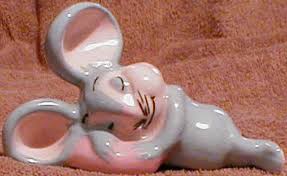
A mother hen leaves her eggs. Not smart. They are being watched by a hungry weasel. He sneaks up to feast, when the chicks hatch and nearly give him a heart attack. In the nearby forest, there are lots more animals to have fun with. (You didn’t think we’d stay on the farm for all of our frolics did you?) There we see a field mouse with abnormally large ears, who keeps hearing things. Believe it or not, he has a name. His name is Rosebud. And even though he only appeared in one other short besides this one, we got some merchandise of him.

Let sleeping statues lie.

Even though they are small, even ants care for their young by calling them home. For the sake of not boring you, I will refrain from pointing out all the misleading ant facts that are shown here. Except for the ant butt crack. (What is up with that?) As we head back to the farm, we see the pigs still at the clock. They refuse to go play. I guess that clock is more entertaining than we will ever know.

A more bizarre sight is that of a cat and a mouse in a loving embrace. Apparently the cat loves that mouse and takes good care of him. This doesn’t stop the mouse from begging for help and trying to escape. The cat catches him and happily goes back to sleep. Before the day is over though, we stop by the piglets one more time. Seems they were watching the clock to know when it was their favorite time of day: Dinnertime. They happily run home to their mother’s teat and began suckling. (“Every day it’s the same thing.”)

Personal Rating: 3

Crazy Cruise

“Monotonous, isn’t it?”

Supervision uncredited; begun by Fred Avery, completed by Robert Clampett; Story by Michael Maltese; Animation by Rod Scribner. Musical Direction by Carl W. Stalling. Released in 1942.

You know, Clampett is still my favorite director, but I find more and more lately that I wish Avery never was fired. It would have been great if he had stayed on the Warner’s team the whole time. Who knows? Maybe he would have gone on to still create Droopy, Screwy Squirrel, and Red?

This short contains a bunch of spot gags that Avery had a real talent at. We see a tobacco plantation and take a peek at an animal that does untold amounts of damage to the plants: the tobacco bug. (Which looks more like a species of worm to me.) It talks like an auctioneer and spits. Our cruise then heads to Havana and Sloppy Joe’s bar for some refreshments. After getting “tanked up” we head for out next destination in the most direct route possible. (When you’re as drunk as that, spiraling IS the most direct you can be.)

During this time of war, our ships are camouflaged so well, that all you can see are the sailors, flags and smoke. After stopping by the Swiss Alps (Where our plane slides over the mountains.) and an oil derrick, (Where we have our second spitting tobacco joke.) we come to an African Jungle. We see a species of carnivorous plant: the Eatemus abuggus. Or as it’s known in English: the Carnivore Flower. It tries to make a meal out of the bee that flies into its “mouth”, but it is stung. A line of animals wait for a turn to drink at a water hole. (Wait, why is there a pronghorn in Africa?) You might be wondering why the elephant is being so patient, as in the wild they tend to use their size to bully their way in first. Why, it’s because a zebra mother is helping her young to take a drink from the fountain. Isn’t that precious? (What? You thought it was going to be a lake? You clearly are new to these shorts.)

Past Veronica Lake (which is shaped like Veronica Lake) is a land of giant cannibals. Two hunters and their racially insensitive guide are heading that way to try and capture some. (I think that freckled one is supposed to be a caricature of Friz Freleng.) Their guide (who only speaks in scat singing) is excited to show they were captured. (Was he a spy? Or is he happy because he escaped?) The cannibals are so giant, that the hunters are nothing but mere candy bars to them.

Next we see some baby rabbits. Awwwww! (My favorite one is the one whose back is turned to us.) But they have been spotted by a Japanese vulture. (Also depicted in an unflattering way, just because he’s from another country doesn’t make him any less of a bird.) The rabbits respond with an anti-aircraft gun. The one whose back was turned turns around and… Hey! That’s no baby bunny! It’s Bugs Bunny! Before the short ends, his ears make a victory V. (Sad to say, there are no victors in war. Only losers.)

Personal Rating: 3

Bacall to Arms

“Anybody got a light?”

Care to help a fellow American who’s down on her luck?

Directed by Robert Clampett (uncredited); Animation by Manny Gould, Don Williams, Rod Scribner and I. Ellis; Layouts and Backgrounds by Thomas McKimson and Philip DeGuard; Musical Direction by Carl W. Stalling. Released in 1946.

One of Clampett’s last shorts and it feels like his heart wasn’t really in it. Many scenes are reused from “She was an Acrobat’s Daughter,” including the crowd switching seats, the fat hippo, and the young goose annoying his father. A wolf is shown his seat by a female usher. (I swear that’s Porky sitting behind him.) He rushes off to flirt with her but is slapped. A news reel is shown that radar has a new purpose: alerting a family to the mother-in-law coming. The film then starts. A parody of the real picture “To have and have not” called “To have…To have…To have…” (etc.)

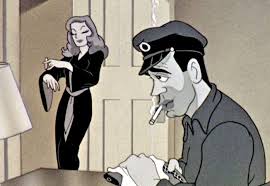
It stars parodies of the stars of the actual film, Humphrey Bogart and Lauren Bacall (to arms) played by thier Toontown counterparts: Bogey Gocart and Laurie Bee Cool. The rest of the cast’s names scroll on the screen. They’re not important. The movie itself says they are the “cast off characters.” The wolf (who shall hence forth be known as Winchell) starts to doze off. (After the cartoons, I would too) The Tex Avery hippo is told by Gocart to sit down and stop inconveniencing people as the film is starting.

When Laurie shows up on the screen, Winchell pays attention. She’s so hot, that she leaves little flame trails wherever she walks. As she kisses Gocart, the wolf is in heaven. (The whites of his eyes disappear at one point even.) Winchell continues to go nuts. Kissing the back of the head of the patron in front of him, whistling so hard someone’s wig flies off and jumping out of his clothes. (Apparently the audience left to go smoke at that point as the theater seems deserted.) When Laurie is finished with her cigarette, Winchell dives after it and takes a puff. Not amused, Gocart shoots the wolf and takes it for himself.

It blows up leaving him in blackface. (Yes, this part was cut for television.) He exclaims that he can work for Mr. Benny now. (It’s a little known fact that there were at least 12 Rochesters and that Gocart played the 3rd one)

Personal Rating: 3. There’s just barely enough new here to keep it a little interesting.