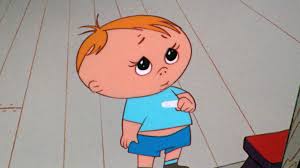
Pizzacato Pussycat

“Whoever heard of a mouse pianist?”

Directed by I. Freleng. Released in 1955. (A nice touch: the quotation marks in the title are music notes.)

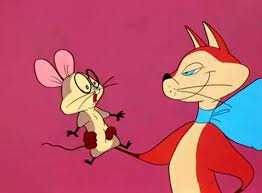
This short, which looks a lot like the shorts U.P.A. was producing, stars two animals. They live in the house of John and Vi Jones. Vi claims that not only has a toy piano gone missing, but she keeps hearing it play. If I know anything about mysteries, (And I definitely do.) then the culprit was the lobster! No wait, he’s a percussionist. It was probably that Schroeder kid. But seriously, the thief is a mouse. He sneaks out to get some more sheet music, but the cat of the house takes notice. (Name time! Let’s call the cat, Chauncey and the mouse, Michael.)

The mouse loses his glasses in the chase and the cat kicks them under the couch before grabbing the rodent. Then he picks up another pair off the ground. (What?) Now seeing his possible doom in front of him, Michael asks to be spared. After all, he can play piano. (Although, I’m more interested in where he got glasses.) Laughing at the absurdity, Chauncey gets the piano and demands a demonstration. Michael provides, but now that he is out of his hole, both of the Jones’s can hear him. In a panic, the cat puts the pianist mouse in the larger piano and mimes playing it himself. The owners are shocked and call the papers. The cat decides to spare the mouse as long as he plays (get it?) along.

Soon they are all set to play for a large audience, including several critics. Things start smoothly, but all too quickly, one of the piano keys breaks Michael’s glasses. The resulting music is quite abominable, and the cat is exposed as a fraud much to his and his owner’s shame. Back at their place, the cat chases the mouse again. The resulting chase leads them to a drum set, (Who plays those? The piano can at least be seen as decoration, but who just keeps drums around the house?) While swatting at the rodent, Chauncey discovers that he is quite skilled at the drums. Michael grabs the piano and they form a pretty sweet duet. Vi goes to call again, but John declines against it and the two keep their musical pets a secret to the world. It’s probably for the best. Michael isn’t going to live longer than 3 years.

Personal Rating: 3

Dough Ray Me-ow

“Louie is my friend. Yes sir, my best little pal.”

Directed by Arthur Davis. Released in 1948

One of Warner Bros. best one shots! This short stars two pets. The parrot, Louie and the cat, Heathcliff. (Who predates the comic strip Heathcliff by about 25 years. Speaking of, have you ever read it? It’s the most surreal bizarre comic I’ve ever seen. I can’t even tell half the time if there is a joke being told.) Back to the REAL star…

Heathcliff is dumb. He’s so dumb that he actually forgets to breathe! That… is flucking hilarious. No, that’s not a typo. I’m not swearing. Louie helps him out though, despite the fact he is clearly annoyed. (That’s so sweet.) Heathcliff (who actually got make a cameo in “Looney Tunes back in Action“) finds a piece of paper that he wants Louie to read. Turns out, it’s their owner’s will, and when they go, Heathcliff will inherit everything. Once he’s gone, Louie gets the dough. (Makes sense. Parrots tend to live longer than cats.) Louie tells him that instead of reading, he should go on a vacation. The cat returns half a second later due to being homesick. Looks like he’ll have to be permanently removed.

Louie bribes a bulldog to come kill the cat when Louie calls for help. Heathcliff is as strong as he is stupid and saves his chum while holding the dog in one paw. While the cat cracks nuts, (with the nut in his mouth and his head in a giant nutcracker) Louie tries playing a game of “William Tell.” (Which he unhappily seems to be a master at.) He rips a wire out of the wall and invites the cat to play “Radio.” You’ve never played? It’s a wonderful game! All you do is stick two live wires in your ears. Music will then play. (Warning! This only applies to mammals. If you are a bird, then the basic rules of electricity WILL apply to you.) Even putting a can on the cat’s head and having walk into an upcoming train doesn’t kill him. He should have just let Heathcliff do himself in. Besides his breathing problem, he seemed pretty close to crushing his head when he was playing with his nuts. (Don’t try to find an innuendo there by the way; there is none.)

Louie then surprises Heathcliff with a birthday cake. With 3 real candles, and a stick of dynamite. (It’s the thought that counts.) Heathcliff is apparently smart enough to know about numbers as he claims that he is only 3 and hands the explosive back saying it’s unneeded. (So depending on how old Louie is, he probably couldn’t wait another 10-11 years.) Despite Louie claiming he IS four, Heathcliff refuses to accept it and takes the cake and runs. (Why didn’t Louie make all the candles explosive? Your face, that’s why.) After a chase scene, Heathcliff finds his birth certificate that literally says he’s four. He takes the candle back, and wouldn’t you know it, Louie’s scheme works. Heathcliff bids him farewell, as his nine lives fly up to cat heaven.

But Louie just can’t keep his big beak shut, and tells him about the money he can’t take with him. Life number 9 calls the other back, and they all fly back into the body. If Heathcliff can’t take the money with him, then he’s not going. (I didn’t know death was that easy to get out of. I guess every time we sleep, we technically die. We just choose not to permanently die yet. Death is considerate like that.)

Personal Rating: 4

The Aristo-cat

“Good grief, I’m all alone!”

Directed by Charles M. Jones. Released in 1943.

Why am I doing a post a day earlier than I usually do? Well, my dear readers, tomorrow happens to be White Wednesday. The last day where you should remember November. Since come Thanksgiving, people seem to recall that there actually are 11 months. It’s also a great day to be miserable, since society demands you be “merry” and “bright” for the Christmas season. Besides, I’m going to the movies tomorrow, and I can’t promise I’ll have time.

Don’t worry about that title, you are at the right place. I didn’t go all Disney on you. This short came out 27 years earlier. Besides, I think “The Aristocats” is my least favorite Disney film anyway. No way I’d be wasting a blog post on it.

A cat named Pussy (No immature jokes, please. None of them will be clever.) has got it made. He’s the pet of a rich lady and therefore gets a comfy bed, breakfast brought to him in it, and complete control of Meadows the butler. He’s a bit of a dick though. Squirting grapefruit juice into Meadow’s eye and letting him slip on bars of soap. It’s no surprise that Meadows quits. The cat panics as he realizes that as a pet, he has no clue how to fend for himself. (Look at those backgrounds courtesy of a one John McGrew, they are a beautiful abstract masterpiece. Best part of the picture, no question.)

In his panic, he finds a book about cats. (Written by a one F.E. Line.) To his luck, it opens up to the chapter that details the eating habits of the cat. It says that they feed on mice. Sounds easy enough, but never having seen an actual mouse, the cat runs in terror when he finds one. The mouse in question is Hubie, making his debut here. (You could say this cat is Claude, but the appearance is all wrong and his bed says Pussy remember? Although he does have a similar voice.) Hubie calls his friend Bertie, (just called Bert here) and shows him that the cat is no threat to them. The mice (whose colors will switch for later appearances) happily feast on cheese.

They refuse to share with the cat, telling him he should eat mice. He admits he doesn’t know what they look like, and the two point him out to a nice large one named Rover. Pussy tries to make a sandwich out of him, but that goes about as well as you’d expect. (One should never try to eat something alive that can open it’s mouth wider than you.) The cat is thrown back into the house, where he slides into the book again. Conveniently, he finds himself looking at the part of the book that clearly labels the cat’s prey and enemies. With his new knowledge, he chases the mice. They run into Rover’s dog house just as the dog comes home and pounds them. Pussy wakes up back in his bed, as it was just a horrible dream. Rover agrees. (Keep your gay jokes to yourself please. They’re not funny.)

Personal Rating: 4 Those backgrounds are an abstract masterpiece, and are worth a point on their own.

The Sour Puss

“G-G-G-Guess what we’re gonna have for dinner t-t-tomorrow night?”

Directed by Robert Clampett. Released in 1940.

Before we begin, I’d like to say a few words before my words. I have mentioned the following before, but I don’t know how many people read my older posts, so I’ll reiterate here: I think suicide can be funny when it’s used as a joke in media. Now, in real life, suicide is never the answer. I’m not a psychiatrist or even really that good at being sensitive, so you probably shouldn’t take this opinion seriously, but to me, killing yourself proves you really don’t give a f*ck about the people in your life. They are the ones who really suffer in these situations. Forever wondering if it was their fault. If they could have helped. And since we have no proof of an afterlife, they don’t even have the guarantee they’ll see you again.

But in cartoons, it’s totally fine and often very funny. (To me.) Remember in “Rabbit Romeo” when Bugs forced a goldfish to kiss Millicent? It killed itself and that was funny. As long as you ensure that the situation the character is in isn’t too sad/serious, I’m not going to complain. I’m sorry for making you read all of this, but I don’t want you to get the wrong idea when I laugh at the suicide that takes place in this short.

One night at Porky’s place, he is reading his paper and sees that fishing season will begin tomorrow. He excitedly gets decked in his angling gear. (Personally, I find fishing one of the most boring and yet barbaric wastes of time.) He lets his cat know of tomorrow’s dinner by imitating a fish. To most, that is simply a humorous picture, but to someone with icthiophobia, that is the stuff of nightmares. (NotthatIwouldknow.) The cat is so excited he bounces around the house. (Why does Porky have an empty fish bowl?) He even kisses a mouse. This action makes the canary of the house pull a gun on himself, since he’s now seen everything. (Fun-ny. And I’ll thank all of you who have suicidal thoughts to stop ruining comedy for me.)

They head to bed. Porky counts sheep, but his cat (who is sleeping in a drawer, because there’s no point wasting money on a bed for an animal that won’t even use it.) counts fish. When you have an obsession, it’s near impossible to sleep while thinking about it. No surprise, the cat hits 1,000,000 and is still awake. He takes something for insomnia: A hammer to the head. The next day, pig and cat each have cast lines. (The cat’s line tied to his tail.) A flying fish approaches. That’s not a freshwater fish, but am I really complaining about that, while the fish is literally flying? Yes. I just don’t want people to go to a lake and expect flying fish. I know about fish.

The cat takes a swipe and the fish is down. Not really. This fish is like if Daffy had gills and fins. He jumps around laughing hysterically and talking with a weird vibrating voice. (I like him. He’s silly.) Porky seems to get him on his hook, but the fish just does a yo-yo imitation. (Why not try fly fishing? I know about fish.) The fish sticks one of his pectoral fins out of the water to imitate a shark. Porky falls for it, and warns the cat. The cat is a moron and doesn’t know that sharks have been found in freshwater. (I know about fish.) He calls the fish’s bluff only to find it really is a shark. (I don’t really get how that happened.) The cat runs off into the distance much to the shark’s confusion. “Pussycats is the cwaiziest peoples.”

Personal Rating: 3

Conrad the Sailor

“You’re a sthlovenly housthekeeper.”

Directed by Charles M. Jones. Released in 1942.

Who is Conrad? Well, you asked the right person. If you didn’t ask you are either: A) already quite knowledgeable about cartoons and just come here for my jokes, or B) you are a sad person who isn’t even looking at my blog. shame on you. Conrad the cat only appeared in 3 shorts. All of which were directed by Jones, all of which came out the same year. This is both the only one with his name in the title and the only one where he speaks. His one defining character trait is that he has a little shuffle walk but I like him. His appearance makes me smile. This short was his final appearance. It takes place on a ship. (No surprise.)

While most of the crew appear to be dogs, Conrad is not. Perhaps this is the reason he’s the only one swabbing the deck? Listen to his voice. Does he sound familiar? No, it’s not Mel. Please stop guessing him. Would I even bring it up if it was Mel? That my friends is Pinto Colvig. The original voice of Goofy. Even if he is being discriminated, Conrad cheerfully mops and sings. To his displeasure, he finds muddy duck prints all over. Daffy Duck prints to be precise. After mocking his singing, Daffy switches his bucket of water for red paint. Conrad doesn’t even notice until the duck points it out. Angered, the cat gives chase.

Despite Daffy thinking he gave him the slip, Conrad is right behind him and pulls him into a lifeboat and pounds him. Coming out they both salute the captain, before Daffy is tossed into the sea. That’s obviously not going to stop him. The chase continues when he gets in Conrad’s way of polishing a cannon. Before they can chase though, the captain comes by again and they salute once more. Daffy starts up a game of “Patty cake” using the lyrics to “Pease porridge” instead. Which is a really odd rhyme when I really think about it, why is it not spelled peas? Why are they in porridge? Do people really want to eat porridge that’s nine days old? What is porridge?

They chase, (salute the captain again) and Daffy hides in a gun. Conrad knows exactly where he’s hiding and loads it. When fired, the bullet continues to chase Daffy. Him running behind Conrad, means that the cat has to run too. But this doesn’t stop all three of them from saluting the captain again.

Personal Rating: 3

The Night Watchman

“I guess you’ll have to watch the kitchen tonight, son.”

Directed by Charles Jones. Released in 1938.

In Chuck’s directorial debut, our story takes place in a house. There is a cat there, but he is sick tonight. Therefore, his “The Night Watchman” duties will have to be handled by his son. His son looks like some kind of a rodent to me, with his big buck teeth. And he’s kinda clumsy too. Even smacks himself when trying to salute. He heads out to perform his old man’s job. Geez, he’s tiny! I know he’s a rodent, but he didn’t look much smaller than his father. Maybe the kitchen is giant?

Either way, he’s immediately in the company of a mouse. The mouse does the ole “what’s that and flicks his nose” gag and steals one of his buttons. Learning that the regular watchman is sick, he calls his posse and they begin to feast. They eat their way through the food and make some humorous sight gags. Like, starting at one end of a pretzel and eating one’s self into a knot, and getting into a jar of olives and eating them all. (Thus creating your own prison with only an olive jar.) The kid tries to get them to stop, but he’s not very assertive and actually ends up helping prepare a steak for the leader.

The mice perform a floor show and this forces the child to yell to get his “quiet” heard. The leader hits him and he walks off in tears. His conscience berates him for letting his father down and reminds him he’s a cat. (Really? All this time I though he was a gopher. That still doesn’t explain why he’s so small.) With newfound courage, he heads back into the fray and pounds every mouse that tries to stand in his way. Before he’s through with them, he is sure to steal a button from the leader. Turnabout is fair play.

Personal Rating: 3

Charles Jones

Here is another example of the amazing talent Warner Bros. had. Some would say he’s the peak.

Born in 1912, he was the son of an unsuccessful business man. When this father would start up a new business, he would always get some stationary with the new company name on them. When they failed, he told his children to use them up as fast as possible. As such, young Charles got plenty of drawing practice. Good thing too, in an art class later in his life, the professor said that everyone has 100,000 bad drawings in them that they have to get out before they can draw anything worthwhile. (Harsh, but that explains why I can’t draw.) Chuck had no such worry as thanks to all that paper, he was well over the 200,000 mark.

After graduating from Chouinard Art Institute, he received a call from a friend who had been hired by the Ub Iwerks studio. Starting as a cel washer, he moved up from painter to in-betweener, (the person who draws what comes between the drawings the animators make) He also met a cel painter named Dorothy Webster, who would one day become Dorothy Jones. He joined Warner Bros. in 1933 as an assistant animator, but got promoted to actual animator two years later. He was assigned to work with another man named Tex Avery. They moved into what they called Termite Terrace with other men named Bob Clampett, Sid Suterland, and Virgil Ross.

When Frank Tashlin left the studio, Chuck took over his unit and became a director. The man created many characters for the studio. Some not quite well known even though they are more hysterical than the majority of cartoons today, (Charlie dog, the Three Bears, Hubie and Bertie) and some that are rightfully considered cartoon legends. (Marvin the Martian, Pepe Le Pew, and Wile E. Coyote and the Roadrunner.) He would also work with Dr. Seuss himself, Theodore Geisel on Private Snafu shorts, (and later would direct “How the Grinch stole Christmas”) he did some uncredited work on Disney’s “Sleeping Beauty” and wrote the screenplay for the film “Gay Purr-ee” (Animated cats in France? Why does that also sound so Disney?)

He left Warner Bros. in 1963 and worked for MGM, making some Tom and Jerry shorts until 1967. He continued work on animated TV adaptions of stories like “Rikki Tikki Tavi”, “The White Seal”, and “Horton hears a Who.” Also producing the “The Phantom Tollbooth” movie.  He even made a cameo in the movie “Gremlins.” His last Looney Tune was 1996’s “From Hare to Eternity” which was a tribute to Friz Freleng, who had died the previous year. (It’s surreal to see Sam being directed by Jones. Yosemite Sam that is, not Sam the sheepdog.)

The man died in 2002 due to heart failure, and his ashes were set out to sea. He may be gone, but his work is still highly celebrated. He won Academy awards for three of his short films, (“For Scent-imental Reasons“, “So Much for so Little“, and “The dot and the line.”) And in “The 50 greatest cartoons”, Numbers 5, 4, 2, and 1 are all shorts he directed. Mr. Jones, I salute you. You were one of the most talented Human beings on this planet. I am honored to have shared planet time with you. 

90 Day Wondering

“I’m a civilian!”

Directed by Chuck Jones. Released in 1956.

Two posts in a day? It’s an October Miracle! (Or the idiot who runs this place didn’t plan ahead in advance very well, and realized he needed to have two in one.) Well anyways… At a location named “Fort Itude” (Which let’s be honest, is one of the best names of any place in history.) A tornado seems to leave. Taz was in the army? Nah, it’s just Ralph Phillips who is beyond happy to be “normal” again. His family welcome him back, but soon the excitement wears down and they settle back to their daily routine.

Ralph decides to go out for some fun. (Of course, not until after he’s had a few beers and smokes. The kid of “From A to Z-z-z-z”, people. ) He heads to the malt shop he used to go to, but nobody he used to hang with is there. They’ve been replaced with younger teens who make Ralph feel like an old man. But he has his address book! He calls up the girls he used to know. Which leads to an expected, but still hilarious joke: “Mommy? A man wants to talk to you.” He goes through them all; none of them are interested. If you weren’t there to engage them every day, you deserve to die alone.

As Ralph mopes in the park, a tiny little character shows up. This is Pete, the civilians friend. He’s here to tell Ralph the benefits of being out of the army. Another character shows up named Re-Pete. He looks cool, so naturally he is my new friend. Both begin trying to persuade Ralph to stay on/come back to their side. The army may pay less, but it gives so much more. There are over 400 jobs available, it can finance one’s education, give you a paid vacation, and if you play your cards right, you can retire at age 38. (Dang. Is that still possible? I’d look it up, but I don’t want to.) Pete is losing the battle and none of the ideas he’s pitching are working. (Like inventing dehydrated water and inheriting Fort Knox. Both of which I’ve already done multiple times.)

Ralph re-enlists. A nice short, but it seems to be saying that you can’t be happy unless you’re in the army. Say good-bye to free will kids. Your choice has been made.

Personal rating: 2

Ralph Phillips

You know, I’ve mentioned Ralph before in previous posts, but I have yet to give him his own post. I aim to fix.

Technically speaking, Ralph only appeared in 2 classic shorts from the golden age. But, he also starred in two army recruitment films and an unaired TV pilot that was repackaged into a theatrical release. So he still makes the criteria for getting his own spot. Ralph is just like any ordinary boy. He as an active imagination and it showed in his two shorts. He was either daydreaming during school, or fantasizing at home. Both shorts are very creative and his first one is considered one of the 100 greatest Looney Tunes.

In the recruitment films, he was much older and a little bit more serious. Which just goes to show how much he grew up. And if you watch his shorts, listen carefully to his voice. Sound familiar? No, it’s not Mel. It’s Dick Beals, the same person who was Speedy Alka-Setzer. Ralph doesn’t get a lot of recognition these days. (I mean, why market a small boy, when a talking rabbit is far more profitable?) But he will always have a place in the hearts of those who are young at theirs.

A-Haunting we will Go

“I told ya, there’s no such thing as a witch.”

Directed by Robert McKimson. Released in 1966.

Did you ever want to see what would happen if you crossed “Broomstick-Bunny” with “Duck Amuck” and added Speedy in? You did not, and if you are saying you are, you’re just being a smart@ss. Stop it right now. And yet, here we are. (And what an appropriate short, given the season.)

Someone in Bug’s witch costume comes up to Witch Hazel’s door. It turns out to be a young duck who resembles Daffy. When he gets one look at the witch, he bolts. Back home, he tries to tell his Uncle Daffy that he saw a real witch. Daffy, naturally, doesn’t believe him, and drags him out to prove him wrong. Hazel (making her last appearance in the golden era, which means it’s the last short June Foray worked on.) meanwhile, is working on one of her brews. She bemoans the fact that she hasn’t taken a vacation in quite a while, but she is interrupted by Speedy. He wants to borrow some cheese. (Am I the only one who thinks that’s a weird phrase? You can’t borrow food. You eat it.)

She initially refuses, but reasons that if she tinkers with the cheese, she can turn him into her double and then she can go have some fun. She hands him some, and wouldn’t you know it, it works. (Speedy fell for it? Then again, Hazel always has been rather smart. She did catch Bugs a few times, even if he did get away in the end.) Speedy takes the whole thing rather well and the real witch leaves. Speedy messes with the brew a bit, when Daffy shows up. Speedy invites him in and pours him some brew to drink. Daffy is pretty polite here, as he drinks it despite disliking the taste. I guess he made his point. (Despite the fact his nephew isn’t with him anymore.)

As he leaves, he turns into the thing Bugs once painted him to be. Hazel returns, (Wow. Short trip. Who was keeping her from leaving anyway?) and asks Speedy how it went. Speedy shows off the transformed duck who has still yet to leave. (I guess he found out what happened and wouldn’t leave until he was fixed up.) Hazel is angry and turns Speedy back into mouse saying that’s all he’s good at. Speedy seems a lot happier, so that was a waste of an insult.

She then turns Daffy back, and declares it’s been a while since she had duck. Daffy flees, but she scoops him up with her broom. He jumps and somehow has a parachute, but the witch turns it into an anvil and he plummets. But she doesn’t look where she’s going and crashes. On the ground, Daffy’s nephew finds him and asks if the woman was a witch. Whether he just won’t admit the kid was right or he doesn’t want him to be scared, Daffy lies about her identity and they head home. As they walk, Daffy turns back into his flower-headed, four-legged form.

Personal Rating: 1 (Mostly because the shorts it copies from are infinitely better, and Speedy really doesn’t add anything.)