Alpine Antics

“I’ll show that big stiff!”
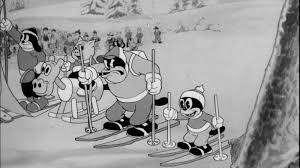
Porky hasn’t got a hat.

Supervision by Jack King; Animation by Riley Thompson and Jack Carr; Music by Norman Spencer. Released in 1936.

Tomorrow is my sixth anniversary of starting this blog! And that means another update that any competent blogger would have started doing on day one! I think from next time onward, I’ll start listing whether or not the short discussed was a “Looney Tune” or “Merrie Melody”. That’ll make people want to visit!

Our short begins with a shot of many characters having winter fun. (If they’re having any fun outside at all, they’re not doing it right.) Skiers ski on the horizon, and some snowmen sing to us. Unfortunately for them, they dance in front of a campfire and melt to death. (Dying snowmen always make me feel warm inside.) One guy takes some boiling water and pours it in a hole in a lake to make his own hot tub. He freezes solid.

Beans the cat is having a good time with his girlfriend, Kitty. He sees a sign telling of a downhill skiing race with $100,000 in cash prizes. Or a cool $2.00. (It was the depression.) But a big bully with a Billy Bletcher laugh. (Hereafter known as Bully Bletcher) breaks Bean’s skis so there will be one less competitor. But little did he know that Beans is the kind of guy who would dismantle his girlfriend’s sled to get more skis. (In his defense, she seems okay with it.)

They take their places at the starting line. Bully is not happy to see Beans again and attaches a firecracker to the cat’s skis. Lighting it, causes Beans to fly backwards and give everyone else a head start. The other competitors are: Porky on a rocking horse, a guy whose skis are pedal powered, (cheater) someone who has a sail and bellows, and a duck on a dachshund. Bully takes the lead and holds out a trip wire. This gets rid of nearly everyone. (Don’t worry Porky, you’re a winner to me.) When Beans crosses it, he doesn’t trip, but instead the wire wraps around Bully. This doesn’t hold him for long though. He continues on with the Double D team, (the dog and duck, remember?) behind him.

Beans jumps a gap, but doesn’t quite make it, getting himself stuck in the cliff side. Bully makes it, no problem. The other two go down the slope and back up, knocking Beans loose and getting him back in the race and bumping themselves to second. They soon go on to take first, but don’t look where they’re going and crash. This just leaves the two B’s. (Bully and Beans remember?) It looks like Bully is going to win, but he crashes into the ground and ends up underwater. (The finish line is on a frozen lake then?) This gives Beans the advantage and he wins! Before he can celebrate too much though, Bully pokes his head through the ice, tripping Beans, and causing him to fall into the drink too.

Personal Rating: 2
The remaining Mr. Hook shorts

In my first year of doing this blog, I made a small post about one of this guy’s shorts. Since I barely said a dang thing about him, I’ll give you a quick rundown. Much like Snafu was made for the military, Hook was made for the navy. (Well, his first short was shown in theaters, but it was made by Walter Lantz studios, so we’re not talking about it.) Unfortunately, Hook wasn’t as interesting as Snafu. He was a goody-two shoes who was happy to follow the rules. And all three of his shorts were about buying war bonds. They’re still entertaining though. (Except for Hook’s annoying laugh. That’s his main character trait.) All three of them were released in 1945.

The Good Egg

“Now ain’t this cute!”

Hook is asleep on his ship. His bad side (personified in the classic cartoon way: a devil version of himself) finds his war bond. (He takes it to bed with him?) He tells the sailor to not waste his time with such things, but his good side disagrees. (What’s more, he flat out beats up the devilish side.) He then explains all the benefits of purchasing a bond. He even recommends purchasing more. After the war, he’ll have a nest egg that will make it possible for him to purchase new clothes and a nice house. A stork also pops up, but the good side says that it will come later.

Personal Rating: 1

Tokyo Woes

“I got a mess of hot platters for you today!”

This short begins with a Japanese radio show. Starring some of the most racist caricatures I’ve ever seen. Yeah, it was a different time, but they have way too many teeth! It creeps me out! Our hostess’ (whom we first see on a toilet) main focus is telling the world that bonds are useless. This angers our perfectly behaved protagonist. He’ll show her! He launches a missile her way, but surely someone as perfect as Hook would never actually kill anybody! (What do you think he’s in? A war?) The missile just unloads a sentient war bond. Good thing he has no moral compass! He hands her many bombs and hightails it out. The bombs explode and leave nothing but their hair, glasses, and grotesquely over-sized teeth.

Later, when the war is over, the same bond comes to Hook to make good of his promise. Granting him new clothes, a nice car, and a boob job. (I’m not joking.) The bond asks if there’s anything else he wants. Hook agrees that there is, but he can get it himself. We end with him being kissed by a woman. Money can’t buy love, you see.

Personal Rating: 1

A couple more Private Snafu shorts: Coming Snafu/Gripes

Coming!! SNAFU

“This…is Snafu.”

Directed by Chuck Jones. Released in 1943.

It’s the first short with Snafu! The goofiest soldier in the army. He’ll walk right off a dock if he’s not paying attention. It’s really more of a trailer than anything else, but we are told of what we can expect from Snafu. (Who has freckles in this short and his voice is slightly different. Still Mel though.) You can find him in the infantry; tying his pack the wrong way, or in the air corp towing a plane to its location. But he thinks about a stripper the whole time and doesn’t notice all the trouble the plane is being dragged into. Don’t worry though, his imaginary girlfriend’s breasts are censored, as is her naval. (Was my brother a part of this?) Naturally, his actions land him in jail. We are told of some of his coming attractions before we end, like “Spies”, “The Goldbrick”, and also…

Personal Rating: 2. (It really is just a trailer, but it at least makes one garner interest.)

Gripes

“If I ran this army, boy, I’m telling you. I’d make a few changes. That’s just what I’d do.”

Directed by I. Freleng. Released in 1943.

Poor Snafu. He joined the army for fun and what does he end up doing? K.P. Specifically, scrubbing pans, peeling potatoes, and sweeping the floor. All at the same time! And there’s so many vaccinations. Even his tattoo is poked in the butt. He’s unhappy and wishes he could be in charge of things. Enter Technical Fairy First Class making his debut here. He uses his magic to promote Snafu to the highest position and Snafu couldn’t be happier. He spoils the men there and lets them have anything they want and lets them hang out with their girlfriends whenever they want. It’s a pretty nice life for awhile. But there is a war going on and the Axis is being a bit more serious. They are coming our way with bombs!

Snafu tries to rally his troops, but they don’t listen to him anymore and he is left to fend for himself. Since he can’t win, he digs a hole and hides himself, but the bombs are equipped with shovels and end up finding their target. Luckily for Snafu, it was all a dream. And luckily for America, he’s now happy to go back to his work.

Personal Rating: 3

Porky’s Pooch

“Who in the w-world could that be?”

Supervision by Robert Clampett; Animation by I. Ellis; Story by Warren Foster; Musical Direction by Carl W. Stalling. Released in 1941.

Somewhat of a precursor to the cartoons with Charlie Dog. I don’t think this one is quite as great as those, but it’s enjoyable nonetheless.

A poor little dog (named Sandy but is a male) watches pancakes being made. The starving little fellow is hungry and is sadly, a non-anthropomorphic dog. (That chef is a dog. What a confusing world Toontown is.) He slumps away but meets an old friend of his. A dog named Rover. And he is sitting in a car because he is no longer a stray, he has a master! He tells Sandy how it happened. It was easy enough. He walked right into “Termite Terrace” apartments and headed up the top floor penthouses. (Just where I expected Porky to live.)

He tells the pig that they should be pet and master and gives him more kisses than I’ve ever seen him receive from Petunia. (But then, Porky doesn’t need to show me his make-out sessions with her.) Porky doesn’t want a dog (despite all the tricks he knows) and drops him down to the ground floor. He runs back to his place panting. But that’s not him panting. Rover is there and shows off his Carmen Miranda impression. When Porky throws him out again, Rover takes the hint and throws himself out. The window that is.

Except not really, he’s still on the edge. Porky shuts the window and ignores him. Rover tries to get his attention by pretending to lose his balance. When he really does lose it, he plummets. Porky runs to catch him but doesn’t. He cries and hugs the poor puppy who reveals he is fine. (If Porky can drop him and he’ll live, I don’t see why this would be much of a problem.) The short ends there, but from the way Porky is smiling, it’s pretty clear that it’s the start of a beautiful relationship. Too bad Rover dies or something. Why else would he never show up again? And that could be why Porky doesn’t want Charlie ever! He reminds him too much of his lost friend! I’m a genius!

Personal Rating: 3

A Tale of Two Kitties

“HEY, BABBIT!”

Supervision by Robert Clampett; Story by Warren Foster; Animation by Rod Scribner; Musical Direction by Carl W. stalling. Released in 1942.

This short was supposed to introduce the world to new characters who would be stars for Warner Bros. But someone else stole the spotlight. The two supposed stars are two kitties. (This is their tale.)

The taller one is named Babbit (Tedd Pierce) and the stout one is Catstello. (Mel) His name is never mentioned in the short, but come on. He’s a cat and if you have any idea who Abbot and Costello are, then you know who these two are based on and you’ve made the pun yourself. (That and the studio model sheets labeled him as such.) It’s time to eat and Babbit tells his comrade to go get a bird out of a nest so they can eat. Catstello is reluctant even after he’s told of how small it is. (I guess they’d each get a mouthful, but I have a feeling Babbit would hog it all.) Turns out hes got “Heightrophobia” and it takes a pin to his backside to finally get him up the ladder.

Scared sightless as his partner is, Babbit has to angrily demand that he gives him the bird. (Catstello laments that the Hayes office is what is keeping him from fulfilling that desire. I just didn’t know the term existed in the forties.) He makes a swipe at a sleeping bird but misses. This is the birthplace of Tweety. (Inspired by nude baby photos that Clampett’s mother had and he resented.) The ladder breaks and Catstello begs to be rescued from atop the remainging pole. So scared is he that he doesn’t notice Babbit saving him until he is in his arms.

For the next attempt, Babbit shoves his pal into a box against said pals protests. He’s also afraid of the dark. Babbit lets him out and the springs on his feet bounce him up to the nest. Here, our little baby Tweety (model sheets had him labeled as Orson) utters his first words: “I tawt I taw a putty tat.” Seeing as he did taw a putty tat, Tweety has no choice but to defend himself. And does he ever! Using an arsenal of guns, clubs and even TNT sticks, he continues to beat the crap out of the poor putty tat. Catstello cries over his failure while unbeknownst to him, he sits on an explosive. When Babbit detonates it he flies up towards the nest again. But he flies past it. (Tweety helps himself to Catstello’s apple. Or rather, the worm that was inside.)

When gravity kicks in, the cat falls and is able to cling onto a telephone wire. Tweety comes over to play “This ittle piddy.” A sequence that would be reused, essentially verbatim, in “Roger Rabbit“. Even down to Tweety resembling his old design.  The bird isn’t totally heartless, as he throws the cat a rope. It’s attached to an anvil, though. Said anvil crushes the cat into the ground and drags all the surroundings towards it. This includes Babbit and his victory garden. (I really like how concerned he sounds for his friend. Turns out he really does care.) The final attempt is launching Castello with wooden wings strapped on. Wouldn’t you know it, it works. (Human beings have been trying to fly for years, and it took a simpler mind to figure it out.)

Tweety calls the “fourt interceptor tommand” to report the disturbance and the cat is blasted out of the sky. He manages to avoid landing on a pitchfork in favor of his partner. (While they didn’t become the stars, they did appear in a couple more shorts after this. But they were mice. How humiliating.) Tweety is now on the ground and initiates a blackout. Seeing their chance, the two cats stalk their prey with faces that haunted my childhood.  Tweety doesn’t freak out, though. He yells at the two to turn out the lights like he told them too. Their glowing eyes instantly dim. (As does the moon.)

Personal Rating: 4

The Daffy Doc

“I gotta find a patient.”

Supervision by Robert Clampett; Animation by John Carey and Vive Risto; Musical Direction by Carl W. Stalling. Released in 1938.

When this short begins we see two ducks on their way to a hospital. I only bring this up because they’re wearing pants! Ducks in pants! They don’t wear pants! That’s one of the unspoken rules of cartoons!

Okay, okay. I’m calm now. Inside the hospital, (Which above the entrance has one of the best puns ever, “As we sew, so shall we rip.” Genius!) there is a surgery underway by Dr. Quack and his assistant, Daffy. (He is also a quack.) Daffy in this short has eyes very similar to the first Woody Woodpecker and he’s been practicing his ventriloquy as there are several times he talks and his beak clearly doesn’t move. The doctor wants it quiet enough to hear a pin drop. Which thanks to Daffy checking, we can confirm it is. (But not for long.)

He hands the doctor his tools but soon starts acting like his daffy self we know and love. Throwing the tools everywhere, and using the oxygen bag as a punching bag. He is thrown out and he lands in an artificial lung, which causes his body to inflate and deflate constantly. Believe it or not, people have taken offense to that. Why? Because some people NEED artificial lungs. Pathetic reason, that. People need food too. Should I be offended when a fictional character eats? Daffy is angered and vows to show that he is as competent as any doctor. All he needs to prove it is a patient. He grabs a mallet and begins his search. (I love his methods.)

Meanwhile, Dr. Quack is pointing out that his operation is too serious for any wackiness. He’s stitching a football. (Hey! That’s insensitive. Some people NEED stitches!) Back with Daffy, he has found a perfect patient: Porky. He knocks him out and carries him to his room. Daffy is clearly not the best doc. His thermometer is just a lollypop. (Labeled in case you couldn’t recognize it.) He smacks himself with his mallet which causes him to vibrate so he can consult with his ghostly selves. They agree that an operation is the only solution and he prepares to carve Porky open. (This seems to happen to the poor guy whenever he is near a hospital.) Porky runs for it, but in the resulting chase, the two of them fall into that lung again, and once more inflate and deflate.

Personal Rating: 3

Wagon Heels

“Him, screwball.”

Directed by Robert Clampett; Animation by Rod Scribner, Manny Gould, I. Ellis, and C. Melendez; Layouts and Backgrounds by Thomas McKimson and Michael Sasanoff; Voice Characterization by Mel Blanc; Musical Direction by Carl Stalling. Released in 1945.

What’s going on? Why is this place updating a day early? Well, I’m working tomorrow so you’ll have to put up with me during your holiday. Happy Martin Luther King Jr. day! If you’re racist, the Martin Luther King snake will bite you!

This is a color remake of an earlier short by Clampett called “Injun Trouble.” This new title is much more friendly. If I was smart, I would have reviewed all the shorts in chronological order. (However, I amn’t smart.)

In 1849, the U.S. was a much smaller country. It was all relegated to the east coast and the rest of the land belonged to the red man, Injun Joe. (If he was born today, he’d be called Native American Joe.) But if you read your history books, (And I know you did. Kids love history!) you’ll know that the white men decided that the land was theirs and they would soon have it. A wagon train is headed to what is today known as California. (Back then, it was Joelifornia.) There are some familiar looking faces in those wagons. They look an awful lot like the gremlins from “Russian Rhapsody.”

Seeing as they’re entering enemy territory, (Containing such lovely locales as Joeklahoma, New Mexijoe, Minnejoeta, and Injunsaas.) they send out a scout to watch for trouble. Who better than my pal, Porky? Not too long after crossing the border, he finds the remnants of Joe’s last massacre. There’s only one survivor: Sloppy Moe. A blue-skinned runaway from Wackyland who may or may have clearly been driven insane by Joe’s wrath. He does admit to knowing something he won’t tell. Shouting that it’s a secret when Porky inquires. Porky shrugs him off as a lost cause.

Now why don’t we check in on this Joe character? How strong is he? And what of his age? Is the mighty Joe, young? Well, he’s certainly earned his title. He’s the original Joe Cool. He doesn’t walk around mountains, he walks through. Trees with what look like Tweety clones in his way? Them too, without pity. He reduces the most ferocious of bears into whimpering cubs, and bites bear traps into letting him go. Naturally, if you’re going to fight him, you’re going to have to send someone beyond cool, manly, and cunning. And I don’t see how you could disagree with me, but Porky fits that description. Unfortunately, Joe has found Porky’s wagon train and diverts them off course leaving them out in the open. You might think Joe loses coolness points for riding a stick horse, but that’s actually quite clever. What horse could hold his weight?

The train tries to fight back, but they don’t stand a chance. Joe uses whole trees as arrows and can make uses of bullets too. He crams them in his mouth and fires back cannon shells at them. Porky catches up and wrestles Joe’s tomahawk away from him and gives him a smack on the foot. At least he hurt Joe. That’s more than any of us could have done. The angry Injun causes Porky to jump out of his skin-colored pants, and chases him to a cliff. It looks bad. How could things get worse? Well, Moe comes back. He’s still singing about his secret, but Joe won’t put up with such tomfoolery and demands to know it. Turns out, he already did.

Moe’s secret is about Joe’s weakness: he’s ticklish. Using his beard Moe tickles the burly brave into submission and he falls off the cliff. The force of his impact causes all of his territory to be dragged down with him, stretching our country to it’s current size. Goodbye, U.S.J. and hello U.S.A. (Bet you didn’t know that the country was fully formed at that time. We just didn’t announce it until 1912.) It’s all thanks to our heroes: Porky the fearless and Sloppy Moe the brave. (Moe would appear years later on “Tiny Toons” when they did a parody of “The Great Piggy Bank Robbery.” There, he was called Ticklepuss.

Personal Rating: 4 Better than the original. (If I was smart, it’d be discussed by now.)

The Wise Quacking Duck

“Buck up, B.B. eyes!”

Do you like quacksberry pie?

Supervision by Robert Clampett; Story by Warren Foster; Animation by Phil Monroe; Musical Direction by Carl W. Stalling. Released in 1943.

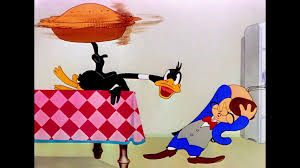
Hope you weren’t expecting me to keep trying to tie the week’s featured short into something related to the time of year. I’m past that. Here’s another short with a one of those one time appearing characters that Termite Terrace loved so much. This is Mr. Meek. His voice annoys me to no end, but he isn’t Red Hot Ryder so he’s not all bad. Today, his wife wants roast duck for dinner. He doesn’t really have the heart for it, but what Sweetie-Puss wants, Sweetie-Puss gets. Luckily, there is a duck who is casually resting his head against a tree stump. Just begging to be chopped off. Unluckily, it’s Daffy. (Oh, like you couldn’t tell.)

He doesn’t take too kindly to the near decapitation and decides to really mess with Meek. (He looks like a Marvin. Let’s call him Marvin.) He starts by shoving his head into his neck and spraying ketchup around. (Geeze!) This does not help Marvin’s case at all and he slumps back to his house. There’s a kind soul inside willing to lend an ear to his woes: Daffy again. He offers Meek a cup of coffee, but finds that Sweetie-Puss already beat him to the “giving lumps” joke. This doesn’t stop him from adding more. And cream! AND DANCING IN THE FOOD! (This might be Daffy at his craziest.)

Meek catches on that it’s the same daffy duck as earlier and chases, running into a drawing Daffy put up on the wall. The duck then drops an egg on him from high up in the air. (Is there no roof?) But Meek has reached his boiling point. He points a gun at Daffy. What else can he do? Strip! No, really. Daffy starts taking off his feathers rather seductively, causing the poor man to blush. (It’s a good thing his wife doesn’t come in at this point. In fact, we never see her. She’s probably really beautiful.) Don’t worry, he stops once he reaches his boxer shorts. Next he dresses up as a swami with a Jerry Colona-esque voice. Not only does he read the bumps on Marvin’s head, (The one’s from earlier have healed, so he thoughtfully adds more.) but he offers him his palm red. (This is such a great joke. I’ve used it on my friend before. He luckily thought it was funny too.)

Meek grabs his gun again in a bit of animation that looks just like the one earlier. (Even Daffy points out this is the second time it’s happened in the same picture.) Meek shoves him in the oven and turns it up full blast! But he can’t bear to hear Daffy screaming from inside and opens the door. Is this the end of Daffy Duck? Nah. He’s still alive and well and happily basting himself. It ends like that, leading me to believe that they didn’t have much of a story in mind and just wanted to have Daffy be daffy for the sake of being daffy. (And God bless them for it.)

Personal Rating: 3

The Wacky Wabbit

“You chubby little rascal!”

Supervision by Robert Clampett; Story by Warren Foster; Animation by Sid Sutherland; Musical Direction by Carl W. Stalling. Released in 1942.

For the past two weeks, I’ve been able to connect the featured short with something appropriate for the time of year. Can I do it again? You bet! Elmer is in his fat phase again, just like how most of us are after the holidays. (But not me because I was dieting all of last year.)

Elmer is out in the desert. (My guess is it’s in California. Do you really care though?) He’s off prospecting for gold whilst singing “Oh, Susannah!” (No one sings that anymore though. Shame.) Bugs is there too, hiding under a bovine skull. He says hi to the the passing prospector, who politely says hi back. Not getting the reaction he wanted, Bugs tags along joining in the song. Eventually, Elmer catches on and freaks out. (I know I would be if I saw a singing skull with eyes still in the sockets.) He quickly figures out it was just that “scwewey wabbit” and starts digging. (I love how he makes an “X” before digging in a completely different spot.)

He drops an explosive down the hole, but it keeps popping back up. In desperation, he zips the hole up an hides. Being the nice guy he is, (*snicker*) Bugs returns him his T.N.T. Elmer cowers, but the stick was a dud. That doesn’t stop Bugs from shouting “BAM” anyway. Elmer grabs his gun but Bugs has exciting news: Gold has been found! Where is it? It’s his gold tooth. Elmer shows off his own before realizing the trick. He tries to dig Bugs out of his hole, but his pick axe has gotten stuck in the cliff wall behind him. Bugs uses this opportunity to cut Fudd’s clothes off, revealing his girdle. Seeing us laughing, Elmer scolds us, saying that he’s sure plenty of the audience’s men wear one too. (Not me personally, but I love how comfortable he is with himself.)

Redressing, he leaps into the hole himself. Bugs buries him and walks off. (Notice that the shot has changed. They were in a canyon before, but now they appear to be out in the open.) Elmer escapes somehow and tells the wabbit his plans: he came for gold, and he’s going to get it. And Bugs definitely has some. Bugs is not willing to part with a piece of his body, so Elmer tackles him and wrestles it away. The short ends with him smiling at his success, unaware that the tooth he is holding is his.

Personal Rating: 3

The Old Grey Hare

“What’s up, Pruneface?”

A bad case of rabbitightens.

Direction by Robert Clampett; Animation by Robert McKimson; Story by Michael Sasanoff; Voice Characterization by Mel Blanc; Musical Direction by Carl W. Stalling. Released in 1944.

Here’s your final entry of 2016. Everyone has already said that this year sucked. They’re right. I’d go more into it, but this blog is for Looney Tunes and Looney Tunes related things. So, let’s just agree that the year was crap, we’ll hope the next will be better and around this time next year, we’ll be saying the exact same things. Now then, with time constantly moving on, why not talk about a short that shows just that?

Elmer is crying. It’s only been four years since he started, but he’s already given up hope on ever succeeding in getting Bugs. A voice tells him to keep trying. It’s never explicitly stated, but it’s kinda obvious that it’s God. (And he’s voiced by Mel. Don’t you think it would have been a bit more clever if he was voiced by Arthur Q. Bryan?) Elmer agrees that he should keep trying, but how long will it take? So God allows Elmer to look into the future to see how things will turn out. This means one of two things: either he’ll succeed, or die trying.

It seems that things will come to an end in 2000 A.D. Which is odd; I was alive by that point and I don’t recall any of this. (But then, I had just discovered Cable T.V. and it was hard to pry me away.) A lot has changed. (And I don’t just mean appearance wise.) The horse Bing Crosby bet on still hasn’t come in, and Smellivision replaced Television. (The paper that Fudd is reading says that Carl Stalling doesn’t think it will catch on. Guess he was right.) And Elmer is now toting a “Buck Wogers Wightning Qwick Wabbit Kiwwer.” There’s no way he can lose! All we need now is Bugs.

Luckily, he pops up not too long afterwards. He’s looking pretty good for being 54 years older. (All that time has passed and I only can see one grey hare.) Sure he’s aged somewhat, (less teeth, glasses, and a beard) but he still has enough strength to strangle Elmer before hobbling away. (Seems like he’s got lumbago too.) Elmer fires his new weapon, and wouldn’t you know it: he shoots Bugs. The bunny can’t believe it either. He begins reminiscing and gives Fudd a present: A photo album! It shows all their good times together, including the first time they ever met. That happened when they were babies. Even though Fudd’s picture is labeled with him being “only 3 and a 1/2 years old.” (They just couldn’t resist making that joke again. It really should say “seconds” instead of years. Wouldn’t it be funnier to think that the very first thing Elmer did after being born was go hunting?)

A flashback ensues. Elmer is crawling along with a pop gun and looks into a small rabbit hole. Bug’s pops up and babbles some baby talk while drinking carrot juice. (Luckily there is a subtitle for those of us older than the age of 1. But then they both start talking in English. I guess we’re just seeing things from their point of view?) They begin their first chase of many. Only to stop briefly to take a nap. When they resume, Bugs is able to get away. (This proves that no matter how many times Bugs is called a “rabbit” he is really more of a hare, as young rabbits are born naked and helpless, whereas hares are not.) Needing to match his prey’s speed, Elmer gets a stroller and drives after the leveret. (That’s the term for a baby hare, folks.)

Miming a cop, (that includes miming a motorcycle too. Something proto-Bugs did once. Leading me to believe he is Bug’s father.) he pulls Fudd over and berates him for speeding. After he leaves Fudd crying in his carriage, (I think that’s a real baby cry too. Way to be authentic, Bob.) the flashback ends and we go back to the two seniors. (This is the only Bugs Bunny short where Bugs doesn’t appear once as his modern self.) Elmer is devastated that he has killed his oldest and dearest friend, while Bugs starts digging his own grave. He tells Elmer to smile while he does it. (Doesn’t every dying person say that?) Elmer is so distraught that he doesn’t notice Bugs switching places with him, until the rabbit (I mean hare) buries him alive.

So there’s God’s answer: Elmer is never going to win. Elmer is unhappy, but he takes some solace in the fact that he is rid of Bugs forever. Bugs comes back to give him some parting gifts: a goodbye kiss, and a lit firecracker. Don’t worry. Bob may use actual crying of children for sound effects, but he draws the line at blowing up the elderly. But that doesn’t stop it from rattling the “That’s All Folks!” end card once it does blow.

Personal Rating: 4